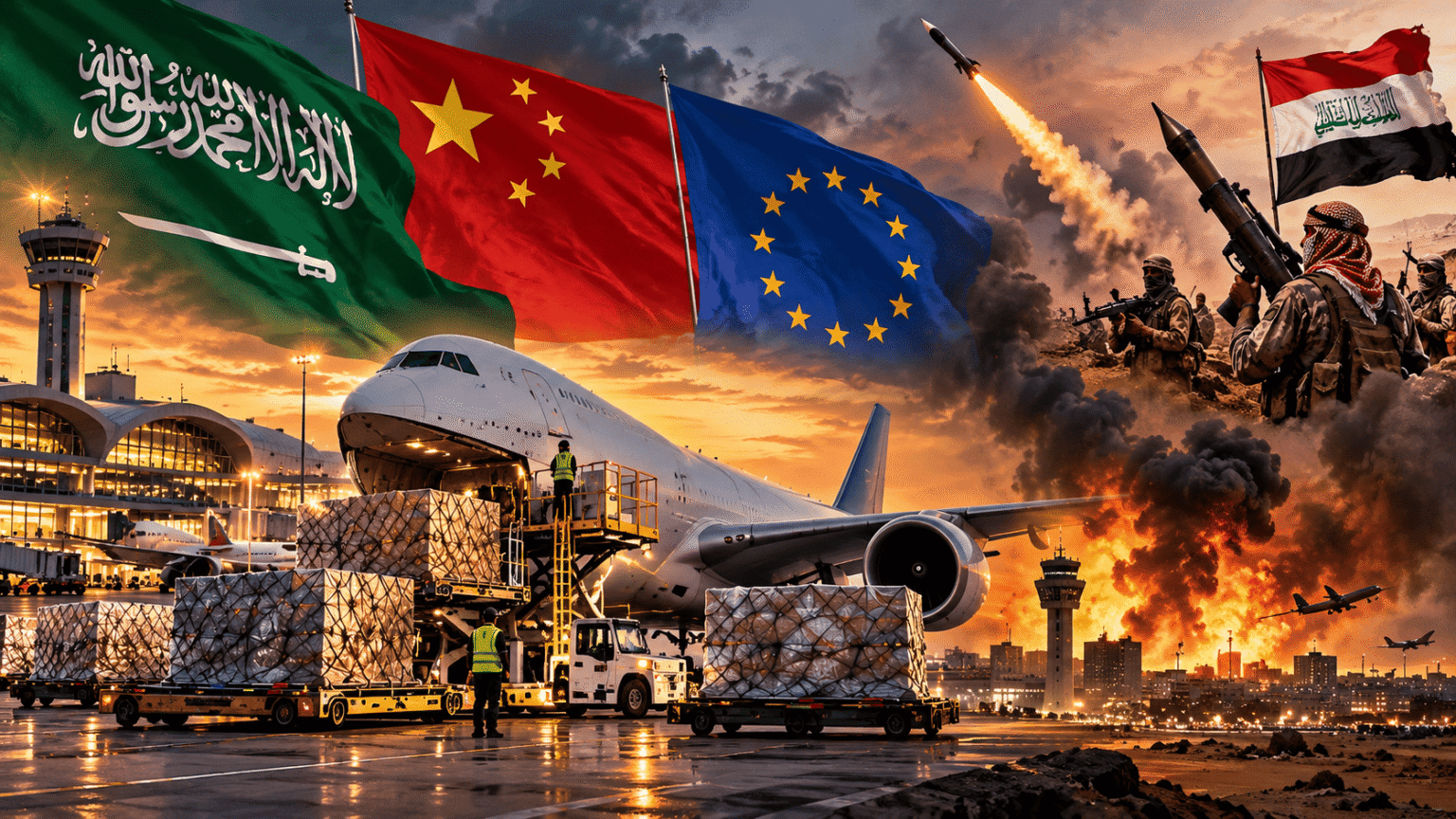
Rochester, NY/Brussels, BE: The global air cargo industry is confronting two fundamentally different challenges: escalating security threats to Saudi Arabia’s aviation infrastructure and declining freight rates on the China–Europe trade corridor.
Together, these developments illustrate how geopolitical instability, weakening consumer demand, changing transportation capacity and uncertainty in energy markets are reshaping international commerce.
Attacks targeting Saudi aviation infrastructure have raised concerns about flight cancellations, airport closures, cargo handling disruptions and the safety of international transportation corridors.
Meanwhile, falling air freight prices between China and Europe suggest a weakening of demand for certain categories of merchandise, particularly consumer goods and e-commerce shipments.
The consequences extend well beyond the aviation industry. International manufacturers, pharmaceutical companies, electronics exporters, retailers and logistics providers depend on reliable air cargo services to maintain production schedules and fulfill commercial commitments.
According to the International Air Transport Association (IATA), air transportation carries more than one-third of global trade by value, despite accounting for less than 1% of its physical volume. This disproportionate economic importance means even localized disruptions can affect goods worth hundreds of millions of dollars.
However, declining freight rates should not automatically be interpreted as evidence of collapsing global trade. Prices can fall because of weaker demand, excess transportation capacity, changing trade routes or a combination of these factors.
The central question is whether regional security disruptions and declining freight demand will remain separate challenges or combine to produce a broader crisis for international supply chains.
Saudi Airport Attacks: The Immediate Economic Impact
Saudi Arabia’s aviation sector experienced serious disruption following Houthi attacks on Riyadh’s King Khalid International Airport in October 2026.
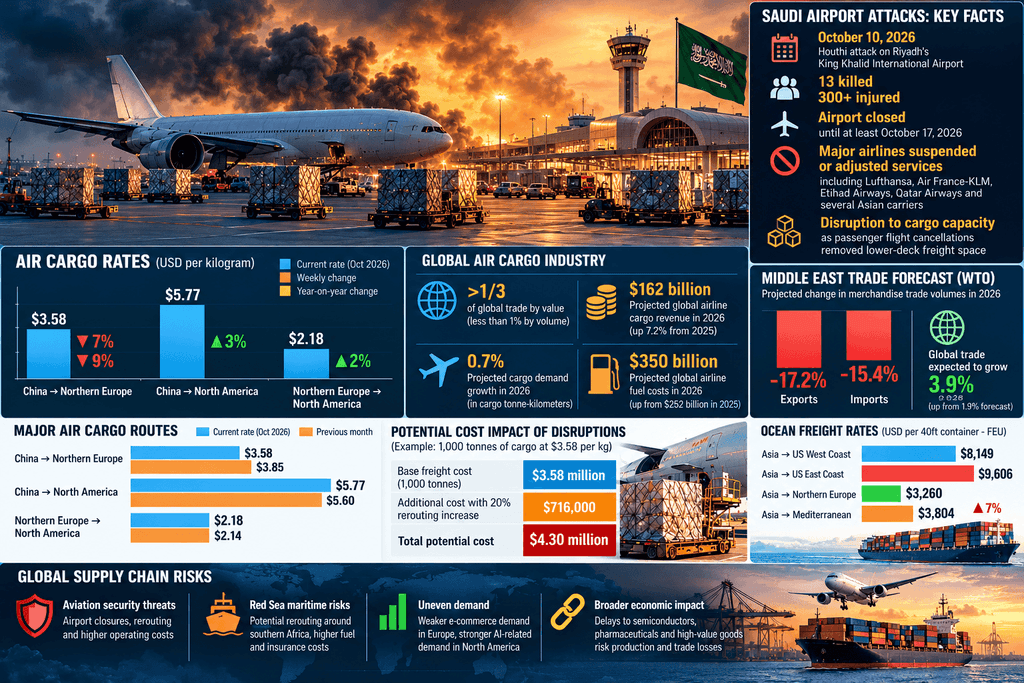
Reuters reported that an October 10 attack killed 13 people and injured more than 300. The airport was subsequently scheduled to remain closed until at least October 17, while international airlines suspended or adjusted their services.
Airlines affected included Lufthansa, Air France-KLM, Etihad Airways, Qatar Airways and several Asian carriers. Disruptions also extended to other Saudi aviation hubs.
For international cargo operators, the consequences were significant because passenger aircraft transport substantial quantities of commercial freight in their lower-deck compartments. When passenger flights are cancelled, cargo capacity disappears alongside passenger seating.
The operational consequences include delayed imports, missed export deadlines, increased storage expenses and additional costs for rerouting shipments through alternative airports.
However, the broader international impact requires careful assessment. Freightos observed that Saudi Arabia, unlike some neighboring Gulf States, is not a dominant international air cargo transshipment hub. Consequently, disruptions at Saudi airports may have a more limited worldwide impact than comparable closures in major regional cargo transfer centers.
The greater danger would arise if the conflict spread to additional Gulf aviation hubs or disrupted the region’s maritime transportation routes.
China–Europe Air Freight Rates Fall Despite Rising Global Transportation Costs
While Saudi Arabia faces disruptions caused by military conflict, China–Europe air freight markets are experiencing falling prices.
According to the Freightos market update published in October 2026, air cargo rates between China and Northern Europe declined to $3.58 per kilogram, a weekly reduction of 7% and a year-on-year decline of 9%.
In comparison, air freight rates between China and North America increased 3% to $5.77 per kilogram, while Northern Europe–North America rates rose 2% to $2.18 per kilogram.
Despite the China–Europe decline, the global Freightos Air Index benchmark remained approximately 33% above its level a year earlier and 29% above the level preceding the Strait of Hormuz closure.
These figures demonstrate a growing division between international freight markets.
The China–Europe decline appears partly linked to reduced e-commerce shipments following changes to European Union customs treatment of low-value imports. At the same time, strong demand for artificial intelligence equipment and data-center components is supporting cargo transportation between Asia and North America.
Airlines are responding by shifting some freight capacity toward more profitable transpacific routes.
This development challenges the assumption that geopolitical conflict always increases transportation prices. Military instability can increase operating costs, but freight rates may still decline where cargo demand weakens more rapidly than available capacity.
Global Trade Exposure: How Much Money Is at Risk?
International air cargo carries high-value merchandise, including pharmaceuticals, semiconductors, medical equipment, industrial machinery, electronics and perishable products.
The worldwide air cargo industry transports goods valued at trillions of dollars annually, making aviation an essential component of international commerce.
The financial implications of disruptions can be understood through several indicators.
First, IATA’s June 2026 outlook projected global airline cargo revenue of approximately $162 billion in 2026, compared with $151 billion in 2025. That represents an expected increase of 7.2%.
However, cargo demand growth was projected at only 0.7% when measured in cargo tonne-kilometers. Much of the revenue increase was therefore expected to result from higher freight yields rather than substantially greater shipment volumes.
Second, IATA projected that airline fuel expenditure would increase from approximately $252 billion in 2025 to $350 billion in 2026, an increase of about $98 billion.
This is an industry-wide fuel-cost projection, not a loss attributable specifically to the Saudi airport attacks.
Third, the economic effects of cargo delays can extend beyond freight expenses. Delayed semiconductor shipments may interrupt manufacturing, while postponed pharmaceutical deliveries can create additional storage and distribution costs.
For example, at a freight rate of $3.58 per kilogram, transporting 1,000 tonnes of merchandise would cost approximately $3.58 million before additional charges.
A hypothetical 20% increase in transportation costs caused by rerouting would add $716,000 to that shipment’s freight bill.
This calculation illustrates potential exposure; it is not a documented loss from the Saudi attacks.
At present, reliable public data do not establish the total dollar value of cargo permanently lost, delayed or rerouted specifically because of the October Saudi aviation disruptions.
That distinction matters because delayed merchandise is not necessarily destroyed merchandise, and increased transportation expenses are not equivalent to the full commercial value of the affected goods.
Middle East Trade Faces Severe Contraction
The World Trade Organization’s October 2026 outlook presents a troubling picture for the Middle East despite stronger global trade projections.
The WTO expects worldwide merchandise trade volumes to grow by 3.9% in 2026, substantially above its earlier forecast of 1.9%.
However, Middle Eastern merchandise exports are projected to contract by approximately 17%, while regional imports are expected to fall by around 15%.
In an October 15 interview with Reuters, WTO Director-General Ngozi Okonjo-Iweala warned that geopolitical tensions and ongoing conflicts could have lasting consequences for international trade patterns.
She also highlighted the growing tendency of businesses to diversify their supply chains in response to security risks and geopolitical uncertainty.
The contrast is economically important.
Global trade may continue expanding because of strong Asian manufacturing, AI-related investment and alternative energy supplies, while the Middle East experiences substantial commercial contraction.
This suggests that the financial burden of regional conflict is not distributed equally across the international economy.
Countries closest to the conflict face the greatest immediate disruption, while distant trading partners may adapt by sourcing goods elsewhere.
Red Sea Shipping: A Potential Second Economic Shock
Saudi Arabia’s aviation disruption is occurring alongside renewed concern about maritime security in the Red Sea.
The Bab el-Mandeb Strait is an important passage connecting the Gulf of Aden with the Red Sea and the Suez Canal route.
Houthi attacks against Saudi-linked shipping during July and August increased concerns about the safety of vessels using this corridor.
Freightos reported that container shipping companies had gradually increased their Red Sea transits since June 2026. A renewed escalation could reverse that recovery, forcing vessels to use longer routes around southern Africa.
The economic implications would include longer delivery times, greater fuel consumption, higher insurance-related expenses and additional pressure on vessel availability.
Ocean freight prices already reflect considerable uncertainty.
During the week of October 13, Asia–US West Coast container shipping rates stood at approximately $8,149 per forty-foot equivalent unit (FEU), while Asia–US East Coast rates reached $9,606.
Asia–Northern Europe rates stood at $3,260 per FEU, while Asia–Mediterranean prices increased 7% to $3,804.
Despite declines since July, Freightos indicated that Asia–Europe container rates remained approximately 70% higher than a year earlier.
For exporters and importers, these figures create difficult commercial decisions.
Companies signing long-term shipping agreements must determine whether current rates represent temporary geopolitical premiums or a more persistent increase in international transportation costs.
The Financial Pressure on Airlines and Logistics Companies
The international aviation industry faces rising expenses even when freight prices remain elevated.
IATA projected global airline net profits of approximately $23 billion for 2026, representing a net margin of only 2%.
The organization also warned that Middle Eastern disruptions and high fuel prices were undermining profitability.
Middle Eastern airlines account for approximately 13% of global cargo capacity, according to IATA. This means wider disruptions to major regional aviation hubs could create serious capacity shortages across international transportation networks.
Airlines exposed to Saudi Arabia face several overlapping risks: lost passenger and cargo revenue, additional fuel costs from rerouting, aircraft scheduling complications and uncertainty about when normal operations can resume.
Logistics companies may also face increased costs from customs delays, cargo warehousing and emergency transportation arrangements.
The effects are particularly serious for smaller exporters that lack the financial resources to absorb unexpected transportation expenses.
Why Falling Freight Rates Do Not Necessarily Mean Lower Consumer Prices
The decline in China–Europe air freight prices could theoretically reduce transportation expenses for European importers.
However, the relationship between freight prices and retail inflation is neither immediate nor automatic.
Transportation represents only one component of the final price of imported merchandise. Customs duties, energy costs, labor expenses, currency movements, warehousing and domestic distribution also influence retail prices.
Furthermore, the products experiencing weaker demand may not be the same goods facing higher transportation costs.
Consumer electronics and e-commerce products shipped from China to Europe may benefit from lower freight rates, while high-value industrial components transported through disrupted Middle Eastern corridors may face rising costs.
Consequently, global freight inflation and deflation can occur simultaneously across different sectors.
Economic Outlook: Three Possible Developments
The future direction of international air cargo and maritime transportation will depend heavily on regional security conditions and global demand.
Under a diplomatic de-escalation scenario, Saudi airports could progressively restore normal operations, airlines could rebuild schedules and shipping companies could expand their use of the Red Sea corridor. This would reduce transportation uncertainty and potentially ease some freight costs.
Under a prolonged but geographically contained conflict, Saudi Arabia would continue facing elevated logistics expenses and intermittent aviation disruptions, while global freight markets might remain relatively resilient.
The most damaging scenario would involve attacks spreading to major Gulf aviation hubs, oil infrastructure and international maritime corridors. Such an escalation could produce simultaneous increases in fuel prices, insurance-related costs and transportation delays.
None of these scenarios should be treated as a certain outcome. Their economic consequences would depend on the duration and geographical extent of the conflict.
Conclusion: Global Trade Remains Resilient, but Regional Economic Risks Are Rising
The disruption of Saudi aviation infrastructure and the decline in China–Europe air freight rates demonstrate the increasingly uneven nature of international trade.
Saudi Arabia is confronting the direct consequences of military escalation, while China–Europe cargo operators face weakening demand and changing commercial conditions.
The global economy has so far demonstrated considerable resilience. WTO projections indicate continued merchandise trade expansion in 2026, supported partly by AI-related investment and diversified supply chains.
Nevertheless, the economic vulnerabilities remain substantial.
Rising airline fuel expenses, disruption to regional transportation networks, falling Middle Eastern trade volumes and uncertainty surrounding Red Sea shipping could impose significant costs on international businesses.
The available evidence does not support assigning a single multibillion-dollar loss figure specifically to the October Saudi airport attacks. It does, however, establish that the wider Middle Eastern conflict is creating substantial financial pressure on airlines, logistics operators and regional commerce.
For Saudi Arabia, protecting civilian aviation infrastructure and restoring international connectivity are essential economic priorities. For international shipping companies, maintaining alternative transportation routes and improving operational flexibility will remain critical.
The most consequential threat to global trade is not simply the immediate loss of cargo capacity or the temporary movement of freight prices. It is the possibility that recurring geopolitical disruptions will permanently alter transportation routes, investment decisions and the structure of international supply chains.
As the Saudi–Houthi confrontation continues, the economic stakes extend beyond the Arabian Peninsula. The outcome will influence the future reliability, cost and security of commercial connections linking Asia, Europe, the Middle East and North America.
The global landscape is constantly evolving. Stay connected with The Variant for reliable news and thoughtful analysis.