


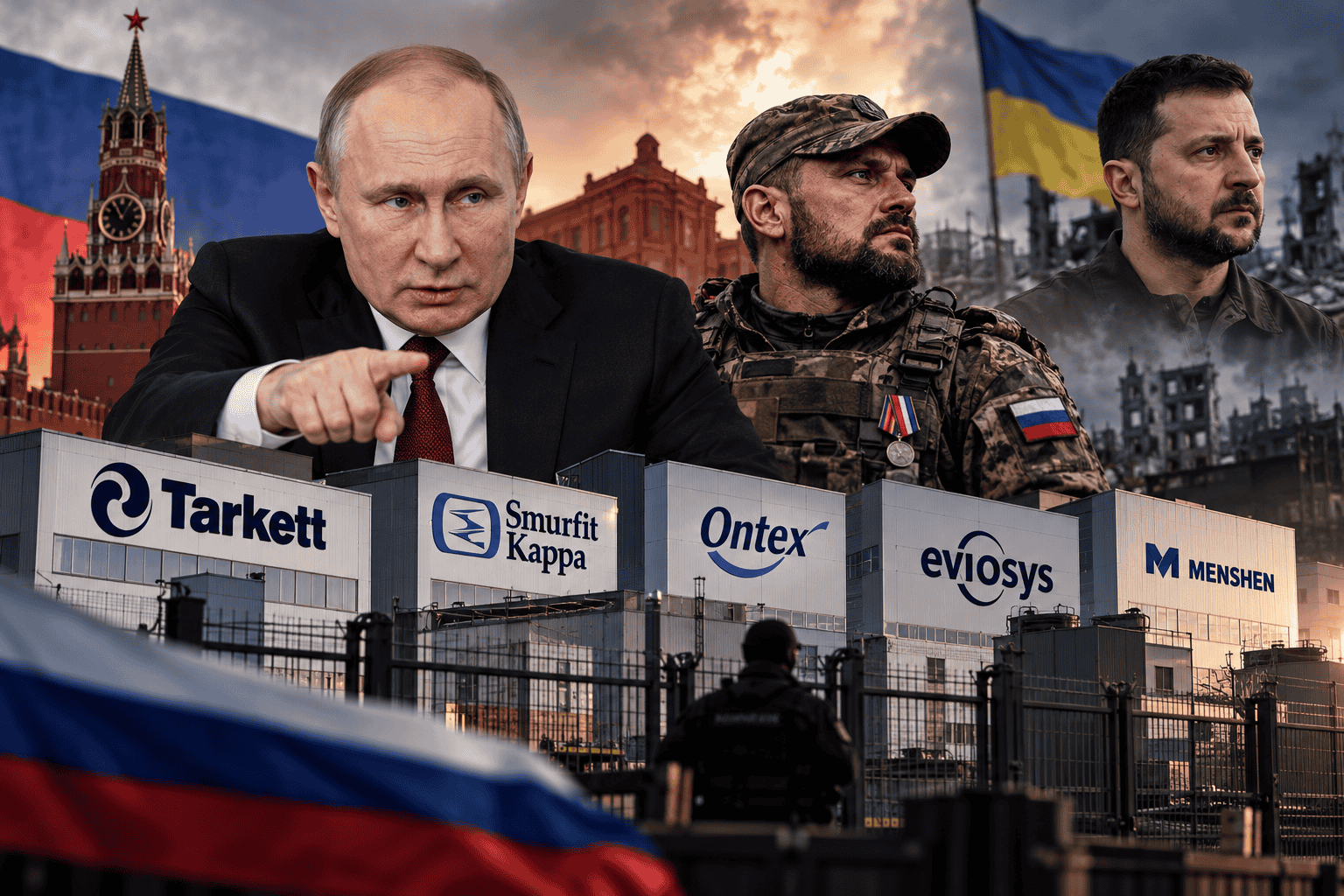
Moscow, RU: Russian President Vladimir Putin has transferred temporary management of five Western-owned companies operating in Russia to a firm controlled by a veteran of the Ukraine war, marking another significant development in Moscow’s economic confrontation with Western governments.
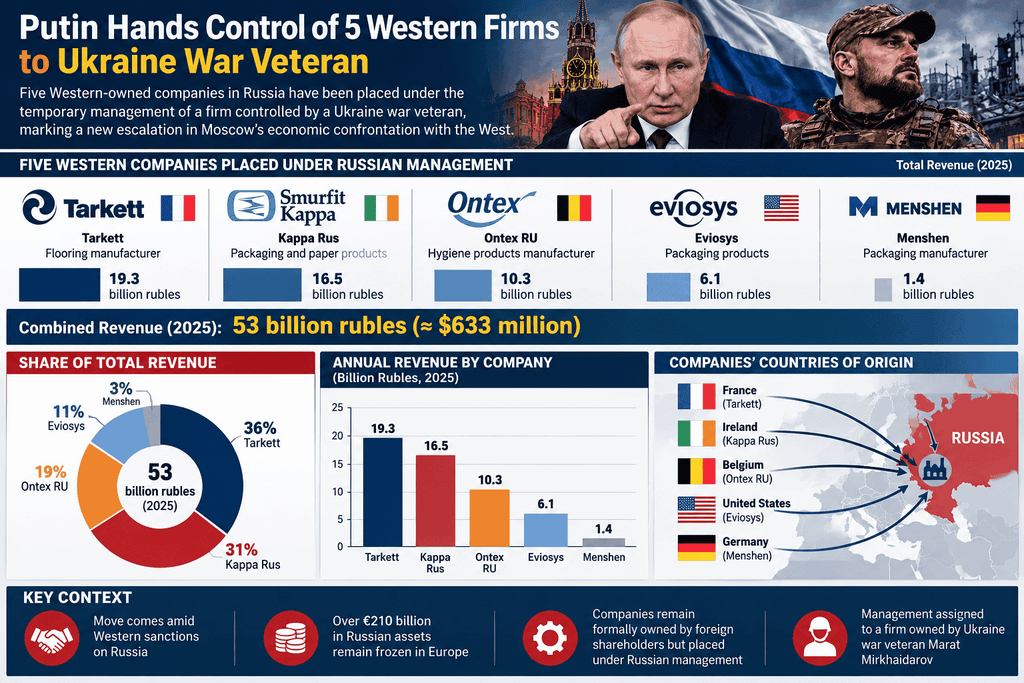
The presidential decree, signed on October 15 and reported on October 16, 2026, affects companies associated with France, Belgium, Germany, Ireland and the United States. Together, their Russian operations generated approximately 53 billion rubles, equivalent to $633 million, in revenue during 2025.
The decision reflects Moscow’s increasingly assertive approach toward foreign businesses following Western sanctions imposed after Russia’s full-scale invasion of Ukraine in February 2022.
Although foreign shareholders formally retain ownership, operational authority has been transferred to Russian management. This arrangement allows the Kremlin to exercise substantial economic control without necessarily pursuing outright nationalization.
The implications extend beyond corporate ownership, raising questions about international investment protections and the growing influence of military veterans within Russia’s political and economic institutions.
Five Western Companies under Russian Administration
The affected businesses operate in manufacturing, packaging and consumer goods.
French flooring manufacturer Tarkett represents the largest operation, generating approximately 19.3 billion rubles in Russian revenue during 2025.
Kappa Rus, historically associated with Ireland’s Smurfit Kappa group, recorded approximately 16.5 billion rubles. Belgian hygiene manufacturer Ontex RU generated 10.3 billion rubles, while Eviosys, linked to American packaging company Sonoco Products, reported approximately 6.1 billion rubles.
German packaging manufacturer Menshen’s Russian operations generated another 1.4 billion rubles.
These businesses contribute to domestic manufacturing, employment and industrial supply chains. Their continued operation may therefore be economically important to Moscow.
However, the combined revenue figure does not represent the value of confiscated assets or confirmed financial losses. The direct economic consequences of the transfers remain uncertain.
War Veteran Marat Mirkhaidarov Emerges as a Corporate Administrator
Management of the five businesses has been assigned to Tsentr Kapital Management Company, established in Moscow in February 2026 and owned by Marat Mirkhaidarov, a former deputy governor of Russia’s Zabaikalsky region.
Mirkhaidarov reportedly joined Russia’s military campaign in Ukraine in early 2024, serving with the Akhmat unit associated with Chechnya. He subsequently left regional government service in March 2025 following injuries reportedly sustained near the frontline.
Speaking to the independent Russian outlet Agentstvo, Mirkhaidarov acknowledged his military service:
“I’m a patriot; I served in the special military operation [in Ukraine]. I have combat awards.”
His appointment highlights an emerging relationship between military service, political influence and economic administration.
Russia has increasingly promoted war veterans into public institutions. Their involvement in managing significant commercial assets could indicate a further extension of this policy.
Nevertheless, there is no conclusive evidence that Mirkhaidarov received the appointment exclusively because of his military background.
The broader question is whether Russia is developing a politically connected business elite whose economic influence increasingly depends on wartime credentials.
Putin’s Position: Economic Sovereignty and Western Sanctions
The Kremlin has defended interventions in Western-owned businesses as retaliatory measures against international sanctions and restrictions affecting Russian assets.
In April 2023, Putin established a legal framework allowing temporary state administration of selected foreign-owned operations.
Moscow argues that Western governments have undermined Russian property rights through financial sanctions and the freezing of sovereign reserves.
On October 16, Kremlin spokesman Dmitry Peskov explained that the national origins of the affected companies influenced the decision.
“Their origin was one of the factors taken into account when making the decision.”
Peskov linked the transfers to Western restrictions on Russian assets.
No separate verified statement by Putin specifically explaining these five corporate transfers has been identified.
However, his recent remarks demonstrate Moscow’s broader uncompromising approach toward the conflict.
During an October 16 military command visit, Putin emphasized Russia’s determination to establish security arrangements along its border with Ukraine.
“Our goal is to ensure the absolute security of Russia’s border regions for the future, and we do not plan to make this a subject for potential peace negotiations with Ukraine.”
Although the statement concerned military strategy, it reflects the political environment surrounding Russia’s economic decisions.
From Moscow’s perspective, controlling Western industrial operations may preserve domestic production, reduce foreign influence and strengthen its position in disputes over frozen Russian assets.
Zelenskyy Demands Continued International Pressure
Ukrainian President Volodymyr Zelenskyy has consistently maintained that economic pressure is essential to restricting Russia’s ability to finance and sustain its military campaign.
While no verified statement directly addressing the latest five-company transfer has been identified, Zelenskyy’s recent remarks illustrate Kyiv’s broader position.
Addressing European leaders on October 16, Zelenskyy emphasized the importance of European unity.
“Without a determined European Union capable of making strong decisions Putin would have gone much further by now.”
On October 17, Zelenskyy also criticized Washington’s easing of certain restrictions against Russia, questioning whether sanctions relief could encourage Moscow to negotiate.
“Unfortunately, I don’t think this is a way to stop (Russian President Vladimir) Putin. On the contrary, he feels joy that he has such support.”
Kyiv argues that sustained sanctions and international financial restrictions remain necessary to limit Moscow’s military capabilities.
Russia, conversely, portrays Western sanctions as economic coercion and uses them to justify retaliatory measures.
These opposing positions demonstrate how economic assets have become an increasingly important component of the wider conflict.
Western Assets Become Instruments of Economic Pressure
Since February 2022, Western governments have imposed extensive financial restrictions on Russian banks, corporations and individuals.
More than €210 billion in Russian sovereign assets remain immobilized in Europe, according to figures cited in recent reporting.
Moscow has responded by restricting foreign companies’ ability to withdraw investments and transferring selected businesses into temporary administration.
Previous interventions affected international companies including Carlsberg and Danone.
The latest decree suggests that foreign-owned industrial assets are becoming instruments of economic leverage.
However, freezing sovereign reserves and transferring management of private businesses are legally distinct actions. Their legitimacy depends on applicable laws, international obligations and the specific circumstances involved.
Disputes over ownership and compensation could continue long after the military conflict ends.
Economic Risks: Can Russia Maintain Foreign-Owned Industries?
The immediate advantage for Moscow is greater administrative control over established manufacturing facilities.
Domestic management could help maintain employment, industrial production and government revenues while limiting Western corporate influence.
However, the long-term economic consequences could be substantial.
Manufacturing competitiveness depends on access to technology, international financing, specialized equipment and reliable supply chains.
If foreign owners withdraw technical assistance or future investment, affected companies could experience declining productivity and operational difficulties.
The policy may also discourage international investors from entering or returning to Russia.
Nevertheless, successful domestic management remains possible, particularly where businesses primarily serve Russian consumers and can obtain alternative suppliers.
The ultimate economic outcome will depend on managerial competence, industrial efficiency and access to essential technology.
Conclusion: Strategic Control Comes With Long-Term Costs
Putin’s decision to place five Western-owned companies under the management of a firm controlled by a Ukraine war veteran illustrates the growing intersection of military conflict, economic nationalism and political influence.
For Moscow, the transfers demonstrate its willingness to retaliate against Western sanctions while maintaining domestic industrial operations.
For Western investors, they reinforce concerns about commercial predictability and property rights.
For Ukraine, the development forms part of a broader economic confrontation in which sanctions, financial assets and industrial resources have become instruments of geopolitical pressure.
Yet Russia faces a fundamental strategic dilemma.
Gaining administrative control over foreign businesses may strengthen the Kremlin’s immediate authority, but rebuilding investor confidence and sustaining technological competitiveness could prove considerably more difficult.
The latest decision therefore represents more than an isolated corporate intervention. It illustrates how the economic consequences of the Russia–Ukraine war may reshape international investment relationships for years to come.
Follow our latest coverage for deeper insights into the policies, trends, and developments influencing today’s world.


