


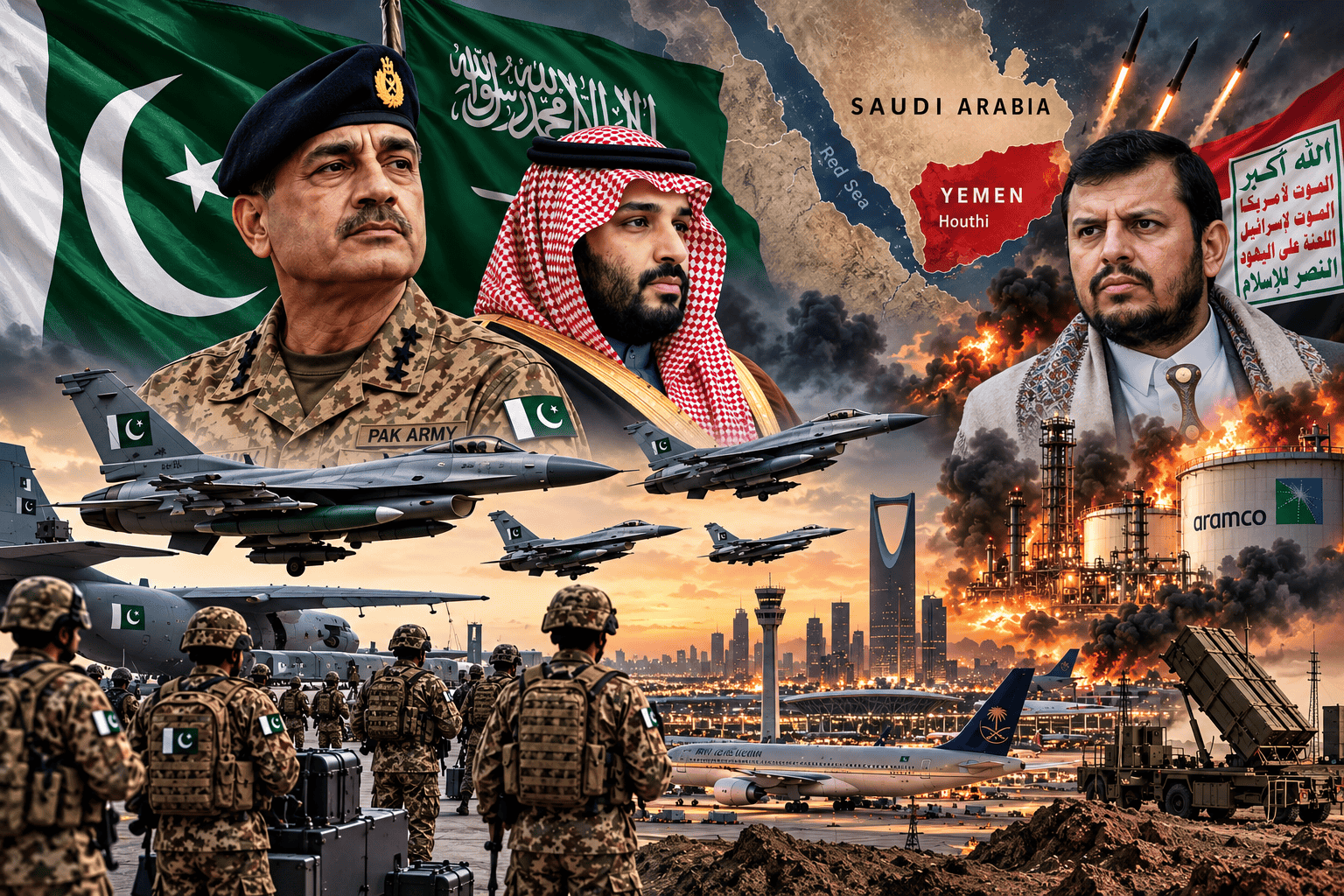
Rochester, NY: As Houthi missile and drone attacks strike Saudi airports, oil infrastructure and military facilities, Pakistan face a consequential strategic test. Islamabad has pledged military solidarity with Riyadh and confirmed the presence of Pakistani forces in the Kingdom.
Yet the extent of its combat involvement, particularly the use of Pakistani fighter aircraft and missiles, remains publicly unverified.
The intensifying confrontation between Saudi Arabia and Yemen’s Houthi movement has brought Pakistan closer to one of the Middle East’s most dangerous military crises.
By mid-October 2026, repeated attacks on Saudi aviation and energy infrastructure had forced Riyadh to strengthen its regional defence partnerships, placing Islamabad’s commitments under the Makkah Joint Defence Agreement under unprecedented scrutiny.
Pakistan is no longer merely expressing political sympathy for Saudi Arabia. Its military leadership has confirmed that Pakistani personnel are serving in the Kingdom in multiple capacities, while the government has committed itself to fulfilling its collective-defence obligations.
On October 16, Pakistan’s Foreign Office reaffirmed its support for Saudi sovereignty and territorial integrity, including under the Makkah Agreement. It also confirmed that operational decisions concerning deployments and military action belong to the armed forces and the alliance’s developing command structure.
The distinction is crucial. Pakistan’s military deployment and defence commitments are established facts; direct Pakistani participation in offensive strikes against the Houthis is not yet independently confirmed by the public evidence examined.
This uncertainty comes as Saudi Arabia confronts a widening security emergency. Reuters reported on October 14 that Houthi attacks had reached Riyadh’s international airport and Saudi Aramco’s headquarters, threatening both civilian aviation and the economic foundations of the Kingdom.
The crisis now raises three fundamental questions: How far will Pakistan go in defending Saudi Arabia? Does the Makkah Agreement oblige Islamabad to enter the Yemen war? And can Pakistan strengthen Saudi defenses without becoming a direct combatant in another prolonged regional conflict?
October attacks: Airports, oil facilities and military targets under pressure
The October escalation demonstrated how the Houthis’ relatively inexpensive drones and missiles can challenge a military establishment equipped with some of the world’s most sophisticated Western weapons.
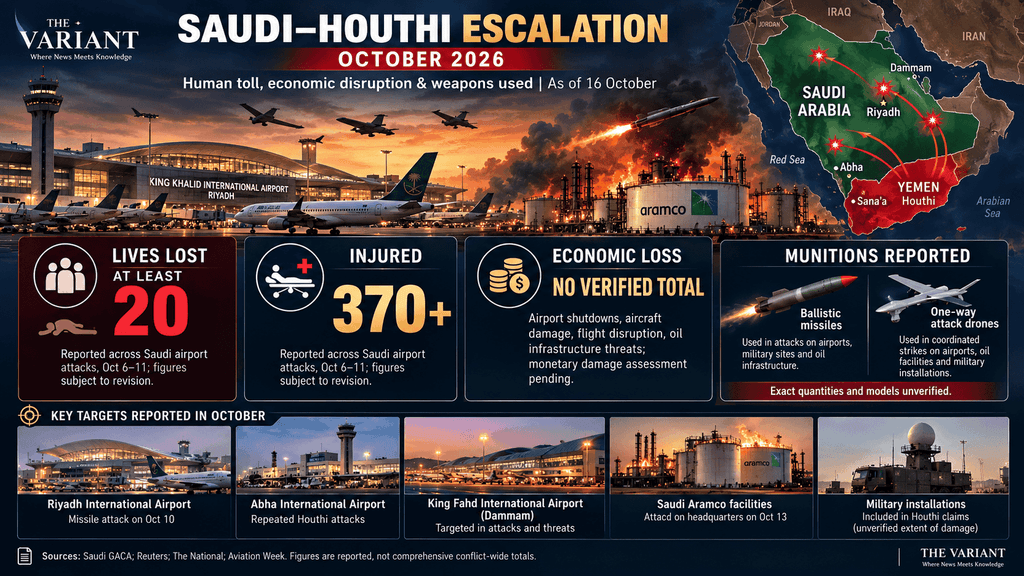
On October 10, a missile struck King Khalid International Airport in Riyadh. Initial Saudi figures reported 12 deaths and 309 injuries. Subsequent reporting placed the death toll at least at 13, reflecting evolving casualty assessments.
The attack disrupted commercial aviation, forced flight cancellations and diversions, and exposed the vulnerability of a major international transportation hub. The Houthis subsequently claimed responsibility for operations against the airport.
Further attacks and threats affected Abha International Airport, while reports also described projectiles near King Fahd International Airport in Dammam.
Saudi Arabia’s energy sector also became a central target. On October 13, an attack struck Saudi Aramco’s headquarters, causing fires and disrupting operations. Houthi attacks and threats involving the East–West oil pipeline, petroleum installations and maritime shipping increased concerns about the Kingdom’s export security.
Military installations and bases were also included in Houthi claims, although independent confirmation of the damage at individual sites remains incomplete. This distinction matters because claims issued by belligerents cannot automatically be treated as verified battlefield results.
The economic implications extend beyond Saudi Arabia. Threats to the Red Sea and Bab el-Mandeb shipping corridor increase insurance costs complicate maritime transport and create uncertainty for energy-importing economies across Asia, including Pakistan.
The October attacks also exposed an uncomfortable strategic reality: superior military expenditure does not guarantee effective protection against coordinated, low-cost aerial threats. Saudi Arabia’s challenge is not simply acquiring additional weapons but improving early warning, interception, intelligence integration and infrastructure resilience.
The Makkah Agreement: What Pakistan has actually promised?
Pakistan’s present obligations emerge from two important agreements.
The first is the Strategic Mutual Defence Agreement, signed by Prime Minister Shehbaz Sharif and Saudi Crown Prince Mohammed bin Salman in Riyadh on September 17, 2025. Its central provision treats aggression against either country as aggression against both.
The second is the Makkah Joint Defence Agreement, signed on August 7, 2026, between Pakistan, Saudi Arabia and Türkiye.
This trilateral arrangement expanded the bilateral security framework into a collective-defence structure, declaring that an armed attack against one member would be regarded as an attack against all three.
Pakistan’s Deputy Prime Minister and Foreign Minister Ishaq Dar explained the agreement’s purpose in an official message:
“The Makkah Accord is defensive in nature. It is not directed against any country.”
Dar further described collective defence as consistent with Article 51 of the United Nations Charter, which recognizes the inherent right of individual and collective self-defence.
The agreement is strategically significant because it establishes a framework for collective deterrence, military consultation, capability coordination and potentially joint operations.
However, collective defence should not be confused with an automatic obligation to conduct offensive military operations inside Yemen. The legal justification, nature of an armed attack, necessity and proportionality of any response, and national decision-making processes remain important considerations.
On October 5, the alliance’s members agreed to provide designated military forces and capabilities in response to growing threats against Saudi Arabia. This represented a practical step toward implementation, but did not establish that all three countries had commenced offensive combat operations.
The unresolved issue is how Pakistan’s military contribution will be defined: defensive protection of Saudi territory, intelligence and logistical assistance, integrated air defence, or direct participation in attacks against Houthi forces.
Pakistan’s political and military leadership has adopted a notably firm position in support of Saudi Arabia, although its public statements leave important questions about combat operations unanswered.
On September 25, Field Marshal Syed Asim Munir, Pakistan’s Chief of Defence Forces and Army Chief, participated in high-level military discussions in Riyadh with Saudi and Turkish counterparts. The talks addressed military coordination, intelligence sharing and strengthening collective defence capabilities under the Makkah framework.
Reuters reported that the discussions were intended to improve trilateral defence cooperation amid the expanding Houthi threat.
While these meetings demonstrated Munir’s direct involvement in the alliance, the reviewed reporting does not establish a specific public statement from him ordering Pakistani airstrikes against Yemen.
Pakistan’s military spokesperson, Lieutenant General Ahmed Sharif Chaudhary, has been more explicit.
In September, he said Pakistan would go to “any extent” to defend Saudi Arabia and described Islamabad’s security commitment as “unconditional.”
He simultaneously emphasized Pakistan’s continuing diplomatic consultations aimed at achieving a negotiated settlement.
On October 8, Chaudhary confirmed that Pakistani troops were already serving in Saudi Arabia, explaining that they operated in multiple military capacities and domains.
His confirmation established the presence of Pakistani military personnel but did not specify whether they were conducting offensive operations.
Pakistani troops, fighter jets and missiles: What is actually operating against the Houthis?
The most sensitive question concerns Pakistan’s direct military contribution.
According to Reuters reporting reproduced by Arab News, Pakistan deployed approximately 8,000 troops, a fighter-jet squadron and an air-defence system to Saudi Arabia under its expanded bilateral defence cooperation.
The report confirms an important level of Pakistani military involvement, but it does not identify the fighter aircraft model, the specific missile systems deployed or any verified offensive mission against Houthi positions.
Pakistan possesses several capabilities that could theoretically support Saudi defence operations, including JF-17 Thunder multirole fighters, F-16 aircraft, airborne surveillance platforms and ground-based air-defence systems.
However, the existence of these weapons in Pakistan’s inventory must not be confused with evidence that they have been deployed or used against the Houthis.
No independently verified public evidence available establishes that Pakistani JF-17s or F-16s have conducted strikes inside Yemen or that Pakistan has launched its own ballistic or cruise missiles against Houthi targets.
On October 9, Pakistan’s Foreign Office was directly questioned about reports that Pakistani fighter jets were participating in airstrikes. The briefing did not publicly establish such combat involvement. Officials declined to disclose operational details.
The most credible interpretation is therefore that Pakistan is providing an established military presence and defensive assistance, while the extent of direct combat involvement remains undisclosed.
Potential military contributions include air-defence coordination, surveillance, technical assistance, training, logistics and intelligence support. These are plausible roles, not confirmation of specific operational assignments.
The distinction between defensive and offensive participation is strategically significant. Intercepting missiles approaching Saudi cities would carry different political and legal implications from bombing Houthi positions in Yemen.
Historical background: Why Pakistan has traditionally avoided the Yemen battlefield
Pakistan and Saudi Arabia have maintained military relations for decades. Pakistani personnel have provided training, advisory assistance and security cooperation to the Kingdom, while Saudi Arabia has repeatedly offered financial support to Pakistan during periods of economic difficulty.
Yet the Yemen conflict has historically tested the limits of that partnership.
In April 2015, Pakistan’s parliament supported neutrality in the Yemen war while emphasizing its commitment to Saudi Arabia’s territorial security and the protection of Islam’s holy sites.
That position reflected concerns about military overstretch domestic political divisions and the possibility of damaging Pakistan’s relationship with Iran.
The 2025 bilateral agreement and 2026 Makkah Accord represent a significant evolution from that earlier approach. Pakistan has moved from broad assurances of support toward more formal collective-defence commitments.
However, the underlying dilemma remains unchanged: Pakistan must reconcile its security partnership with Riyadh with its geographical, economic and diplomatic interests involving Tehran.
Iran, Türkiye and Pakistan’s strategic dilemma
Iran’s relationship with the Houthis complicates Pakistan’s calculations. Tehran has supported the movement, although the Houthis retain their own political objectives and operational decision-making.
Saudi officials have accused Iran of encouraging Houthi escalation and supplying military assistance. Iran, meanwhile, has pursued regional diplomatic outreach aimed at limiting the widening conflict.
Pakistan cannot disregard Iran, with which it shares a border and important security concerns.
Direct Pakistani participation in sustained strikes against Houthi territory could create additional tensions with Tehran, even if Islamabad describes its involvement as collective self-defence.
Türkiye offers another dimension. Ankara has discussed air-defence and technical contributions under the Makkah framework, while emphasizing that the agreement is defensive rather than offensive.
For Pakistan, coordination with Türkiye may provide a way to distribute military responsibilities without assuming an unlimited commitment to Saudi Arabia’s campaign.
Strategic assessment: What Pakistan stands to gain or lose?
Pakistan’s involvement presents both opportunities and risks.
A successful defensive contribution could strengthen Islamabad’s standing as a dependable security partner, improve military interoperability and deepen cooperation with Saudi Arabia and Türkiye.
It could also reinforce Pakistan’s diplomatic relevance in Gulf security discussions.
But deeper combat involvement could expose Pakistani forces to casualties, provoke regional retaliation, increase defence expenditure and complicate relations with Iran.
There is also an important domestic accountability question. A formal collective-defence commitment should not eliminate parliamentary scrutiny over the scope, cost and objectives of military participation.
Pakistan must also avoid allowing its armed forces to become involved in an open-ended campaign without a clearly defined political settlement.
The Houthis’ ability to sustain attacks despite years of military pressure illustrates the limitations of relying exclusively on airpower. Saudi Arabia’s superior conventional capabilities have not eliminated the movement’s missile, drone and territorial capabilities.
A durable strategy must therefore combine credible defensive measures with negotiations addressing Yemen’s fragmented political system, humanitarian emergency and unresolved distribution of power and resources.
Conclusion: Defending Saudi Arabia without inheriting the Yemen war
Pakistan’s commitment to Saudi Arabia is now more substantial than diplomatic rhetoric. The Makkah Agreement, confirmed troop presence, military coordination and statements from senior Pakistani officials establish that Islamabad has accepted meaningful security responsibilities.
Yet the available evidence does not justify claiming that Pakistani fighter jets are bombing Yemen or that Pakistani missiles have been fired against Houthi forces.
Pakistan’s strongest strategic option is to provide clearly defined defensive support while preserving its ability to encourage negotiations.
Saudi Arabia has legitimate grounds to protect its population and critical infrastructure from missile and drone attacks. Equally, any military response must respect international humanitarian law and avoid unnecessary harm to Yemeni civilians.
The central challenge for Islamabad is not proving loyalty through unrestricted military involvement. It is demonstrating that a credible defence partnership can coexist with strategic restraint, regional diplomacy and national accountability.
Pakistan’s ultimate contribution to Saudi security may be measured not by how extensively it joins the war, but by whether it helps prevent the conflict from becoming a broader regional catastrophe.
Keep following The Variant as we continue to monitor developments and provide informed perspectives on this evolving situation.


