


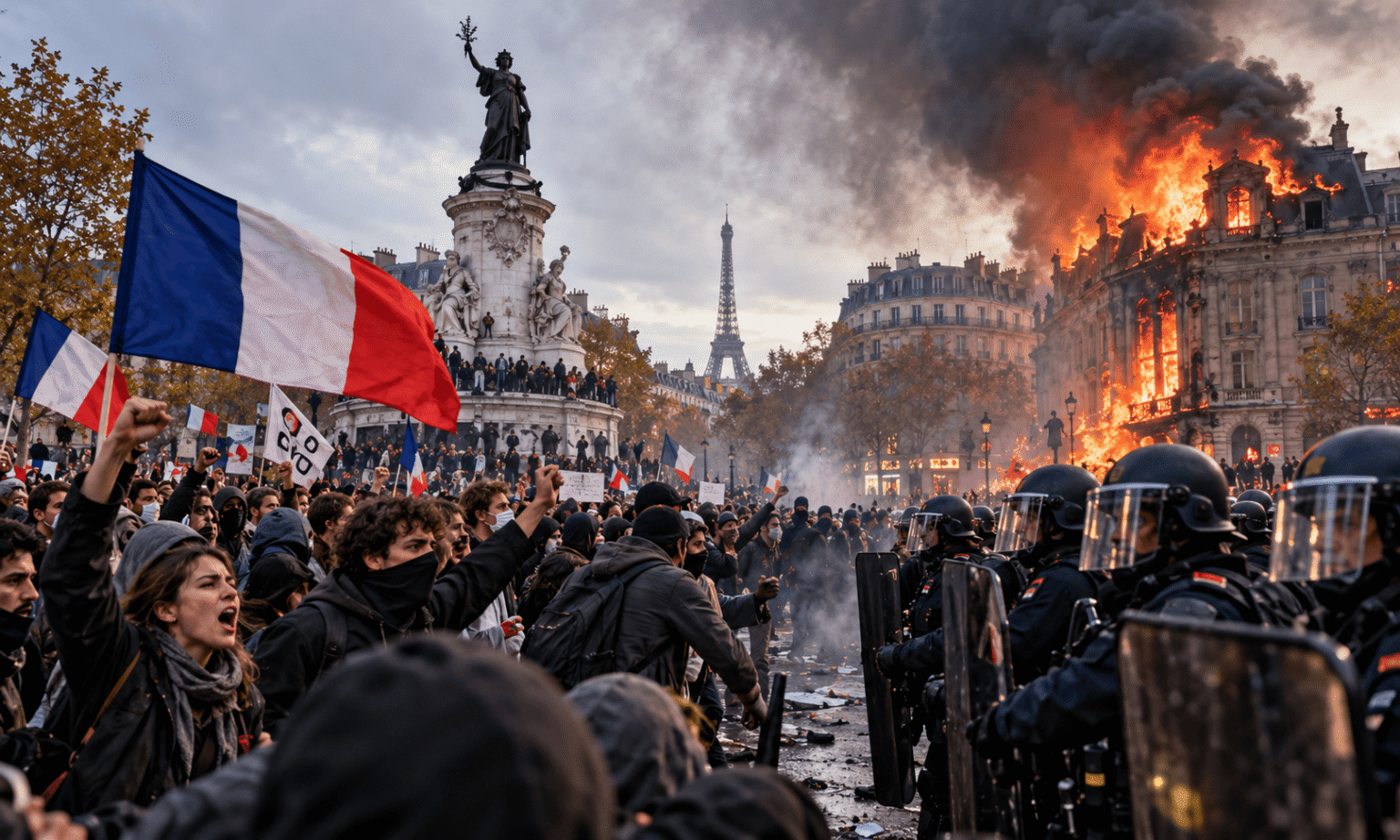
Paris, FR: France is confronting one of its most serious episodes of domestic unrest in recent years, as demonstrations that began with students demanding better educational facilities have developed into a nationwide confrontation over economic inequality, deteriorating public services and the political direction of the country.
What initially appeared to be a localized dispute over teacher shortages and overcrowded classrooms has evolved into a broader movement involving trade unions, university students, public-sector workers and activists associated with the Yellow Vest movement?
The resulting demonstrations have challenged President Emmanuel Macron’s government at a particularly vulnerable moment, when political fragmentation and mounting fiscal pressures have already weakened its capacity to respond.
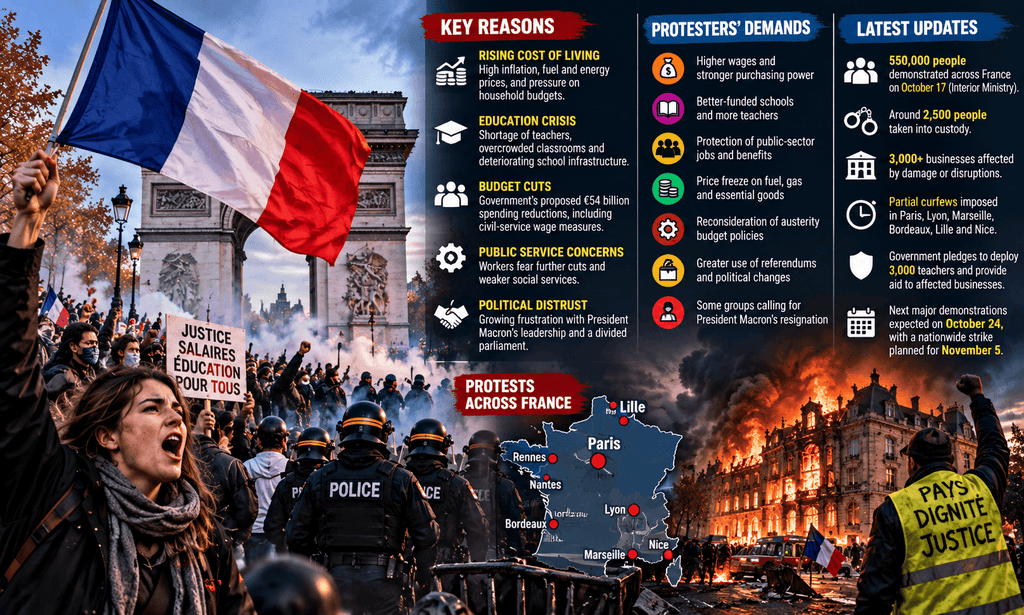
The crisis reached a turning point on October 17, when approximately 550,000 people participated in demonstrations across France, according to the Interior Ministry.
Although most protesters remained peaceful, violence erupted in several cities, with rioters attacking public buildings, setting fires, confronting police and looting commercial establishments.
The destruction of the historic town hall in Limoges became a particularly powerful symbol of the crisis.
For a country whose republican institutions are central to its national identity, the burning of a municipal government building represented more than property damage: it illustrated the growing hostility toward institutions that some citizens believe have become unresponsive to their concerns.
From School Classrooms to Nationwide Demonstrations
The origins of the latest unrest can be traced to September 2026, when high school students in working-class northern suburbs of Paris began protesting against shortages of teachers, inadequate infrastructure, overcrowded classrooms and deteriorating educational standards.
The demonstrations gradually spread to Bordeaux, Rennes, Nantes, Lyon, Lille and Marseille. Students argued that the government was failing to provide the educational resources necessary for their future employment and economic advancement.
Their grievances soon attracted wider support from public-sector employees and trade unions already dissatisfied with government spending priorities.
The proposed 2027 national budget intensified these frustrations. The government’s planned package of approximately €54 billion in spending reductions and tax measures, intended to address France’s fiscal deficit, includes a proposed freeze affecting civil-service salary calculations.
For unions, such measures symbolize an economic strategy in which ordinary workers are being asked to absorb the consequences of fiscal pressures while public services remain underfunded.
The protesters’ demands extend beyond education. They include higher purchasing power, protection of public-sector wages, improved working conditions, better-funded schools, affordable energy and a reconsideration of austerity-oriented budget policies.
These are not necessarily the demands of a single organization. Rather, they represent overlapping grievances among groups whose political priorities differ but whose dissatisfaction with government policy has increasingly converged.
The Historical Roots: France’s Recurring Crisis of Social Confidence
France has a long tradition of mass demonstrations influencing political decisions. From the revolutionary upheavals of 1789 to the student and labor mobilizations of May 1968, street protests have repeatedly served as an alternative arena of political pressure.
More recently, the Yellow Vest movement that emerged in November 2018 demonstrated the potential for economic frustration to transform into a nationwide challenge to presidential authority.
Initially organized against proposed increases in fuel taxes, the Yellow Vest demonstrations developed into a wider campaign against declining purchasing power, economic inequality and the perceived concentration of political power in Paris.
The movement revealed a particularly important divide between metropolitan political institutions and communities struggling with transportation expenses, stagnant incomes and limited public services.
The 2023 demonstrations against Macron’s pension reforms further reinforced the perception among sections of French society that major economic decisions were being imposed without sufficient public consent.
The latest unrest draws upon these historical grievances but introduces an additional dimension: young people are now at the center of a movement questioning not only their present circumstances but also their future prospects.
The 2024 parliamentary elections, which produced a deeply divided National Assembly without an outright governing majority, have compounded the problem. Political fragmentation has made it increasingly difficult for successive governments to build durable agreements on taxation, spending and institutional reform.
Macron’s Response: Defending the Republic While Recognizing Public Anger
President Macron has adopted a dual approach, acknowledging legitimate grievances while condemning the destruction accompanying some demonstrations.
In his October 18 televised address, Macron denounced what he called “unbridled violence” and declared that “nothing justifies” the attacks on public and private property.
He distinguished peaceful demonstrators from individuals responsible for looting and vandalism, describing the latter as radical elements and criminals exploiting public dissatisfaction.
Macron also warned that those responsible for attacks on republican institutions would face legal consequences.
His central political message was that democratic protest must remain protected, but violence cannot become an accepted instrument of political negotiation.
The president has simultaneously faced criticism over the government’s failure to anticipate the scale of the violence.
Interior Minister Laurent Nuñez acknowledged serious shortcomings in the security response, while opposition parties demanded accountability.
Macron reportedly refused Nuñez’s resignation and instead directed him to examine failures in intelligence gathering and operational planning.
The decision suggests that the president considers continuity in security leadership more important than an immediate ministerial replacement during an ongoing national emergency.
Nevertheless, the government’s position remains politically difficult. An aggressive police response risks reinforcing accusations of authoritarianism, while insufficient intervention could encourage further violence and undermine public confidence in state authority.
Latest Developments: Curfews, Arrests and a new wave of Protests
As of October 22, the government’s immediate priority remains preventing another outbreak of violence.
Approximately 2,500 people have been taken into police custody, while more than 3,000 businesses have reportedly suffered damage or disruption. Partial curfews have been introduced in several cities, including Paris, Lyon, Marseille, Bordeaux, Lille and Nice.
Prime Minister Sébastien Lecornu has promised reinforced security operations, while the government has announced financial assistance for affected businesses and measures to protect employment. Authorities have also pledged to deploy approximately 3,000 qualified teachers to address staffing shortages.
However, dialogue has produced limited progress. Following talks with Lecornu on October 21, union representatives expressed disappointment over the absence of substantial economic concessions.
CGT leader Sophie Binet argued that the government had failed to respond adequately to workers’ grievances. Meanwhile, Yellow Vest representatives have demanded price freezes on fuel, gas and essential goods, alongside broader political reforms, including greater use of referendums. Some have explicitly called for Macron’s resignation.
Further demonstrations are scheduled for October 24, while major trade unions are preparing a nationwide strike on November 5.
These developments indicate that, despite temporary improvements in public order, the underlying political confrontation remains unresolved.
Political Consequences and the Road Ahead
France’s unrest is unfolding against the backdrop of the approaching 2027 presidential election, increasing pressure on an administration already struggling with declining political confidence.
The crisis provides opportunities for both the far right and the radical left to challenge the government’s credibility. Yet neither political camp has demonstrated that it can easily reconcile the competing demands for increased social spending, lower living costs and fiscal discipline.
The central dilemma is economic as much as political. France cannot indefinitely expand public expenditure without confronting its debt burden, but austerity imposed without broad public support risks deepening social alienation.
The government must therefore pursue two objectives simultaneously: restore security through proportionate law enforcement and negotiate credible improvements in education, wages and essential public services.
Excessive policing could radicalize sections of the protest movement, while a failure to control vandalism could weaken public support for legitimate demonstrations.
Conclusion: A Crisis beyond the Streets
The latest French protests are not merely an eruption of anger over inflation or deteriorating schools. They reflect a deeper struggle over the relationship between citizens, economic opportunity and political authority.
Macron’s government may succeed in restoring order to the streets of Paris, Lyon and Marseille. However, restoring public confidence will require more than arrests, curfews and promises of administrative reform.
France’s immediate challenge is to prevent violence without undermining the democratic freedoms that define the Republic. Its longer-term challenge is to demonstrate that political institutions can respond meaningfully to citizens who believe their voices have been ignored.
Ultimately, the outcome will depend less on how quickly the government clears barricades than on whether it can rebuild the social contract that those barricades have come to symbolize.
The next demonstrations will therefore test not only the capacity of the French state to maintain order, but also its willingness to address the economic and institutional grievances that have repeatedly brought its citizens into the streets.
Discover more perspectives, breaking news, and in-depth reports from around the world by visiting The Variant.

