


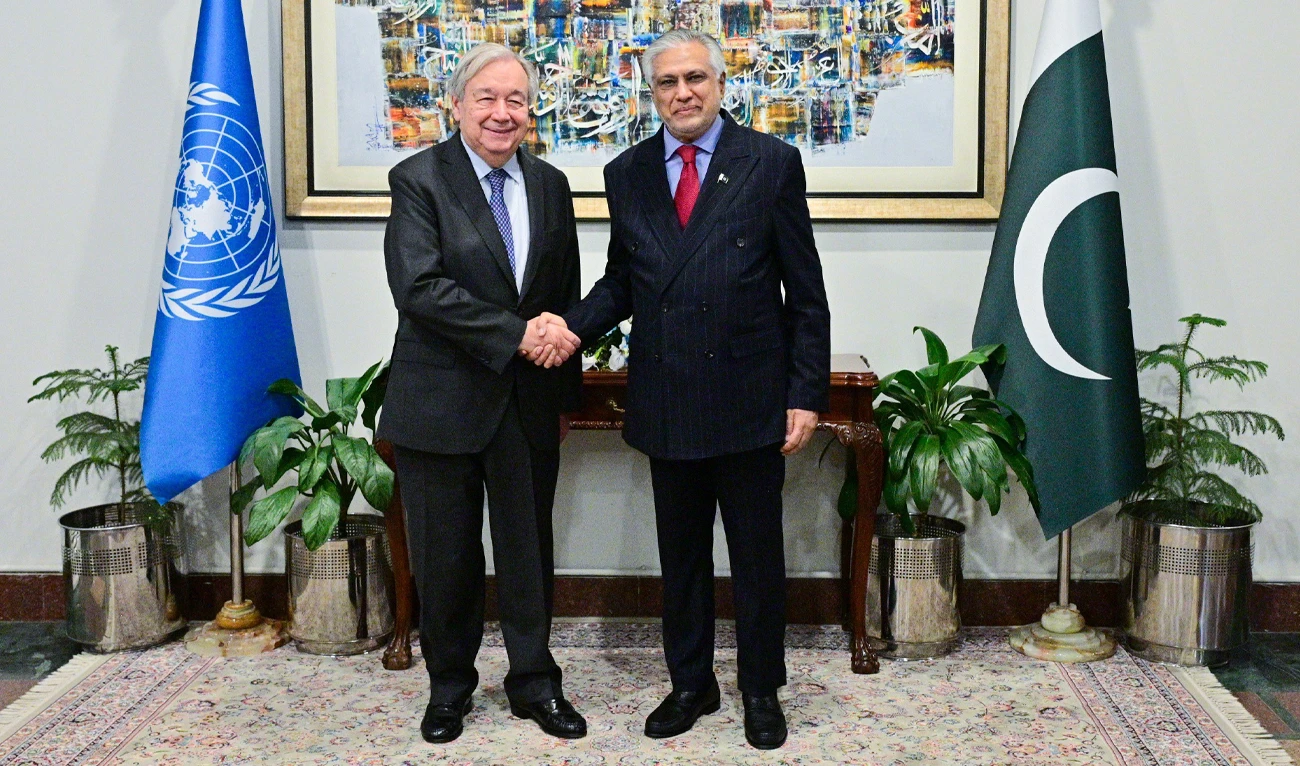
The visit also provided Pakistan with an opportunity to raise longstanding disputes with India, particularly Jammu and Kashmir and the Indus Waters Treaty.
Ishaq Dar reiterated Islamabad’s position that the Kashmir dispute should be resolved in accordance with relevant United Nations Security Council resolutions and the aspirations of the Kashmiri people.
He also expressed concern over India’s decision to hold the Indus Waters Treaty in abeyance, which Pakistan regards as a violation of international law.
India, however, maintains a different interpretation of the Kashmir dispute, considering it a bilateral matter and emphasizing security concerns, including cross-border terrorism. New Delhi has also linked its position on the water treaty to broader tensions with Pakistan.
These competing positions demonstrate why international diplomatic engagement has repeatedly struggled to produce a settlement.
The Secretary-General’s visit to the headquarters of the United Nations Military Observer Group in India and Pakistan (UNMOGIP) carried symbolic significance, reaffirming the UN’s historical involvement in monitoring the dispute.
Nevertheless, UNMOGIP’s role remains politically contested, and the mission lacks the authority to impose a political settlement.
Water security presents another challenge. The Indus basin supports agriculture, electricity generation and livelihoods across both countries. Any prolonged deterioration in cooperation could create serious economic and humanitarian consequences.
A constructive approach would require both governments to separate essential water-management cooperation from wider political confrontation while utilizing established treaty mechanisms and peaceful dispute-resolution procedures.
Afghanistan: Security concerns and the limits of regional diplomacy
Afghanistan featured prominently in discussions between Guterres and Dar.
Pakistan raised concerns over militant organizations allegedly operating from Afghan territory and conducting attacks inside Pakistan.
Islamabad has repeatedly urged Afghanistan’s Taliban authorities to prevent militant groups from using Afghan territory against neighboring countries.
The Taliban government disputes Pakistan’s accusations and has criticized Islamabad’s military actions and approach to bilateral security.
This disagreement creates a difficult diplomatic environment.
Pakistan faces genuine security challenges from militant violence, but military retaliation across internationally recognized borders carries risks of escalation, civilian harm and further deterioration in bilateral relations.
The UN could potentially contribute through diplomatic engagement, humanitarian coordination and confidence-building initiatives. However, sustainable improvement would require credible counterterrorism cooperation and respect for sovereignty by both governments.
Palestine and the credibility of international law
The discussions also addressed the Palestinian question and the wider Middle East crisis.
Pakistan reiterated its support for Palestinian self-determination and statehood, while Guterres expressed concern about violence and settlement decisions in the occupied West Bank that could undermine prospects for a two-state solution.
The issue highlights a broader challenge confronting the United Nations: the perceived inconsistency in implementing international law.
Resolutions concerning Palestine and Kashmir remain politically sensitive, and disagreements among influential states frequently obstruct international action.
Nevertheless, these disputes have different historical, legal and political circumstances. Their resolution requires attention to their specific international frameworks rather than assuming that one diplomatic formula can resolve both.
The credibility of multilateral institutions ultimately depends on whether principles such as civilian protection, territorial integrity, self-determination and peaceful dispute settlement are applied consistently.
Climate vulnerability and Pakistan’s contribution to the UN
Beyond security disputes, the visit highlighted Pakistan’s longstanding relationship with the United Nations in humanitarian assistance, peacekeeping and development.
Guterres acknowledged Pakistan’s history of hosting millions of Afghan refugees and its contribution to international peacekeeping operations.
His visit to the National Disaster Management Authority also provided an opportunity to examine progress in disaster preparedness and early-warning systems following the devastating floods of 2022.
Pakistan remains highly vulnerable to climate-related disasters despite its relatively limited contribution to cumulative global greenhouse-gas emissions.
For Islamabad, this creates an opportunity to connect its diplomatic engagement with demands for greater climate finance, adaptation assistance and international development support.
However, international financial assistance must be accompanied by stronger domestic institutions, transparent spending and effective implementation.
Climate resilience cannot be achieved through international commitments alone. It also requires improvements in infrastructure, land-use planning, emergency management and public accountability.
Reforming the United Nations: A question of effectiveness and representation
Guterres’ Islamabad visit took place during the closing months of his tenure as Secretary-General, giving his remarks additional significance.
He called for stronger multilateral cooperation and reforms to make the United Nations more representative and effective.
His remarks also emphasized the importance of development financing, debt relief and concessional support for developing countries.
The central weakness of the current international system is not necessarily the absence of diplomatic institutions but the limited ability of those institutions to act when powerful states disagree.
Security Council divisions, the veto power of permanent members and competing geopolitical priorities frequently prevent timely collective responses to international crises.
For developing countries, meaningful reform would involve greater representation, fairer access to international financing and stronger mechanisms for implementing international commitments.
Pakistan’s support for multilateralism is therefore consistent with its interest in a rules-based international order. Nevertheless, its credibility in advocating these principles will also depend on the consistency of its own regional diplomacy and domestic governance.
Diplomatic outcomes: What did the visit achieve?
During the October 6–8 visit, Guterres met President Asif Ali Zardari, Prime Minister Shehbaz Sharif, senior military leadership and other officials. He also addressed the Foreign Service Academy.
President Zardari conferred the Nishan-e-Imtiaz upon Guterres in recognition of his international service and contributions to peace and development.
The visit produced three identifiable diplomatic outcomes.
First, it reinforced international recognition of Pakistan’s involvement in efforts to facilitate US-Iran negotiations.
Second, it provided a high-level platform for Pakistan to communicate its concerns regarding Kashmir, water security, Afghanistan and Palestine.
Third, it reaffirmed cooperation between Islamabad and the United Nations on climate resilience, humanitarian assistance and multilateral reform.
However, publicly available official accounts do not establish that the visit produced a new binding peace agreement, a settlement of regional disputes or a formal international security mechanism.
Its immediate achievements were therefore primarily diplomatic and political rather than legally enforceable.
Conclusion: Diplomatic recognition must translate into sustainable peace
António Guterres’ visit to Islamabad represented a meaningful moment for Pakistan’s international diplomacy, particularly as the country seeks to strengthen its role in regional conflict resolution.
The UN Secretary-General’s recognition of Pakistan’s mediation efforts offered Islamabad diplomatic credibility at a time when relations among major regional and global powers remain unstable.
Yet diplomatic recognition alone cannot establish Pakistan as a lasting center of regional peace initiatives.
To translate this opportunity into meaningful influence, Islamabad must maintain balanced relationships with competing powers, strengthen its diplomatic institutions, prioritize regional economic cooperation and pursue consistent engagement on unresolved security disputes.
Equally, the United Nations must demonstrate that its commitment to international law extends beyond public appeals and ceremonial engagements.
The central lesson of the Islamabad press conference is that mediation can create opportunities for peace, but sustainable agreements require political commitment, accountability and credible implementation.
For Pakistan, the real measure of success will not be the international praise received during the Secretary-General’s visit.
It will be whether Islamabad can help convert diplomatic openings into durable agreements that reduce conflict, protect civilian populations and strengthen regional stability.
For the international community, the message is equally significant: diplomacy remains indispensable, but without sustained political will, even promising peace initiatives risk becoming temporary pauses between renewed confrontations.
Follow our latest coverage for deeper insights into the policies, trends, and developments influencing today’s world.


