


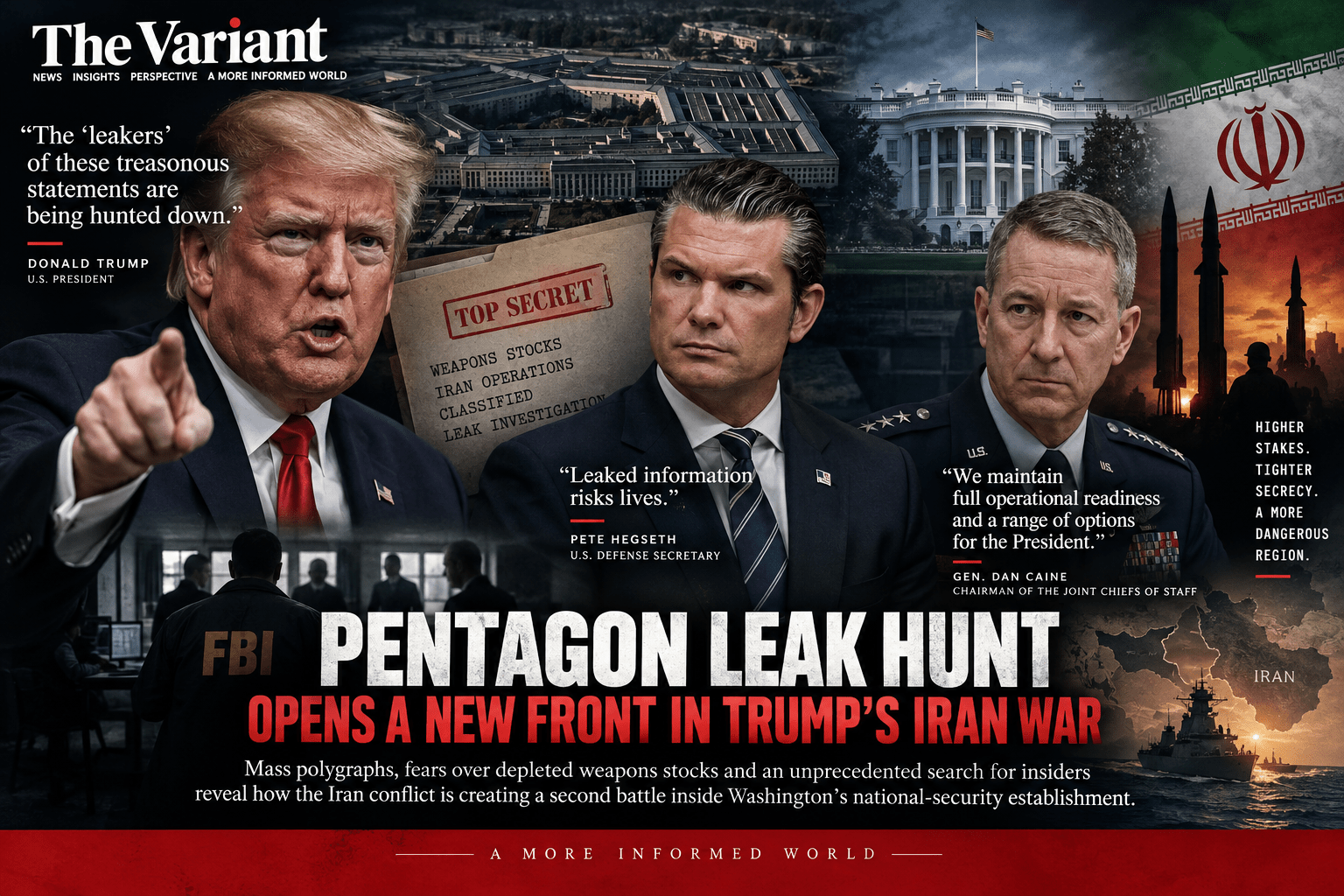
WASHINGTON, D.C: The escalating confrontation between the United States and Iran is producing an unusual second front—not in the Persian Gulf, but inside the Pentagon.
The Trump administration has intensified its hunt for officials suspected of leaking sensitive information about U.S. military operations, weapons inventories and the sustainability of the campaign against Iran.
Roughly 50 military and civilian personnel associated with the Joint Staff underwent polygraph examinations in August, according to recent reporting, with some officials connected to U.S. Central Command and other combatant commands also questioned.
The scale of the investigation is remarkable. But its significance goes far beyond identifying who spoke to journalists.
The disclosures at the center of the controversy concern one of the most strategically important questions surrounding the Iran conflict: how long can the United States maintain a high-intensity campaign without placing unacceptable pressure on stocks of precision weapons and air-defense interceptors needed elsewhere?
That question directly affects American deterrence.
If Tehran believes Washington possesses virtually unlimited military endurance, continued escalation becomes extraordinarily dangerous. If Iranian leaders instead conclude that U.S. inventories are being strained and replacement production cannot match wartime consumption, Iran gains an incentive to prolong the confrontation.
That makes information about American weapons stocks itself a weapon.
Trump: The leakers are being “hunted down”
President Donald Trump has strongly rejected suggestions that American arsenals are approaching dangerous levels of depletion.
Responding to reports concerning U.S. munitions, Trump said America possessed “massive amounts” of weapons, with additional production underway. More strikingly, he declared that the “‘leakers’ of these treasonous statements are being hunted down.”
The language demonstrates how the White House views the issue: not simply as embarrassing reporting but as a potential threat to U.S. military leverage.
If classified assessments reveal which interceptors, missiles or precision weapons are being consumed fastest, Iran could adjust its strategy accordingly. Tehran would not necessarily require exact inventory numbers. Understanding which American capabilities are under the greatest logistical pressure could itself influence Iranian calculations.
However, an important distinction remains. While Trump has demanded aggressive action against leaks across his administration, the latest confirmed mass polygraph operation has centered on Pentagon and military personnel.
There is not comparable public evidence establishing that dozens of White House staff members were subjected to the same polygraph program.
Hegseth builds wider anti-leak machinery
Defense Secretary Pete Hegseth has made unauthorized disclosures a major Pentagon priority.
The Defense Department and Justice Department established a coordinated effort in July aimed at identifying unauthorized disclosures and potentially pursuing criminal cases where appropriate.
Hegseth has also empowered Pentagon lawyers and investigators to seek information across the department.
His argument is straightforward.
“Leaked information risks lives,” Hegseth said while explaining the administration’s approach.
He has separately warned against personnel “talking out of school about things they should not,” particularly when classified operational information could expose American forces.
Hegseth’s position reflects a legitimate military concern. During active operations, disclosure of weapons availability, targeting methods, operational limitations or commanders’ assessments could provide an adversary with valuable intelligence.
But the investigation creates another challenge: distinguishing genuinely dangerous unauthorized disclosure from internal disagreement, whistle blowing and legitimate scrutiny of wartime decisions.
That boundary becomes particularly sensitive when the information concerns whether military resources are sufficient to execute political objectives.
The investigation’s surprising result
Despite the extraordinary scale of the polygraph campaign, publicly available information does not indicate that investigators have identified the source of the major disclosures.
CBS News reported that none of the personnel tested failed the specific questions designed to determine whether they had leaked information to journalists.
Chairman of the Joint Chiefs of Staff Gen. Dan Caine was reportedly not among those polygraph.
That outcome complicates the investigation. Either the source has not yet been tested, the relevant information moved through channels investigators have not identified, or polygraph examinations have simply failed to resolve the matter.
Polygraphs themselves also have important limitations and generally should not be treated as definitive proof of truthfulness or deception.
The Pentagon nevertheless appears determined to continue investigating.
Gen. Dan Caine faces a different responsibility
While Trump and Hegseth confront the political and security consequences of leaks, Gen. Dan Caine faces a fundamentally different responsibility: determining what America’s armed forces can actually sustain.
Caine has generally avoided the administration’s more confrontational political rhetoric surrounding the investigation. His public statements have concentrated instead on operational readiness and military options.
Discussing Iran, the chairman has emphasized continued CENTCOM surveillance and the military’s ability to develop options for the president and defense secretary.
During earlier operations, Caine described extensive U.S. missions against Iranian command-and-control infrastructure, missile capabilities, naval forces and intelligence targets.
That distinction is crucial.
Political leaders can project unlimited resolve. Military planners must calculate aircraft availability, interceptor expenditure, missile inventories, maintenance cycles, logistics and replacement rates.
Those calculations become particularly difficult when Washington must simultaneously prepare for crises involving China, Russia, North Korea and other potential theaters.
Is America actually running short of weapons?
The answer requires more nuance than either “yes” or “no.”
Hegseth has maintained that the United States retains sufficient weapons for its current military requirements. During the campaign he stated:
“We have sufficient precision munitions for the task at hand.”
At the same time, Pentagon officials understandably refuse to disclose exact inventory levels.
Washington has also been pressing defense manufacturers to increase production and shorten delivery timelines. That does not necessarily mean America is close to exhausting its arsenal.
It does suggest that consumption rates have become strategically important.
The United States could simultaneously possess enough weapons to continue operations against Iran while becoming increasingly concerned about maintaining reserves for a completely different war.
This is particularly important in the Indo-Pacific.
American defense planning cannot assume that an Iran conflict occurs in strategic isolation. Every sophisticated missile or interceptor consumed in the Middle East potentially affects calculations elsewhere unless industrial production rapidly replaces it.
Iran’s strategy may become a war of endurance
This is where the leak controversy could materially affect Iranian strategy.
Tehran does not necessarily need to defeat the U.S. military conventionally—an extraordinarily difficult objective given America’s technological and conventional superiority.
Iran can instead attempt to increase the cost of maintaining American pressure.
That could involve dispersing missile forces, deploying inexpensive drones against targets requiring expensive defensive interceptors, maintaining maritime pressure and relying on regional partners to stretch U.S. surveillance and air-defense requirements.
The strategic equation becomes economic as well as military.
A relatively inexpensive Iranian drone intercepted by a far more expensive American missile can still represent a tactical U.S. success while contributing to a longer-term resource challenge if repeated hundreds or thousands of times.
Leaks concerning inventory pressures therefore potentially provide Tehran with clues about where such an endurance strategy could be most effective.
The Pentagon now confronts a trust problem
The crackdown creates risks of its own.
Military organizations require secrecy, particularly during wartime. But successful militaries also require commanders and analysts who are willing to deliver uncomfortable assessments to political leaders.
If personnel begin fearing that raising concerns about ammunition stocks, operational assumptions or strategic objectives could make them investigative targets, internal decision-making could suffer.
The administration therefore faces a delicate balance.
It must prevent classified operational intelligence from reaching America’s adversaries without creating an environment in which professional military disagreement is interpreted as disloyalty.
Excessive compartmentalization presents similar problems. Restricting access to classified assessments may reduce opportunities for unauthorized disclosure, but modern joint warfare depends heavily on rapid information-sharing across commands and services.
Security can become counterproductive if it prevents the military itself from efficiently using the information being protected.
Trump’s Iran strategy increasingly depends on industrial power
The controversy also reveals a broader reality about modern warfare.
America’s confrontation with Iran will not ultimately be determined solely by the number of aircraft, warships or missiles currently deployed around the Middle East.
Industrial capacity increasingly matters.
If Washington can replace sophisticated weapons faster than they are consumed, Tehran’s strategy of endurance becomes considerably weaker. If production remains slow while expenditure remains high, time becomes a strategic variable.
That explains why defense-production expansion is nearly as important as battlefield operations.
Trump’s administration therefore faces three interconnected missions: maintaining military pressure on Iran, preventing sensitive operational information from reaching Tehran and rapidly expanding the industrial capacity required to sustain American deterrence globally.
A war outside—and another inside Washington
The Pentagon leak investigation should ultimately be understood as part of the larger Iran confrontation rather than an isolated Washington scandal.
Trump wants Iran to believe American military power can be sustained indefinitely.
Hegseth wants to prevent insiders from revealing information that could challenge that perception or compromise operations.
Caine and America’s uniformed commanders must determine what can actually be sustained without jeopardizing other global military commitments.
Iran, meanwhile, has every incentive to study the gaps between those three realities.
The extraordinary polygraph campaign demonstrates just how seriously Washington views that information battle. Yet the fact that dozens of examinations have apparently failed to publicly identify the suspected source also leaves uncomfortable questions unresolved.
The United States is therefore fighting two interconnected contests: one against Iran over regional power and deterrence, and another inside Washington over secrecy, trust and the true limits of American military endurance.
In a prolonged conflict, the outcome of the first could increasingly depend upon how successfully Washington manages the second.
Stay informed with The Variant for in-depth analysis, breaking developments, and expert perspectives on the stories shaping our world.


