


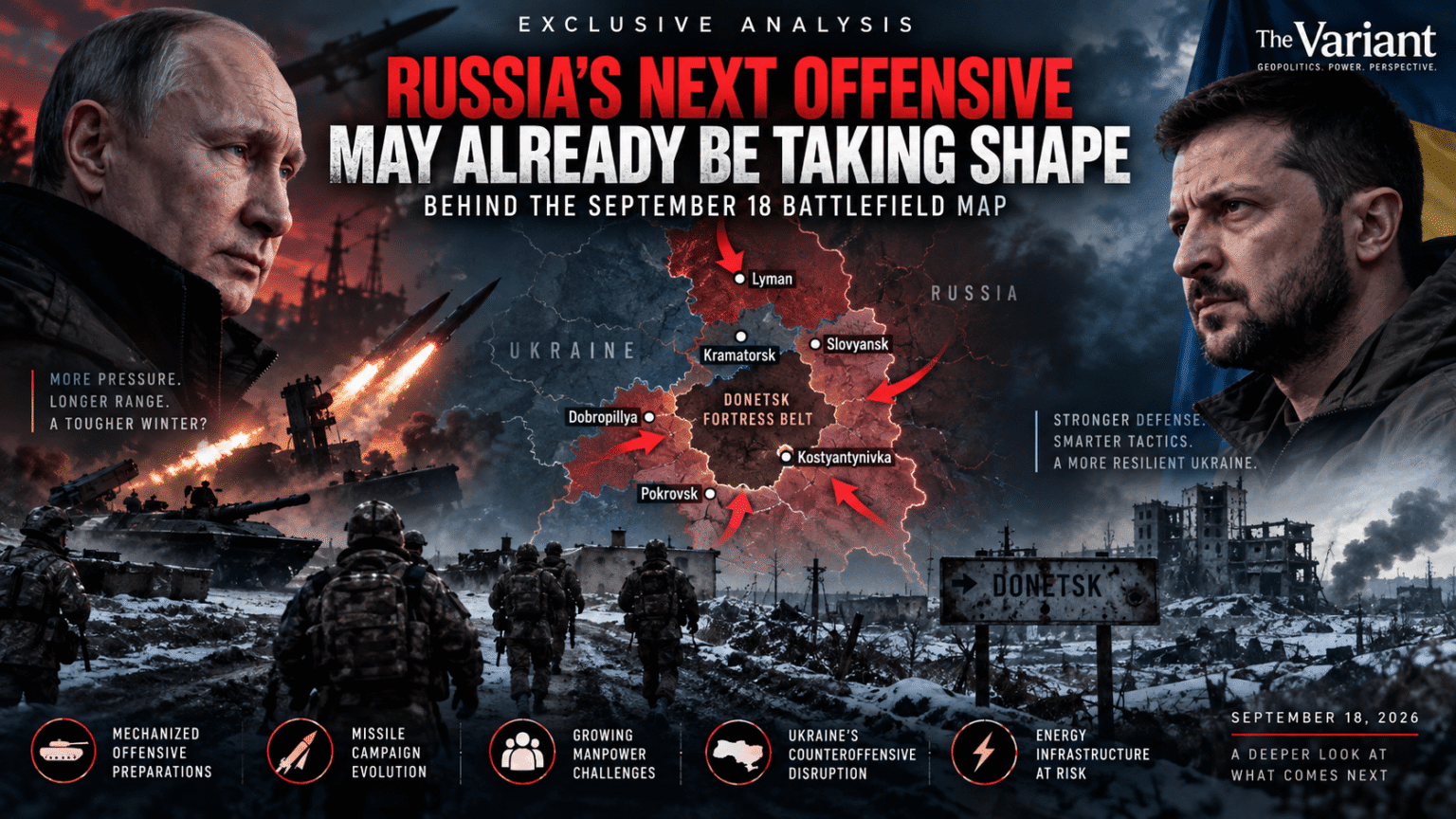
Rochester, NY: The most important development on the Ukrainian battlefield on September 18 may be what did not happen.
Neither Russian nor Ukrainian forces made confirmed territorial advances that day, according to the Institute for the Study of War (ISW). Yet underneath that apparently static frontline, several military developments point toward a potentially consequential transition in Russia’s campaign.
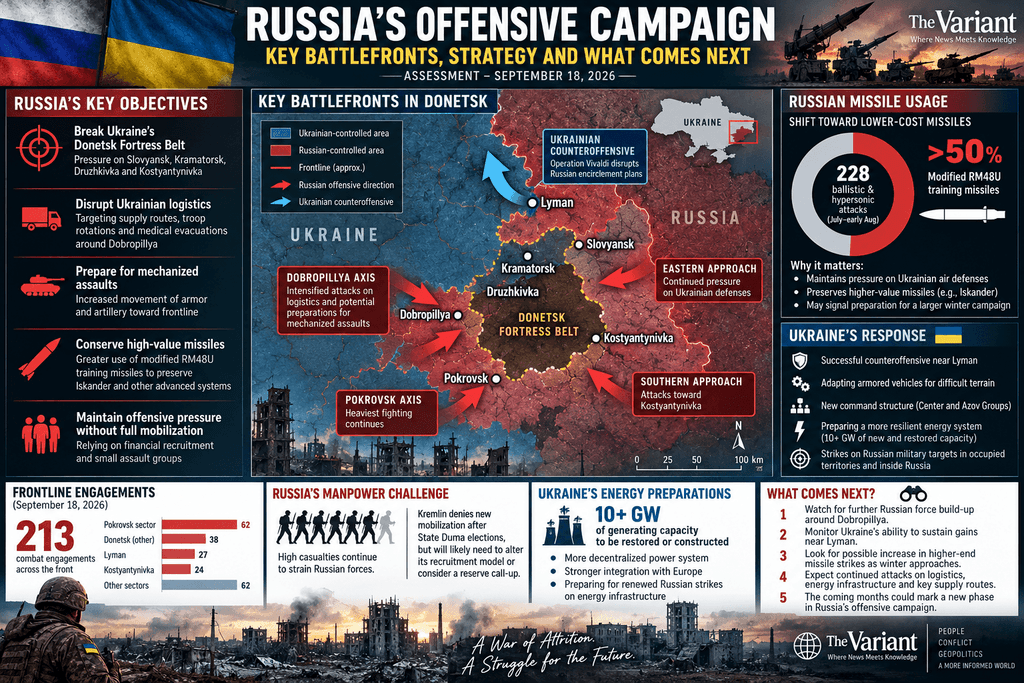
The September 18 Russian Offensive Campaign Assessment describes intensified Russian artillery and drone attacks against Ukrainian logistics around Dobropillya, the movement of artillery closer to the frontline, continuing pressure around the Donetsk Fortress Belt and preparations for possible mechanized operations later in the year.
Read alongside Russia’s changing missile employment, Ukraine’s counteroffensive around Lyman and Moscow’s increasingly difficult manpower equation, a broader picture emerges:
Russia may be entering a battlefield-preparation phase rather than simply continuing its summer offensive at the same tempo.
That distinction matters.
The Battle for Donetsk Is Becoming a Battle for Logistics
Russia’s strategic objective in Donetsk increasingly appears centered on Ukraine’s remaining Fortress Belt — the interconnected defensive urban zone around Slovyansk, Kramatorsk, Druzhkivka and Kostyantynivka.
ISW now divides Russia’s campaign against this belt into several operational approaches: pressure from the northwest through the Lyman axis, from the east, from the south and a wider southwestern maneuver associated with the Pokrovsk-Dobropillya area.
The potentially more revealing development is occurring around Dobropillya.
A Ukrainian brigade spokesperson reported that Russian forces have intensified attacks against Ukrainian logistics, troop rotations and medical evacuation routes while moving artillery closer to the frontline since September 9.
ISW connects this activity with previously reported Russian transfers of armor and drone-support assets toward the area and assesses that these moves are likely preparations for mechanized assaults in the fall.
That creates an important analytical possibility.
Moscow may be attempting to weaken the Ukrainian defensive system before committing significant armored formations.
Instead of immediately attacking fortified Ukrainian positions, Russian forces can use drones, artillery and precision strikes to make the roads behind them increasingly dangerous.
A defensive position does not have to be physically captured to become militarily unsustainable. If ammunition cannot reliably arrive, wounded soldiers cannot be evacuated and reinforcements cannot rotate safely, the effectiveness of the position gradually deteriorates.
This could make the coming fight as much about roads as trenches.
Dobropillya Could Become More Important Than Pokrovsk
Russian pressure around Pokrovsk has attracted enormous attention, but Dobropillya may increasingly matter because of its relationship to Ukrainian communications farther north.
Russia claimed on September 18 that its forces had captured Zolotyi Kolodyaz northeast of Dobropillya, although battlefield claims in this war require considerable caution. A Russian military blogger argued that control of the area could place additional pressure on the T-0514 Dobropillya-Kramatorsk highway.
The significance is operational rather than symbolic.
If Russian forces can progressively threaten the transportation network connecting Dobropillya with Kramatorsk and the broader Fortress Belt, Moscow could try to stretch Ukrainian defenses across several axes simultaneously.
That would potentially force Kyiv to decide whether reserves should reinforce Pokrovsk, Dobropillya, Kostyantynivka or the approaches toward Kramatorsk.
Russia does not necessarily need a dramatic breakthrough for such pressure to have an effect. Forcing Ukraine to repeatedly reposition scarce reserves can itself become part of an attritional strategy.
But Ukraine Has Disrupted Moscow’s Northern Plan
There is another side to the battlefield.
Ukraine’s recent Operation Vivaldi around Lyman represents something more significant than a collection of local counterattacks.
ISW assessed on September 17 that the operation demonstrated Ukraine’s improving ability to restore elements of tactical maneuver, supported by shaping operations and intermediate-range attacks against Russian electronic-warfare capabilities. Ukrainian forces reportedly achieved operational surprise through operational security and counter-drone measures.
Ukraine had already confirmed counteroffensive operations against the Russian salient northwest of Lyman. ISW assessed earlier in the week that these operations disrupted Russia’s effort to conduct a wide encirclement of the Fortress Belt.
Additional details published in the September 18 assessment are revealing.
A Ukrainian battalion commander said Ukrainian forces entered Serednie using armored vehicles after adapting them to operate over wet ground that Russian forces apparently considered unsuitable for heavy equipment. Russian forces subsequently attempted unsuccessfully to retake the settlement, according to Ukrainian commanders cited by ISW.
This indicates an increasingly important battlefield contest:
Russia is trying to create predictable pressure; Ukraine is trying to restore unpredictability.
If Kyiv can continue producing tactical surprise, Russian commanders may have to retain reserves behind sectors they previously considered stable.
That could complicate preparations elsewhere.
Russia Appears to Be Conserving Its Most Valuable Missiles
Another development away from the trenches may provide clues about Moscow’s winter strategy.
Reuters reported on September 18 that Russia has dramatically increased its use of modified RM48U training missiles in attacks against Ukraine. According to Ukrainian officials and data reviewed by Reuters, these converted missiles accounted for more than half of 228 ballistic and hypersonic missile attacks during July and early August.
These weapons are generally less capable than Russia’s more sophisticated Iskander ballistic missiles.
Why use them?
One possible explanation is inventory management.
Using cheaper or less sophisticated systems can allow Russia to maintain pressure on Ukrainian air defenses while preserving higher-value ballistic missiles.
That becomes especially significant approaching winter.
Ukraine is already preparing for another Russian campaign against its energy network. Energy Minister Denys Shmyhal said Kyiv plans to restore and construct more than 10 gigawatts of generating capacity while creating a more decentralized and resilient electricity system integrated more deeply with Europe.
This raises a serious possibility: Russia’s missile campaign and ground campaign may increasingly become synchronized.
Pressure against Ukrainian electricity infrastructure could complicate industrial production, railway operations, civilian resilience and military logistics at the same time Russian ground forces intensify pressure in Donetsk.
That does not prove Moscow has made such a decision. But the convergence of battlefield preparations and missile conservation makes the scenario worth watching.
The Hidden Russian Weakness: Infantry
Russia’s greatest constraint may not be ammunition or armored vehicles.
It may be people.
The Kremlin continued on September 18 to deny that another mobilization would follow Russia’s September 18–20 State Duma elections. ISW assesses, however, that Moscow will eventually need to alter its recruitment model or conduct some form of involuntary reserve call-up if Russian forces continue suffering casualties at their present rate.
That produces a strategic contradiction.
Russia wants to sustain offensive pressure without creating the domestic political consequences associated with another major mobilization.
The result has been a force increasingly dependent upon financial recruitment incentives, small assault groups, drones and enormous volumes of artillery.
The approaching winter could therefore become a race between Russia’s ability to generate manpower and Ukraine’s ability to generate operational disruption.
Ukraine Is Also Changing Its Command Structure
Kyiv, meanwhile, is reorganizing the command architecture responsible for defending the critical Donetsk front.
The former Eastern Group of Forces has reportedly been replaced by the newly created Center and Azov Groups of Forces. The Center formation will oversee an area extending from Lyman toward the Kramatorsk-Kostyantynivka sector, while Azov assumes responsibility farther south around the Dobropillya tactical area.
This restructuring deserves more attention.
Ukraine appears to be aligning operational headquarters more closely with the emerging geography of the Russian campaign.
That could improve command responsiveness by giving commanders clearer responsibility for specific Russian axes.
But reorganizations conducted during active combat also carry risk. Communications, intelligence distribution, logistics relationships and command procedures have to continue functioning while the enemy is attacking.
The effectiveness of this restructuring may therefore become one of the less visible but important variables shaping the coming campaign.
September 18 Was a Day without Advances — Not Without Movement
Ukraine’s General Staff recorded 213 combat engagements on September 18, with the Pokrovsk sector remaining the most active, according to its battlefield update released the following morning.
Yet territorial maps showed no confirmed Russian or Ukrainian advances.
That apparent contradiction captures the current character of the war.
Hundreds of engagements can occur without producing significant movement because both armies are increasingly fighting within a battlefield dominated by drones, electronic warfare, mines, artillery and long-range surveillance.
The decisive activity may therefore increasingly occur behind the immediate line of contact.
Russia is attacking Ukrainian logistics.
Ukraine is attacking Russian ammunition depots, drone facilities, airfields and energy infrastructure.
Ukrainian forces reportedly struck Russian military targets in Rostov Oblast and occupied Luhansk and Donetsk regions on September 17–18, while Russia launched 93 drones against Ukraine overnight.
Both militaries are trying to damage the system supporting the opposing army before attempting to destroy the formations at the front.
What Comes Next
The September 18 battlefield should therefore not be interpreted as static.
It may represent a transitional moment.
Three indicators deserve particular attention over the next several weeks: whether Russia continues moving artillery and armored formations toward Dobropillya; whether Ukraine can expand or consolidate the gains associated with Operation Vivaldi around Lyman; and whether Moscow begins increasing its use of higher-end ballistic missiles as temperatures fall.
If all three develop simultaneously, the battlefield could enter a new phase.
Russia would be attempting to pressure the Fortress Belt from several directions while degrading Ukraine’s logistics and national energy infrastructure. Ukraine, meanwhile, would be trying to disrupt Russian staging areas and command systems before those preparations mature into a larger offensive.
The central question is therefore no longer simply where Russia advanced today.
It is whether Moscow is assembling the conditions for tomorrow’s offensive — and whether Ukraine can disrupt those conditions before Russian commanders are ready to act.
Keep following The Variant as we continue to monitor developments and provide informed perspectives on this evolving situation.

