


Courtesy: Reporting Contribution by Hira Ahmed [A freelance Journalist I Rawalpindi, Pakistan] & Anjali Sharma [A Veteran Journalist I New Delhi, India]
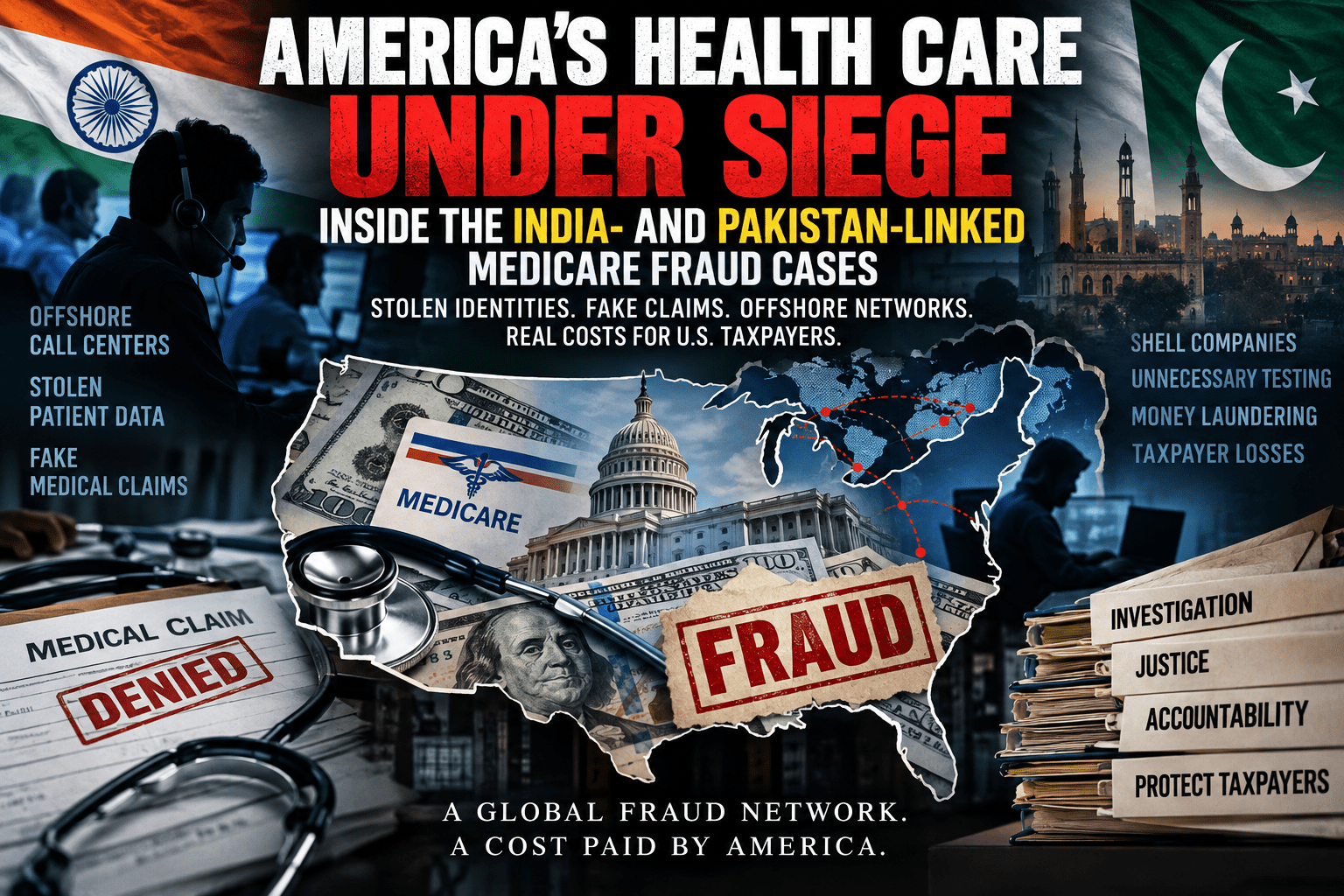
Rochester, NY/Islamabad, PK/New Delhi, IN: From stolen Medicare identities and overseas call centers to phantom laboratories, artificial-intelligence-generated consent recordings and shell companies, recent federal cases involving defendants and operations linked to Pakistan and India illustrate how American health-care fraud has evolved into a transnational financial and cybercrime problem.
The consequences extend beyond insurers: when Medicare or Medicaid is defrauded, public money—and ultimately taxpayers—bears much of the cost.
The traditional image of medical insurance fraud is relatively simple: a provider bills Medicare for a procedure that never occurred or exaggerates the cost of treatment. Recent federal investigations reveal something considerably more sophisticated.
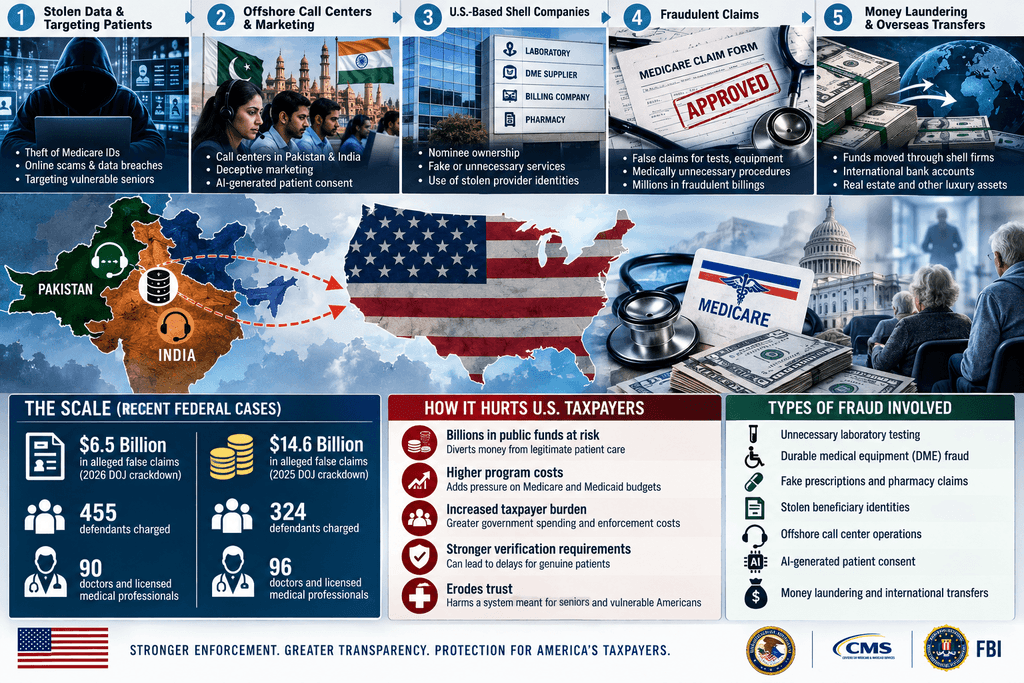
The modern model can combine stolen patient identities, overseas marketing operations, nominee owners of American medical companies, fraudulent laboratory testing, durable medical equipment (DME), fabricated physician information, electronic billing and international money laundering.
Some of the most striking recent cases have included defendants or infrastructure linked to Pakistan and India. These cases do not establish that either nationality or immigrant community is disproportionately responsible for U.S. health-care fraud.
They do, however, demonstrate how weaknesses in America’s enormous health-care payment system can be exploited from thousands of miles outside the country.
A $6.5 Billion Warning
The scale of the wider problem is enormous.
In its June 2026 National Health Care Fraud Takedown, the U.S. Department of Justice announced charges against 455 defendants, including 90 doctors and other licensed medical professionals, involving more than $6.5 billion in allegedly fraudulent claims.
That followed the record-setting 2025 national enforcement action, when 324 defendants were charged in schemes involving more than $14.6 billion in intended losses.
Ninety-six defendants were doctors, nurse practitioners, pharmacists or other licensed medical professionals.
Those numbers should not be interpreted as money actually lost dollar-for-dollar. “False claims,” “intended loss,” amounts billed and amounts actually paid are different measures. Federal agencies can reject suspicious claims before payment and later recover or seize some proceeds.
Nevertheless, the investigations expose the extraordinary amount of public money criminals are attempting to extract from America’s health-care programs.
The Pakistan Connection: A $703 Million Alleged Scheme
One particularly important federal case illustrates how fraud can become international.
In the DOJ’s 2025 takedown, prosecutors charged defendants—including owners and executives associated with Pakistani marketing organizations—in connection with an alleged $703 million Medicare scheme.
According to federal prosecutors, Medicare beneficiaries’ identification numbers and confidential health information were allegedly obtained through theft and deceptive marketing.
Prosecutors allege that a Pakistan-based call-center operation acquired beneficiary information through methods including deceptive websites, scraping and hacking.
The allegation becomes particularly significant because of the technology involved.
Federal prosecutors say artificial intelligence was used to manufacture recordings purporting to show Medicare beneficiaries consenting to receive products.
The information was then allegedly connected to laboratories and DME suppliers that submitted claims for products and services beneficiaries had not requested, needed or received.
DOJ says approximately $703.8 million in false claims were submitted to Medicare and Medicare Advantage plans in this alleged operation and approximately $418.6 million was paid.
That distinction is crucial: $703 million represents alleged claims, not the final taxpayer loss.
The case also demonstrates why offshore operations are particularly difficult to police. The alleged network crossed the boundaries between marketing, identity acquisition, medical billing and international finance.
Another Pakistan-Linked Case Reached Arizona Medicaid
Federal prosecutors have also described a separate case involving a defendant based in Pakistan and the United Arab Emirates who allegedly owned a billing company connected to an Arizona Medicaid scheme.
According to DOJ, approximately $650 million was fraudulently billed for substance-abuse treatment.
Prosecutors alleged that some services were never provided while others were so deficient that they served no legitimate treatment purpose.
The alleged operation recruited vulnerable people, including individuals experiencing homelessness and people from Native American reservations.
Prosecutors said the defendant received at least $25 million in Arizona Medicaid funds and was charged with laundering proceeds, including through the alleged purchase of a $2.9 million Dubai property.
These remain allegations unless and until established through the judicial process.
A separate indictment announced in February 2026 charged Pakistani native Burhan Mirza and Kashif Iqbal in an alleged $10 million scheme involving nominee-owned laboratories and DME providers.
DOJ alleged that false claims were submitted for health-care items and services that were never provided.
The same investigation involved individuals from both Pakistan and India; several co-schemers had already pleaded guilty, while the newly indicted defendants remained presumed innocent.
Indian Nationals Appear in Several Major Cases
Federal prosecutions have separately identified several Indian nationals in significant Medicare cases.
In Texas, federal prosecutors charged Khadeer Khan Mohammed, an Indian citizen, over an alleged genetic-testing operation.
Prosecutors said approximately $93 million in fraudulent claims were submitted to Medicare and roughly $65 million was paid. Authorities seized nearly $6 million from accounts they said Mohammed controlled.
Another 2024 federal enforcement action charged Dr. Vijil Rahulan of Hyderabad, India, in connection with an alleged scheme involving more than $82 million in Medicare claims for DME and genetic testing. DOJ alleged that more than $28.7 million was paid by Medicare.
Federal authorities also charged Indian national Osman Syed in connection with an alleged $79 million respiratory-testing scheme involving Medicare and Texas Medicaid.
Prosecutors alleged that tests were either not provided or medically unnecessary and that a physician’s identifying information was used without authorization.
In another case, Mohammed Asif, an Indian national associated with a Washington diagnostic laboratory, pleaded guilty to conspiracy to commit health-care fraud. In December 2025, he was sentenced to two years in prison.
Prosecutors said the operation billed Medicare for COVID-19 and respiratory tests that had not been ordered or performed, with the fraud amount determined at sentencing at approximately $1.17 million.
These cases range from allegations in pending prosecutions to convictions, so they should not be treated as legally equivalent.
The Architecture of Modern Medical Fraud
Taken together, the federal cases reveal a recurring business model.
The first valuable commodity is often the patient rather than the medical treatment. A Medicare beneficiary’s name, Medicare number and personal information can provide the raw material for fraudulent billing.
Overseas call centers and digital marketers can potentially acquire large numbers of beneficiaries much faster than an individual fraudulent clinic could.
The second component is an American billing vehicle: a laboratory, pharmacy, home-health agency or DME company capable of submitting claims.
Nominee ownership becomes particularly useful. The individual officially listed as controlling a company may not necessarily be the person directing the operation.
The third component is documentation—or its fabrication. A fraudulent claim needs to appear legitimate enough to survive automated payment controls.
Stolen physician identities, unnecessary tests, fake orders and, according to recent DOJ allegations, AI-generated patient consent can create the appearance of legitimate medical activity.
Finally comes monetization. Once Medicare pays the American provider, proceeds can move through domestic accounts, shell companies, crypto currency or foreign banking channels.
This is where medical fraud starts resembling sophisticated international financial crime.
What Does It Cost the American Taxpayer?
The answer requires an important distinction between fraud and improper payments.
CMS estimated that in fiscal 2025, Medicare Fee-for-Service had $28.83 billion in improper payments, Medicare Advantage had $23.67 billion, Medicare Part D had $4.23 billion, and Medicaid had $37.39 billion.
But those figures must not be described as fraud losses.
CMS explicitly warns that improper-payment measurements are not measurements of fraud. Improper payments can result from missing documentation, administrative errors, underpayments and other failures to satisfy payment requirements.
For example, CMS said more than 77% of the estimated Medicaid improper payments for FY2025 resulted from insufficient documentation, which generally does not indicate fraud or abuse.
Across the federal government—not just health care—the Government Accountability Office estimated approximately $186 billion in improper payments in FY2025, of which roughly $153 billion represented overpayments.
GAO says cumulative estimated improper payments reported since FY2003 total roughly $3 trillion.
Again, these figures cannot legitimately be presented as $186 billion of fraud or $3 trillion stolen by criminals.
How Fraud Eventually Reaches Taxpayers
The taxpayer impact operates through several channels.
Medicare and Medicaid are financed overwhelmingly with public resources. When a fraudulent provider successfully extracts $1 million, that money is no longer available for legitimate medical care unless recovered.
There is also a secondary enforcement cost. Fraud requires investigations by the FBI, HHS-OIG, DOJ, CMS contractors, state Medicaid fraud-control units, prosecutors and financial investigators.
Third, widespread fraud forces the government to impose more extensive verification, audits and payment controls. Those safeguards themselves cost money and can create additional administrative burdens for legitimate doctors and patients.
Private insurance fraud has another transmission mechanism. Losses can ultimately contribute to insurers’ overall costs, which can affect premiums and employer health-benefit spending, although no individual premium increase can simply be attributed dollar-for-dollar to fraud.
Most importantly, Medicare fraud attacks a system whose resources are intended primarily for older Americans and people with disabilities. It therefore represents more than an accounting problem.
AI Changes the Threat
The Pakistan-linked case involving allegedly fabricated consent recordings deserves particular attention because it points toward the next generation of health-care fraud.
Generative AI can potentially make a fraudulent medical file look more authentic at enormous scale.
A criminal network no longer necessarily needs hundreds of people manually creating fake records. Software can potentially generate voices, documents, communications and individualized information rapidly.
At the same time, the government is increasingly fighting fraud with technology of its own.
DOJ said data analytics helped detect anomalous billing in a major 2025 transnational scheme, while CMS and HHS prevented approximately $4.41 billion of $4.45 billion scheduled for Medicare payment from reaching the organization.
That is an important counterpoint to the alarming headline numbers: billions of dollars in attempted fraud do not necessarily translate into billions successfully stolen.
The Nationality Question Requires Care
Indian and Pakistani nationals appear in significant federal health-care-fraud prosecutions, and some investigations specifically identify infrastructure operating from those countries.
Those connections are legitimate subjects for investigative journalism.
But there is no evidence in the cited federal data establishing that Indian Americans, Pakistani Americans, Indians or Pakistanis as populations are responsible for a disproportionate share of American medical fraud.
The 2025 nationwide takedown alone involved hundreds of defendants across 50 federal districts and 12 state attorney-general jurisdictions.
The more significant pattern is therefore not ethnicity.
It is transnationalization.
America operates one of the world’s largest and most technologically interconnected health-care payment systems.
Criminal networks can exploit that system without every participant—or even the people directing the operation—being physically present in the United States.
The Larger Battle
The fundamental vulnerability is speed.
Medicare and Medicaid process enormous numbers of legitimate transactions. The system must pay legitimate physicians, laboratories, pharmacies and suppliers efficiently.
Criminal organizations exploit that necessity by attempting to make fraudulent transactions indistinguishable from legitimate ones.
The emerging contest is therefore increasingly technological: AI-assisted fraud versus AI-assisted detection, stolen identities versus real-time verification, shell companies versus beneficial-ownership analysis, and international money laundering versus cross-border financial intelligence.
For American taxpayers, the lesson from the recent Indian- and Pakistani-linked cases is not that fraud belongs to a particular nationality.
It is that a domestic health-care program can now be attacked through a global infrastructure.
A Medicare number stolen in one state can be transmitted to an overseas call center, attached to a fabricated medical order, billed through an American company and converted into funds moved through international financial institutions.
That makes health-care fraud simultaneously a medical-integrity problem, a taxpayer problem, a cybersecurity problem and an international financial-crime problem.
The United States has demonstrated that analytics and coordinated enforcement can stop billions of dollars before they leave the system.
The harder challenge is moving from recovering stolen taxpayer money to preventing fraudulent claims from becoming payable in the first place.
Keep following at all social channels of The Variant as we continue to monitor developments and provide informed perspectives on this evolving situation.


