


Courtesy: Special Reporting Contribution by Ghulam Murtaza [A Senior Journalist I Islamabad, Pakistan]
Rochester, NY/Islamabad, PK: The renewed confrontation between Yemen’s Houthis and Saudi Arabia has transformed the Makkah Joint Defence Agreement from a diplomatic declaration into a practical security dilemma.
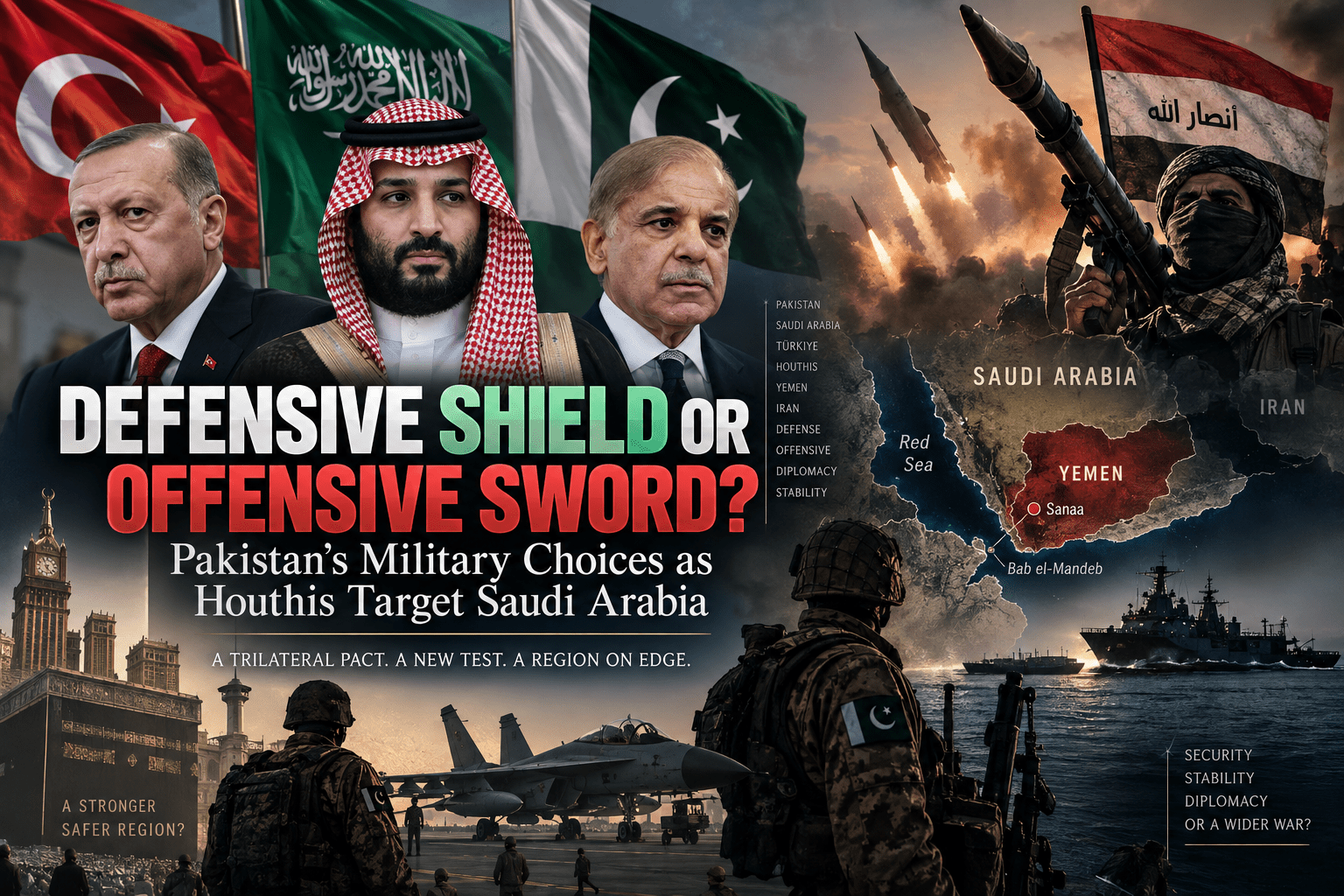
Signed on August 7 by Saudi Crown Prince Mohammed bin Salman, Turkish President Recep Tayyip Erdoğan and Pakistani Prime Minister Shehbaz Sharif, the agreement establishes a powerful principle: an armed attack against one member can be regarded as an attack against all three.
Yet the published declaration did not specify exactly what form a collective response must take, leaving considerable political and military discretion to the three governments.
That ambiguity was manageable when the pact represented mainly deterrence. It is far harder to manage now.
Houthi missiles and drones have struck Saudi targets, Saudi-Yemeni fighting has intensified, and Houthi forces have expanded their presence along strategically crucial territory near the Bab el-Mandeb.
On September 13, Reuters reported that Saudi Arabia was simultaneously dealing with attacks on its territory and disruption to its East-West oil pipeline, while the Houthis had seized the strategically located Perim Island in the Bab el-Mandeb Strait.
The wider crisis has become inseparable from instability around the Strait of Hormuz and the broader confrontation involving Iran and the United States.
The question is therefore no longer whether the Makkah pact has symbolic value.
The question is what collective defence actually means when the attacker is not another recognized state but an armed movement operating from Yemen.
Pakistan’s Red Line: Defence Is Not the Same as Offensive War
Pakistan’s official messaging has been remarkably consistent on one central point: the trilateral agreement is a defensive arrangement.
Prime Minister Shehbaz Sharif has described it as “entirely for defensive purposes,” while Pakistani diplomacy has repeatedly insisted that it is not directed against Iran or any other country. Türkiye has offered similar assurances.
That language is not diplomatic decoration. It creates an important threshold for Pakistani military involvement.
Islamabad can argue that protecting Saudi airspace, defending military installations, strengthening missile and drone interception, guarding strategic energy facilities, providing intelligence or protecting maritime routes would constitute collective defence.
Sending Pakistani aircraft deep inside Yemen to bomb Houthi positions would be much more difficult to describe purely as territorial defence.
Deploying Pakistani ground forces into Yemen would be harder still.
This is likely to become Islamabad’s central legal and political distinction: Pakistan may defend Saudi Arabia without necessarily joining Saudi Arabia in an offensive campaign inside Yemen.
That position is reinforced by the structure of the agreement itself.
Reuters reported when the pact was signed that although an attack on one party would be considered an attack on all, the announcement did not define the specific obligations each country had accepted or automatically require a particular type of military response.
In other words, collective defence does not necessarily mean identical military action.
Pakistan, Türkiye and Saudi Arabia could respond differently according to their capabilities, geography and political calculations.
What DG ISPR Has Actually Said
Pakistan’s military leadership has also deliberately avoided defining operational scenarios.
In the most recent directly relevant public comments I could verify from DG ISPR Lt Gen Ahmed Sharif Chaudhary, made before the signing of the trilateral Makkah pact but in the context of Houthi threats to Saudi-linked interests, the military spokesman reaffirmed Pakistan’s commitment to its strategic defence relationship with Saudi Arabia.
“We have a Strategic Mutual Defence Agreement and remain committed to fulfilling our commitments under that agreement,” he said.
At the same briefing, DG ISPR avoided discussing specific operational contingencies while stressing the strategic importance Pakistan attaches to Saudi security.
Pakistan had also joined efforts aimed at protecting maritime traffic through the Red Sea, Bab el-Mandeb and Gulf of Aden.
That wording matters.
The Pakistan Army is not saying Saudi Arabia will be left alone.
But it is equally not publicly saying that every Houthi missile automatically triggers Pakistani strikes on Yemen.
This is calculated ambiguity: enough commitment to strengthen deterrence, but enough flexibility to prevent Pakistan from being trapped by events it does not control.
Islamabad Is Trying to Remain Both Saudi Defender and Iranian Intermediary
Pakistan’s difficulty is that Saudi Arabia is not its only strategic consideration.
Islamabad has simultaneously cultivated an increasingly important role as a communications channel involving Riyadh, Washington and Tehran.
Reuters reported on September 11 that Pakistan had delivered a Saudi warning asking Iran to restrain the Houthis. Field Marshal Asim Munir also spoke with Iranian Foreign Minister Abbas Araghchi about restoring diplomatic efforts toward de-escalation.
Pakistani officials emphasized that Islamabad wanted restraint, dialogue and diplomacy rather than expansion of the conflict.
This reveals perhaps the most important Pakistani calculation.
Islamabad does not want to choose between Riyadh and Tehran unless absolutely forced to do so.
Saudi Arabia represents an extraordinary political, economic and military relationship for Pakistan. Iran, meanwhile, shares a long land border with Pakistan and possesses the ability to influence security dynamics across the region.
Pakistan also depends on energy and maritime routes vulnerable to instability around Hormuz and the Red Sea.
An open Pakistani war with the Houthis could therefore carry consequences far beyond Yemen.
It could damage Islamabad’s relationship with Tehran, complicate border security, undermine Pakistan’s mediation role and expose Pakistani interests to asymmetric retaliation.
Saudi Arabia May Need Pakistan — But Not Necessarily Pakistani Bombers
The assumption that honoring the Makkah agreement requires Pakistani fighter aircraft attacking Sanaa may misunderstand what Saudi Arabia actually needs.
Saudi Arabia possesses significant offensive capabilities of its own.
The more valuable Pakistani contribution could be in areas where Islamabad has extensive military experience: integrated air defence, counter-drone operations, intelligence sharing, training, command support, protection of strategic installations and reinforcement of sensitive Saudi territory.
Reuters has reported that Pakistan already has thousands of military personnel as well as aircraft, drones and air-defence assets in Saudi Arabia under longstanding defence arrangements.
Pakistani forces have also reportedly been positioned near the Saudi-Yemeni frontier.
This creates several levels of escalation before Pakistan would need to contemplate direct offensive action.
Pakistan could first reinforce Saudi air and missile defence.
It could increase surveillance and intelligence cooperation.
It could protect ports, oil fields, pipelines and military installations.
Pakistan’s navy could expand participation in maritime-security operations around the Red Sea and Bab el-Mandeb.
Pakistani personnel could provide logistical and technical support while remaining outside Yemen.
Only beyond those steps would direct strikes against Houthi territory become necessary — and politically much more dangerous.
The Houthis Have Created a Strategic Trap for the Pact
The Houthis’ strategy presents the three partners with an uncomfortable challenge precisely because they are a non-state armed movement.
If a conventional state invaded Saudi territory, determining whether the collective-defence clause applied would be relatively straightforward.
The Houthis operate differently.
They can launch missiles, drones and maritime attacks while remaining embedded in a fragmented Yemeni war.
Their relationship with Iran provides strategic depth but also enough separation for Tehran to deny direct responsibility for individual attacks.
This allows the Houthis to test the Makkah pact incrementally.
One drone does not necessarily trigger war.
Neither may one missile.
But dozens of strikes, attacks on civilian infrastructure, repeated targeting of Saudi energy installations or a sustained campaign threatening Saudi territory could eventually make restraint politically impossible.
The most dangerous development would therefore not necessarily be one spectacular attack.
It would be the accumulation of smaller attacks until Riyadh formally requests collective military assistance.
At that moment, Islamabad’s ambiguity would become much harder to maintain.
Saudi Calculations Are Also Changing
Riyadh itself appears reluctant to return casually to the kind of prolonged Yemen war that began in 2015.
The kingdom spent years attempting to contain the Houthis without achieving a decisive military settlement. Saudi economic transformation plans under Vision 2030 also require stability, investment and predictable energy exports — conditions undermined by permanent regional warfare.
Yet the latest deterioration is putting pressure on that preference for restraint.
Reuters reported on September 13 that Crown Prince Mohammed bin Salman had sought U.S. military help against the Houthis. Washington, at least initially, was prepared to offer intelligence assistance without entering the fighting directly.
That development makes the Makkah agreement even more significant.
If Washington is reluctant to intervene directly, Riyadh will inevitably examine what practical assistance its newer regional defence framework can provide.
Pakistan and Türkiye could therefore become increasingly important — even without conducting a full-scale offensive campaign.
Pakistan’s Most Likely Role: Shield First, Sword Only as a Last Resort
The current evidence points toward a relatively clear Pakistani strategy.
Pakistan will not abandon Saudi Arabia.
But neither is Islamabad eager to transform the Makkah agreement into a declaration of war against Yemen’s Houthis.
The country’s most probable military role would be defensive rather than expeditionary: protecting Saudi territory, strengthening its air-defence architecture, guarding strategic facilities, securing maritime routes and providing intelligence, training and logistical support.
Diplomatically, Pakistan will continue attempting something even more difficult — persuading Tehran that restraint by the Houthis is also in Iran’s interest while convincing Riyadh that Islamabad remains a dependable security partner.
That balance can survive only as long as Houthi attacks remain below a critical threshold.
If major Saudi cities, oil facilities, military bases or sacred sites suffer sustained attacks causing significant casualties, Pakistan’s room for diplomatic maneuver will rapidly shrink.
The pact would then cease to be a theoretical deterrent.
But even under those circumstances, Pakistan would probably argue that collective defence begins with defending Saudi territory, not automatically with invading or bombing Yemen.
That distinction is likely to define Pakistan’s policy.
The Makkah agreement was created to discourage aggression, not to manufacture another Middle Eastern war. Its success therefore should not be measured by whether Pakistani fighter jets eventually strike Houthi positions.
Paradoxically, the pact will have worked best if its military credibility is strong enough that Pakistan, Saudi Arabia and Türkiye never have to use its most dangerous provisions.
For Islamabad, the preferred outcome remains clear: be Saudi Arabia’s shield, remain Iran’s interlocutor, and avoid becoming another combatant in Yemen for as long as circumstances permit.
The global landscape is constantly evolving. Stay connected with The Variant for reliable news and thoughtful analysis.


