


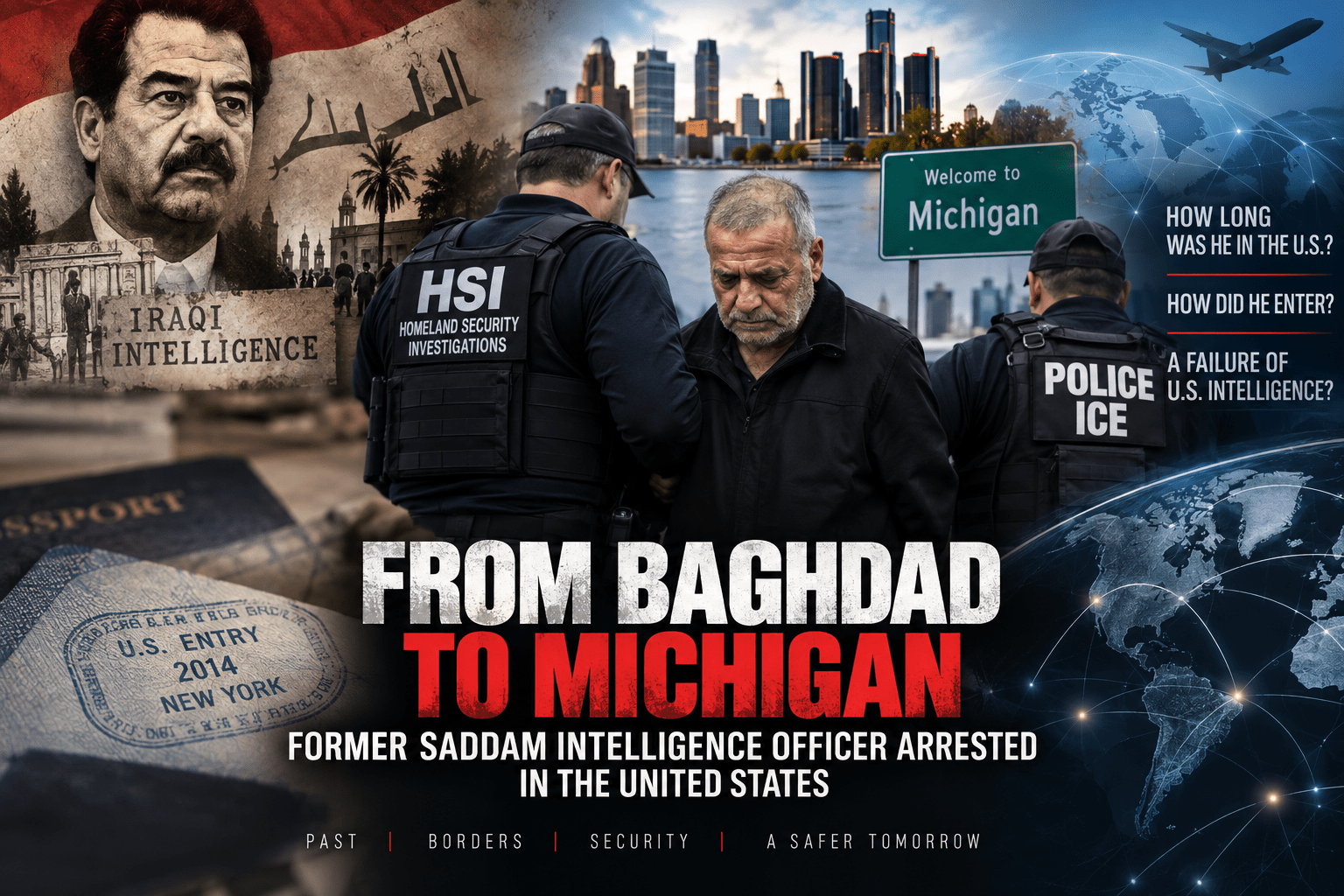
Rochester, NY/Washington, D.C: The arrest of Raad Alanbagi, a 70-year-old Michigan resident whom U.S. authorities allege served as a high-ranking Iraqi intelligence officer during the era of Saddam Hussein, is more than an immigration-enforcement story.
It raises a much larger national-security question: How could someone with an alleged senior position in one of the Middle East’s most notorious intelligence systems enter the United States legally and remain in the country for roughly 12 years before being detained?
Homeland Security Investigations announced the arrest on September 13, saying its Detroit agents had uncovered information connecting Alanbagi to previous service as a “high-ranking Iraqi intelligence officer” under Saddam Hussein.
Publicly available detention records indicate that he had actually been booked into the Calhoun County Correctional Facility on September 3, about 10 days before HSI announced the case.
The most important new detail, however, comes from the Department of Homeland Security itself. DHS told The National that Alanbagi “entered the United States lawfully in New York in 2014 but violated the terms of that lawful admission.”
The department declined to provide further information because the investigation remains active.
That means the central question is no longer whether Alanbagi crossed the border secretly. According to DHS, he did not. He passed through a lawful U.S. entry process.
A 12-Year Question
If Alanbagi entered in 2014 and remained continuously in the United States until his detention in September 2026, the maximum period involved would be roughly 12 years.
What has not been publicly established is whether he remained continuously in America during that entire period, when he moved to Michigan, what visa or other authorization he originally used, or what immigration status he subsequently held.
Those distinctions matter.
Early reports said authorities had not disclosed how or when he entered America. DHS’s later statement clarifies the year, location and lawful nature of the initial admission, but still leaves unanswered whether Alanbagi entered as a visitor, immigrant, refugee, and parolee or through another category.
There is also no publicly identified federal criminal indictment against him in Michigan as of the reporting reviewed for this analysis. It therefore remains unclear whether the immediate case is principally an immigration-enforcement matter or whether prosecutors could eventually pursue criminal charges.
That uncertainty is crucial. An arrest by immigration authorities is not itself proof that Alanbagi committed espionage, torture, war crimes or other crimes while in the United States.
HSI has publicly alleged his prior intelligence affiliation, but authorities have not disclosed his precise position, activities, and years of service or what evidence recently led investigators to him.
How Did He Pass U.S. Vetting?
This is where the case becomes particularly significant.
By 2014, Saddam Hussein had been removed from power for more than a decade. Saddam was captured by U.S. forces in 2003 and executed in Iraq in 2006.
American intelligence and military agencies had acquired enormous quantities of records from the former Iraqi state.
The United States had also previously prosecuted individuals connected to Saddam’s intelligence apparatus.
In one particularly relevant case, the Justice Department said Iraqi intelligence officer Wasim Latchin had been deliberately placed in the United States as a “sleeper” agent.
He immigrated in 1993 and later concealed his Iraqi Intelligence Service and Ba’ath Party affiliations when applying for U.S. citizenship.
Another Justice Department case demonstrated the importance of records recovered after the 2003 invasion. Federal prosecutors said documents obtained in Iraq helped expose Saubhe Jassim Al-Dellemy’s secret relationship with Saddam’s Iraqi Intelligence Service.
DOJ said that, by 2008, it had charged at least a dozen people who had served in America as illegal agents of Saddam’s government or its intelligence service.
These precedents make the Alanbagi case particularly worthy of scrutiny. If his alleged position was genuinely senior, policymakers and investigators will want to know whether his identity appeared in Iraqi government records already available to U.S. authorities.
Intelligence Failure — or Information Concealment?
It is tempting to immediately characterize the case as a failure of American intelligence. At this stage, however, that conclusion goes beyond the publicly available evidence.
There are at least two substantially different possibilities.
The first is a vetting or intelligence-sharing failure: information identifying Alanbagi and his alleged role may already have existed somewhere within American or allied databases but was not available to, matched by or properly interpreted by immigration and security officials when he entered in 2014.
The second is successful concealment: Alanbagi may have omitted or misrepresented relevant information, while the U.S. government lacked sufficiently reliable records to independently establish his alleged background at the time.
A previous Saddam-era case illustrates precisely this vulnerability. Former Iraqi military officer Ahmed Mohammed Ahmed obtained refugee admission to the United States after prosecutors said he concealed the true extent of his military career.
He later obtained permanent residence and citizenship while repeating the false account. The Justice Department eventually prosecuted him; he pleaded guilty in 2019 and was denaturalized in 2020.
That precedent demonstrates an uncomfortable reality about immigration vetting: even extensive screening depends partly on the quality of underlying foreign records and the truthfulness of information provided by applicants.
Biometric screening can establish that a person is who they claim to be. It cannot necessarily reveal an undisclosed intelligence career if the relevant historical records are incomplete, inaccessible, written under alternative transliterations or have never been incorporated into searchable databases.
The Iraqi Records Problem
Iraq presents an unusually complicated intelligence environment.
Saddam’s security architecture involved overlapping military, intelligence, security and Ba’ath Party institutions. After the 2003 invasion, enormous quantities of government documents were captured, abandoned or dispersed.
The DOJ’s previous Iraqi-agent prosecutions show that historical records can remain valuable many years later. They also demonstrate that individuals connected to the former regime have previously concealed affiliations during U.S. immigration processes.
Alanbagi’s arrest therefore raises another important possibility: the information leading to his detention may not have been available in 2014 at all.
HSI says its investigation “uncovered information” connecting him to prior intelligence service, but it has not said when that information became available, where it came from or whether another government provided it.
Without those answers, the difference between an intelligence failure and a later intelligence breakthrough remains unresolved.
Why Michigan Matters
The Detroit metropolitan area has one of America’s most established Iraqi and broader Middle Eastern communities. That fact may explain why an Iraqi immigrant would settle there, but it should not be treated as evidence of wrongdoing by the community.
Indeed, previous Justice Department investigations involving Saddam’s intelligence network demonstrate that the former Iraqi regime historically showed interest in Iraqi expatriate and opposition communities inside the United States.
DOJ said Saddam’s intelligence service recruited people in America and placed others here to collect information useful to Baghdad.
Whether Alanbagi had any such role is not established by the information currently public.
The Questions Washington Still Needs to Answer
The significance of the case will ultimately depend on information DHS, ICE, prosecutors or immigration courts have yet to disclose.
Investigators need to establish what immigration category Alanbagi used to enter in 2014; what information he provided about his employment, military, political and intelligence history; whether he remained continuously in America; when authorities first discovered his alleged Iraqi intelligence background; and whether relevant information existed in U.S. databases before his admission.
Another major question is whether he acquired permanent residency or citizenship after arriving. If additional immigration benefits were granted, that could mean his background passed through more than one stage of government review.
Most importantly, authorities will need to explain what they mean by “high-ranking Iraqi intelligence officer.” Rank, agency, responsibilities and period of service are essential to evaluating both the national-security significance of the arrest and the adequacy of the original vetting.
A Case about the Limits of Vetting
For now, the strongest conclusion is narrower than declaring an intelligence breakdown.
Alanbagi apparently entered the United States lawfully in New York in 2014, according to DHS.
Approximately 12 years later, HSI says investigators uncovered information tying him to high-level service in Saddam Hussein’s intelligence apparatus. He is now in immigration custody in Michigan.
That timeline is significant enough to justify scrutiny of the American vetting system.
But determining whether it represents institutional failure, database fragmentation, inadequate intelligence sharing, deliberate concealment by the applicant, newly discovered evidence — or some combination of these factors — requires information the government has not yet released.
The most consequential question is therefore not simply how did an alleged Saddam-era intelligence officer get into America?
It is whether the United States possessed information that should have stopped him in 2014 — and, if it did, why that information apparently did not do so.
Until DHS answers that question, Alanbagi’s arrest will remain both an enforcement success and an unresolved test of the security architecture designed to prevent precisely this kind of case.
For ongoing coverage and detailed analysis of international affairs, visit The Variant regularly for the latest updates.


