


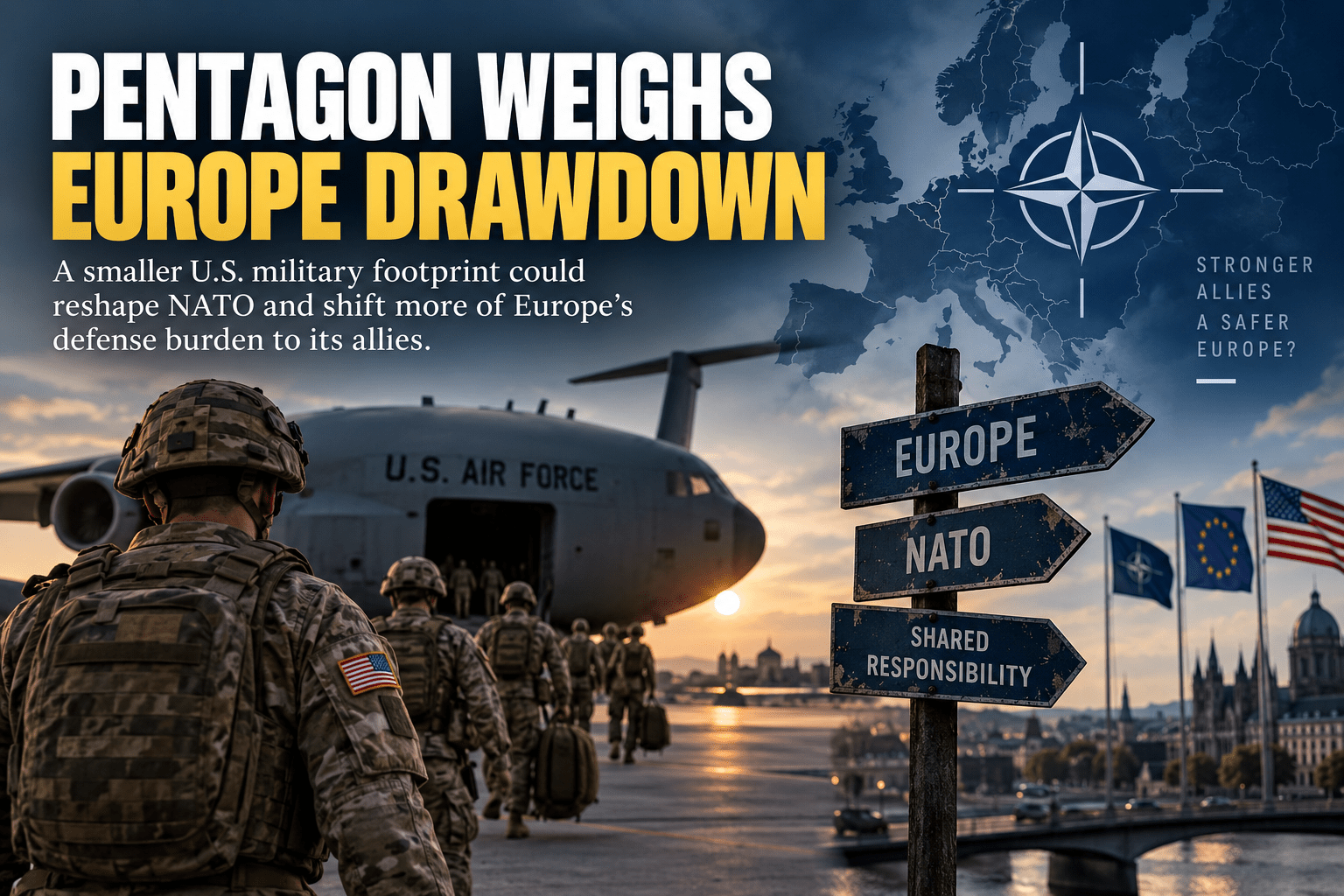
Washington, D.C: The Pentagon is moving closer to one of the most consequential reassessments of America’s military role in Europe since the end of the Cold War.
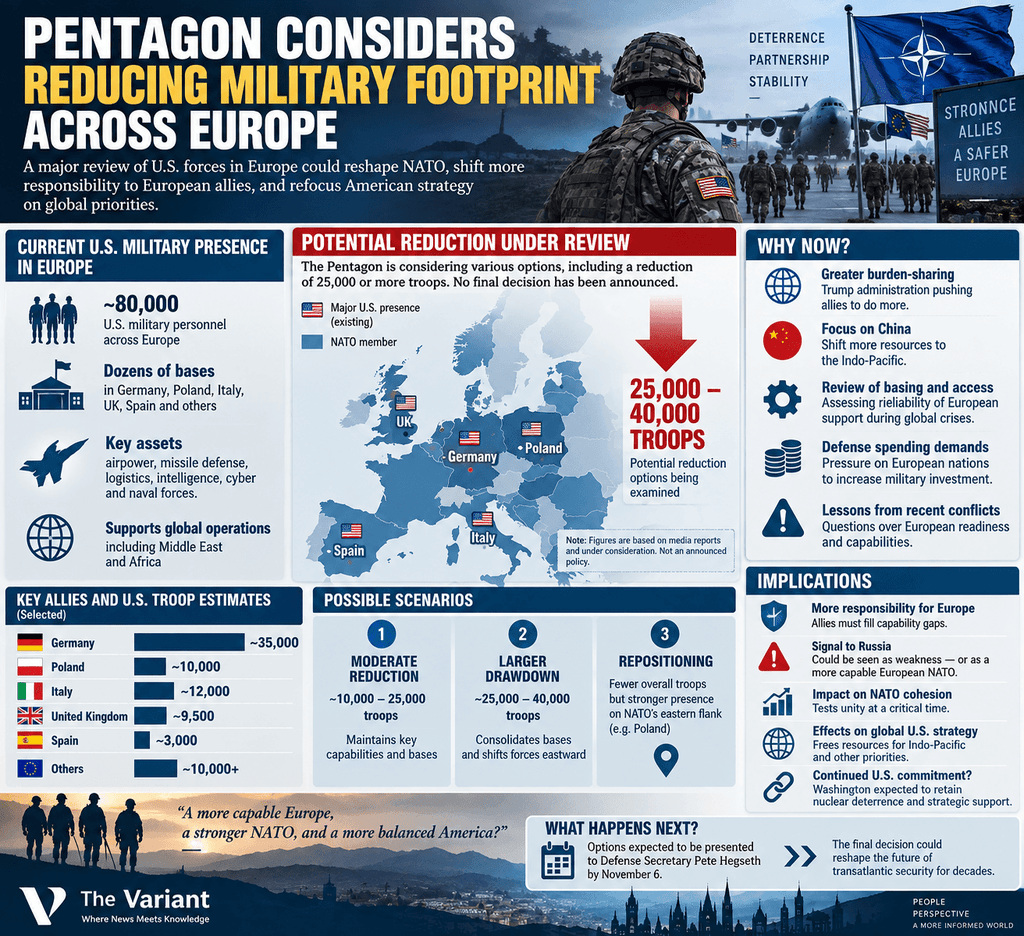
A six-month review ordered by Defense Secretary Pete Hegseth is examining U.S. troop levels, bases, access arrangements and military capabilities across Europe, with several options expected to reach him by November 6. About 80,000 U.S. military personnel remain deployed across Europe, but substantial reductions are among the possibilities being examined.
The crucial point is that no final decision on a large-scale withdrawal has yet been announced. The review is considering different force levels and dispositions rather than implementing a predetermined single plan.
Still, the exercise signals something larger than a routine Pentagon reshuffle: Washington is reconsidering how much of Europe’s conventional defense should continue to depend directly on American forces.
From American-Led NATO to “NATO 3.0”
The strategic concept emerging from Washington has been described by Pentagon policy chief Elbridge Colby as “NATO 3.0”: European allies would increasingly provide the conventional forces necessary to defend the continent, while the United States would remain an essential strategic backstop, particularly through nuclear deterrence and other high-end capabilities.
This distinction matters. A smaller American footprint would not necessarily mean Washington was abandoning NATO.
Instead, it could represent a transition from American-led European defense toward European-led defense supported by American strategic power.
That reflects two pressures inside U.S. strategy. President Donald Trump has repeatedly demanded greater burden-sharing from NATO members, while Pentagon strategists increasingly have to balance Europe against requirements in the Indo-Pacific and elsewhere.
The administration also argues that European governments with sophisticated economies and militaries should assume a larger share of their own conventional defense.
The question is whether Europe can make that transition quickly enough.
How Large Could the Reduction Be?
Recent reporting has discussed options involving substantial reductions, including proposals that could remove at least 25,000 personnel, while some reports have suggested options reaching approximately 40,000. These figures should be treated as proposals under consideration, not announced Pentagon policy.
The review is also broader than troop numbers.
According to Reuters, Pentagon planners are examining access, basing and over flight rights, along with cyber, space and intelligence infrastructure that supports U.S. global operations.
That makes the debate considerably more important than simply asking how many American soldiers will remain in Germany or Poland.
European bases are part of America’s wider global military architecture. Germany, Britain, Italy and Spain, among others, provide logistics, airfields, naval facilities, command infrastructure and support that can facilitate U.S. operations extending into the Middle East and Africa.
A poorly designed withdrawal could therefore reduce America’s ability to project power beyond Europe itself.
Russia Changes the Calculation
Russia remains the most obvious strategic complication.
A reduction in American forces could be interpreted in two very different ways. Washington can present it as evidence that European NATO members have matured sufficiently to defend themselves.
Moscow, however, would closely examine whether the withdrawal creates actual capability gaps along NATO’s eastern frontier.
The distinction between troop numbers and military capabilities is therefore critical.
Ten thousand personnel are not strategically interchangeable. Intelligence and surveillance aircraft, air-defense systems, logistics units, command structures, aerial-refueling aircraft and long-range strike capabilities can sometimes be more consequential than much larger formations of conventional troops.
An assessment cited by Stars and Stripes warned that European land forces are not yet fully capable of providing the conventional backbone NATO requires, suggesting that moving too rapidly could produce a period in which U.S. capabilities disappear faster than European replacements become operational.
This is arguably the greatest strategic risk of the Pentagon review: not withdrawal itself, but the speed and sequencing of withdrawal.
Eastern Europe Could Become More Important, Not Less
Another possibility is that America does not simply leave Europe but redistributes its remaining presence eastward.
That distinction is becoming increasingly visible.
Even while Washington considers reducing overall troop levels, Trump said this week that progress was being made toward establishing a new permanent U.S. Army base in Poland.
Poland has emerged as one of Washington’s most important defense partners on NATO’s eastern flank.
A future American posture could therefore involve fewer forces overall but greater concentration in strategically important locations.
Instead of maintaining a Cold War-style footprint centered heavily on Western Europe, Washington could prioritize Poland and other eastern-flank states while retaining crucial air, naval, intelligence and logistics infrastructure farther west.
That would represent repositioning as much as retrenchment.
The Iran Factor Has Complicated Washington’s Relationship with Europe
There is also a political dimension to the Pentagon review.
Hegseth has criticized NATO allies that Washington says did not sufficiently facilitate U.S. operations during the Iran conflict, including disputes involving basing and over flight access.
Pentagon questionnaires sent to allies have specifically asked about restrictions on American access, bases and airspace.
This introduces a potentially significant principle into American force planning: countries hosting U.S. forces may increasingly be assessed not simply according to geography or their contribution to NATO, but according to how reliably Washington can use facilities during crises outside Europe.
That could change America’s relationship with its European hosts.
For Washington, maintaining tens of thousands of personnel overseas becomes harder to justify if bases cannot reliably support broader U.S. operations.
For European governments, however, granting unrestricted access could draw them into conflicts their populations or governments do not support.
That tension will not disappear simply because defense spending rises.
China and the Indo-Pacific Remain in the Background
Behind the European debate lies another strategic calculation: China.
American military resources are finite. Aircraft, air-defense systems, submarines, intelligence platforms, logistics networks and personnel committed to Europe cannot simultaneously be concentrated in the Indo-Pacific.
Colby has long advocated greater U.S. strategic attention toward Asia, and the current review fits a broader argument that Europe should eventually become capable of handling most of its conventional defense while Washington concentrates additional resources on other theaters. Foreign Policy
Yet Europe cannot be neatly separated from Asia.
A major European conflict could force Washington to redirect assets from the Pacific, while instability in the Middle East can simultaneously increase demand for American forces operating through European bases. The Pentagon is therefore confronting a three-theater problem involving Europe, the Middle East and the Indo-Pacific.
That helps explain why Washington wants allies to carry more of the European conventional burden.
Europe Faces a Strategic Deadline
For European NATO members, Washington’s message is becoming increasingly difficult to ignore.
For decades, debates about European “strategic autonomy” were largely political.
The Pentagon review is turning them into military questions involving ammunition production, integrated air defense, logistics, intelligence, long-range fires, command-and-control and deployable ground forces.
If Europe develops those capabilities successfully, a smaller American footprint does not automatically mean a weaker NATO.
It could eventually produce a more balanced alliance in which Europe supplies substantially more conventional military power while America retains strategic capabilities and nuclear deterrence.
But if U.S. forces leave considerably faster than European militaries can replace the capabilities they provide, the transition could create vulnerabilities precisely when NATO continues to face serious security challenges.
The significance of the Pentagon review therefore extends beyond whether 25,000, 30,000 or 40,000 troops ultimately leave Europe.
The deeper issue is whether Washington is redefining the post-1945 transatlantic security bargain.
For generations, the underlying arrangement was relatively straightforward: America provided an extraordinary share of Europe’s military security while European allies provided territory, political partnership and progressively larger—but often still insufficient—defense contributions.
Washington is now pushing toward a different formula
Europe provides the backbone of Europe’s conventional defense; America provides critical strategic capabilities, nuclear deterrence and reinforcement when required.
Whether that produces a stronger NATO or a dangerous transitional gap will depend less on the headline number of American troops withdrawn than on which capabilities are removed, where the remaining forces are positioned, how quickly European militaries fill the gaps, and whether Washington can maintain credible deterrence during the transition.
For now, the Pentagon is still developing its options. But the review itself sends a clear strategic signal:
America’s military presence in Europe is no longer being treated as permanently fixed and European governments are increasingly being asked to prepare for an alliance in which they carry much more of the conventional military burden.
The Variant remains committed to delivering accurate, timely, and insightful coverage of the world’s most important stories.

