Rochester, NY: The Asia-Pacific Economic Cooperation (APEC) forum is intended to promote economic cooperation, regional integration and shared prosperity among its 21 member economies. Yet high-profile international gatherings often become arenas where geopolitical competition overshadows the official agenda.
The diplomatic attention surrounding the United States, Russia and China illustrates how the political significance of individual leaders can dominate a summit ostensibly devoted to multilateral cooperation.
For Japan, one of Asia’s most technologically advanced economies and a central pillar of the United States’ regional alliance system, such a shift in attention carries considerable symbolic weight.
Tokyo has long regarded itself as an indispensable participant in Asia-Pacific diplomacy. Nevertheless, when the world’s most powerful geopolitical actors occupy the center of international attention, even influential economic powers can find themselves struggling for visibility.
The suggestion that Japan’s prime minister was deliberately ignored by the host country requires careful examination.
A lower media profile does not necessarily establish a diplomatic snub. The distinction matters because ceremonial protocol, bilateral meetings, official statements and actual policy outcomes provide more reliable evidence of diplomatic treatment than television coverage or summit photographs alone.
Nevertheless, the broader question is significant: why do American and Russian presidents command exceptional attention at international gatherings, and what does their prominence reveal about the evolving balance of power in Asia?
China’s Diplomatic Priorities: Why Washington and Moscow Matter More
For Beijing, relations with Washington and Moscow represent two fundamentally different but equally consequential strategic challenges.
The United States remains China’s most important geopolitical competitor. Their relationship encompasses international trade, semiconductor technology, artificial intelligence, military competition, Taiwan, maritime security and the future of the international economic order.
Decisions reached between American and Chinese leaders can influence global financial markets, international supply chains and security calculations far beyond the Asia-Pacific.
Consequently, the presence of an American president at a major summit hosted by China carries extraordinary diplomatic significance.
Beijing has strong incentives to demonstrate that it can engage Washington at the highest level, even amid disagreements over trade restrictions, military deployments and regional influence.
Russia occupies a different position. Moscow is a major nuclear power, a permanent member of the United Nations Security Council and a significant supplier of energy and other strategic commodities.
Its relationship with China has acquired additional importance amid Russia’s confrontation with Western governments over Ukraine and the broader international sanctions regime.
For Beijing, engagement with Moscow offers strategic flexibility, energy security and opportunities to coordinate diplomatic positions against what both governments frequently describe as excessive Western influence.
However, China also has reasons to avoid appearing completely aligned with Russia. Its economic relationships with Europe, Japan and the United States remain critically important.
Beijing must therefore balance its strategic partnership with Moscow against the risks of deepening international economic confrontation.
This combination makes interactions involving American and Russian leaders particularly attractive to the international media and especially important to Chinese diplomatic calculations.
Why Japan Risks Being Overshadowed
Japan’s position in the regional order is fundamentally different from that of the United States or Russia.
Tokyo possesses substantial economic influence, advanced industrial capabilities, major international investments and extensive diplomatic relationships.
It is also a leading participant in regional economic cooperation and an important contributor to international development assistance.
Yet Japan’s postwar security architecture remains closely connected to Washington. The United States maintains military forces in Japan, and the bilateral security treaty forms a cornerstone of Tokyo’s defense policy.
This relationship provides Japan with significant strategic protection but also creates a perception that its security decisions are closely tied to American policy.
From Beijing’s perspective, direct engagement with Washington can therefore carry greater strategic importance than separate discussions with Tokyo, particularly on matters involving the military balance in East Asia.
Nevertheless, treating Japan merely as an extension of American foreign policy would be analytically misleading.
Japan maintains its own economic priorities, regional partnerships and diplomatic interests. Its influence over semiconductor supply chains, advanced manufacturing, maritime trade and investment makes it a major power in its own right.
The issue is not that Japan has become irrelevant. Rather, its influence is often expressed through economic institutions, technology and long-term partnerships, while American and Russian power is more visibly associated with military capabilities, geopolitical confrontation and international crisis management.
A Cold Reception for Sanae Takaichi: Symbolism and Diplomatic Reality
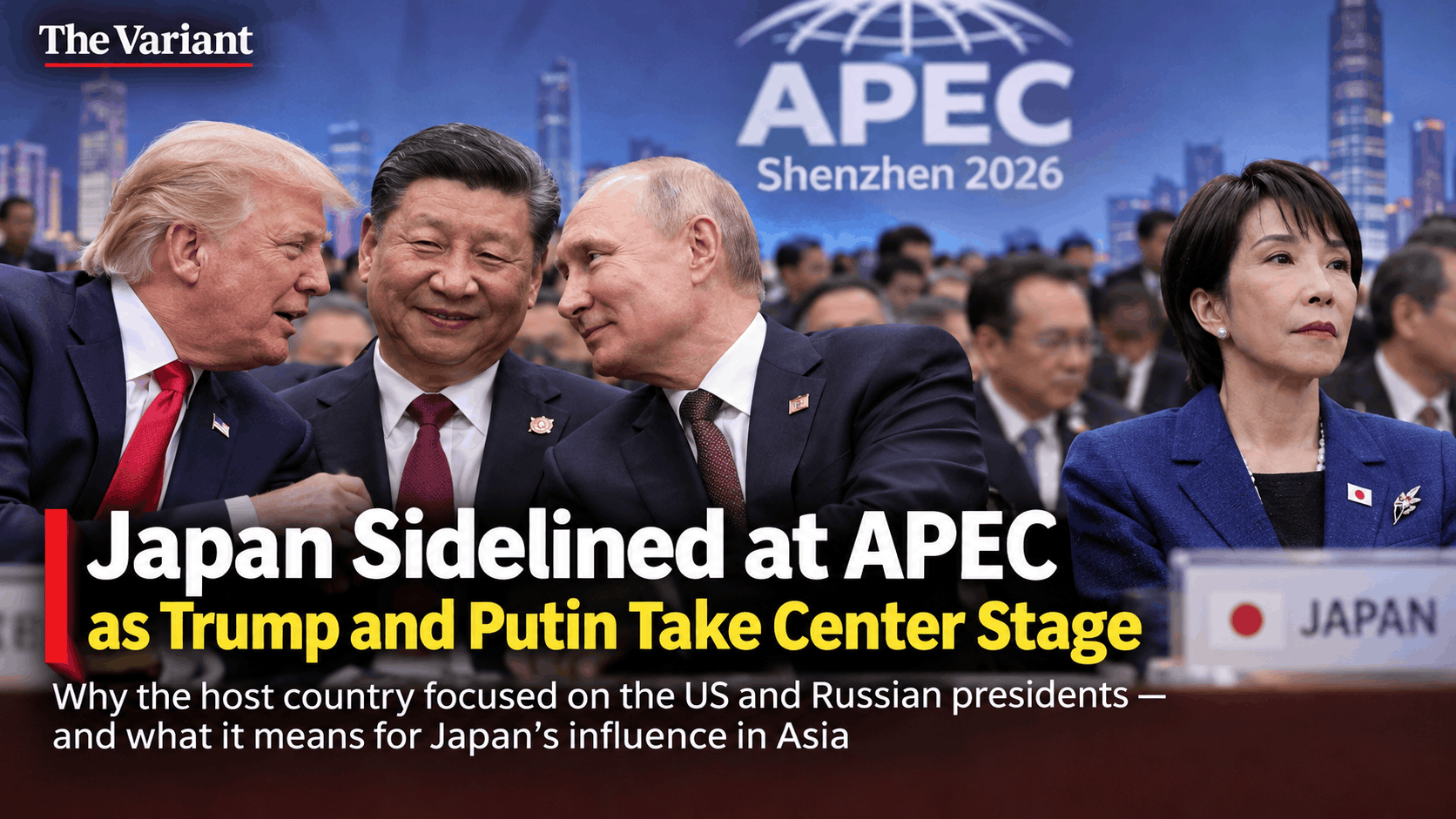
The experience of Japanese Prime Minister Sanae Takaichi at the Shenzhen summit provided a particularly revealing example of how diplomatic protocol can communicate political tension without an explicit confrontation.
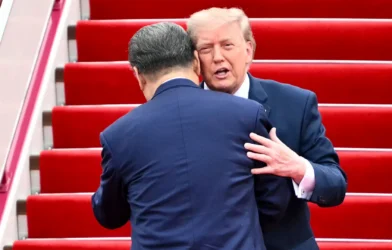
According to Reuters, Takaichi received a noticeably restrained welcome compared with the attention surrounding Trump.
Reports described the absence of young greeters carrying bouquets when her aircraft arrived, while the seating arrangement placed her seven seats away from Xi Jinping. Although Xi and Takaichi exchanged handshakes, they held no bilateral meeting to address their countries’ deteriorating relations.
These details attracted considerable attention in Japan, where diplomatic ceremony is closely scrutinized for indications of political respect and influence.
However, Japanese Chief Cabinet Secretary Minoru Kihara rejected the interpretation that Tokyo had been deliberately snubbed, maintaining that China had extended customary courtesies to the Japanese leader.
This official response is important because the absence of a particularly warm reception does not automatically establish a breach of diplomatic protocol.
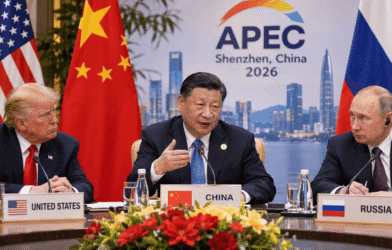
Nevertheless, the contrast was unmistakable. While Beijing presented the Trump-Xi-Putin meeting as an event of exceptional global importance, Japan’s leader struggled to secure comparable visibility.
The tensions surrounding Takaichi also reflected deeper disagreements between Beijing and Tokyo, particularly over Taiwan, regional security and Japan’s increasingly assertive defense posture.
China views Taiwan as a core sovereignty issue and strongly opposes foreign military involvement in a potential cross-strait conflict. Japan, meanwhile, considers peace and stability around Taiwan essential to its own security, given the island’s proximity to Japanese territory and the importance of regional maritime routes.
These competing security perceptions have contributed to deteriorating political trust.
Takaichi’s diplomatic isolation was not absolute. She held a roughly 30-minute meeting with Putin, raising concerns about a detained Japanese journalist and the treatment of Japanese corporate interests in Russia. She also participated in APEC discussions on economic resilience and the rules-based international trading system.
The contrast therefore lies not between participation and exclusion, but between formal diplomatic participation and the exceptional political attention reserved for the three major powers.
The Strategic Importance of Trump and Putin
The exceptional attention given to Trump and Putin was rooted in their countries’ ability to influence the international security environment.
The United States combines military reach, financial power, technological leadership and an extensive network of alliances. American decisions on tariffs, sanctions, defense commitments and advanced technology can rapidly affect governments and businesses across the world.
Russia’s global economic influence is considerably smaller than America’s, but its nuclear arsenal, permanent Security Council seat, energy resources and role in the Ukraine conflict give Moscow substantial geopolitical leverage.
Together with China, the United States and Russia possess the world’s three largest nuclear arsenals. Their first trilateral leaders’ meeting consequently carried significance beyond the immediate agenda of APEC.
The Shenzhen talks addressed nuclear risks and major international conflicts, although they produced limited progress toward resolving the most difficult disputes.
For China, hosting the encounter offered an opportunity to present Xi Jinping as a central figure in international diplomacy.
For Trump, the meeting provided a platform to demonstrate American leadership and pursue negotiations with major competitors. For Putin, participation reinforced Russia’s claim to a place among the world’s decisive geopolitical powers despite Western efforts to isolate Moscow.
The three governments had different objectives, but all benefited from the international visibility of the encounter.
That does not mean the interests of other APEC members were less legitimate. Rather, it illustrates an uncomfortable reality of international politics: countries capable of shaping military confrontations, nuclear stability and global economic rules often receive greater diplomatic attention than those whose influence is primarily economic or institutional.
Is China Sending Japan a Political Message?
The possibility that Beijing deliberately used diplomatic choreography to signal dissatisfaction with Tokyo deserves consideration, particularly given the broader deterioration in Sino-Japanese relations.
A restrained reception can serve several purposes. It may express displeasure without provoking a formal diplomatic incident, reinforce domestic political narratives or demonstrate that improved bilateral relations depend on changes in the other government’s policies.
However, attributing a specific intention to Chinese officials requires more than interpreting seating arrangements and ceremonial gestures.
An alternative explanation is that Beijing concentrated its limited diplomatic time and political resources on meetings it considered most consequential.
The unprecedented gathering of Trump, Xi and Putin was likely to dominate international coverage regardless of how Japan’s delegation was received.
Both explanations may contain elements of truth. China’s strategic prioritization of Washington and Moscow and its strained relations with Tokyo could have contributed simultaneously to the disparity in diplomatic attention.
For Japan, the more important question is whether this symbolic disadvantage translates into diminished influence over regional decisions.
The Danger of Great-Power Diplomacy for Japan and Other Asian Countries
The Shenzhen summit exposed a broader concern about an international order increasingly shaped by direct negotiations among major powers.
When Washington, Beijing and Moscow meet to discuss nuclear security, regional conflicts and global stability, governments outside those discussions may worry that decisions affecting their security could be negotiated without their participation.
Japan has particular reasons to be sensitive to this possibility.
Its national security depends heavily on the credibility of American defense commitments, while its economic prosperity remains closely linked to regional trade, including commerce with China.
A diplomatic arrangement between Washington and Beijing over regional security could have profound consequences for Tokyo. Similarly, any negotiations involving Russia and the future of European security would influence Japan’s broader strategic calculations.
Nevertheless, Japan retains important instruments of influence. Its partnerships with Australia, India, South Korea, Southeast Asian countries and European governments provide opportunities to shape regional policy independently of the three-power framework.
Indeed, Reuters reported that while Trump pursued discussions with Xi and Putin, Japan was looking toward other Asian partners, reflecting a wider effort among influential middle powers to diversify their diplomatic relationships.
This approach may become increasingly important if great-power negotiations continue to dominate major international gatherings.
APEC’s Deeper Contradiction: Economic Equality, Geopolitical Inequality
The events in Shenzhen also revealed a contradiction within APEC itself.
The organization is built around voluntary cooperation among 21 member economies, with an emphasis on trade, investment, innovation and shared economic growth.
Its institutional framework does not grant the United States, China or Russia exclusive authority over regional economic policy. Yet the attention surrounding the trilateral summit demonstrated that the political influence of individual members remains highly unequal.
The official 2026 APEC declaration emphasized openness, innovation, cooperation and the development of a resilient Asia-Pacific community. These objectives depend on the participation of economies large and small, rather than decisions made exclusively by a handful of powerful governments.
If summit diplomacy increasingly revolves around great-power bargaining, there is a risk that the economic priorities of other members will receive insufficient attention.
Japan’s experience illustrates this challenge particularly clearly. Despite its technological capabilities, financial influence and central position in regional supply chains, Tokyo could not command the same diplomatic spotlight as Washington or Moscow.
Yet diplomatic visibility and actual influence are not identical. Japan’s importance to advanced manufacturing, international investment and regional economic stability cannot be measured simply by the warmth of a ceremonial welcome.
Conclusion: A Diplomatic Warning, Not Japan’s Decline
The Shenzhen APEC summit offered a revealing snapshot of the changing international hierarchy.
The exceptional attention surrounding Donald Trump and Vladimir Putin reflected the strategic importance of the United States and Russia to China’s foreign policy, as well as the broader international consequences of their decisions.
For Japanese Prime Minister Sanae Takaichi, the summit was considerably less comfortable. Her restrained reception, limited interaction with Xi Jinping and relative absence from the summit’s defining diplomatic encounter highlighted the difficulties facing Tokyo amid deteriorating relations with Beijing.
Nevertheless, portraying the episode as proof that Japan has lost its regional importance would exaggerate the evidence.
Japan remains an essential economic and strategic actor. Its challenge is not a lack of power, but the growing difficulty of converting economic strength and regional partnerships into influence at a time when international diplomacy is increasingly dominated by security crises and great-power competition.
The lasting lesson of Shenzhen is that diplomatic attention does not necessarily follow economic importance. It follows strategic urgency, geopolitical leverage and the ability to influence international crises.
For Japan, the summit was therefore less a verdict on its standing than a warning about the diplomatic environment it must navigate.
For China, the event demonstrated its growing capacity to convene rival powers. And for the wider Asia-Pacific, it raised a fundamental question: can regional cooperation remain genuinely inclusive when the world’s most powerful countries increasingly dominate the conversation?
The answer will depend not on the choreography of a single summit, but on whether the region’s other influential governments can translate their economic and diplomatic partnerships into a meaningful voice in decisions shaping their collective future.