Doha, QA/Manama, BH: The escalating confrontation between Iran and the United States has once again placed the strategically important Gulf kingdom of Bahrain at the center of Middle Eastern security concerns.
Iranian drone attacks targeting American military installations, followed by Bahrain’s announcement that its air defenses successfully intercepted incoming threats, demonstrate how the broader conflict is increasingly exposing smaller Gulf States to military dangers arising from geopolitical rivalries beyond their direct control.
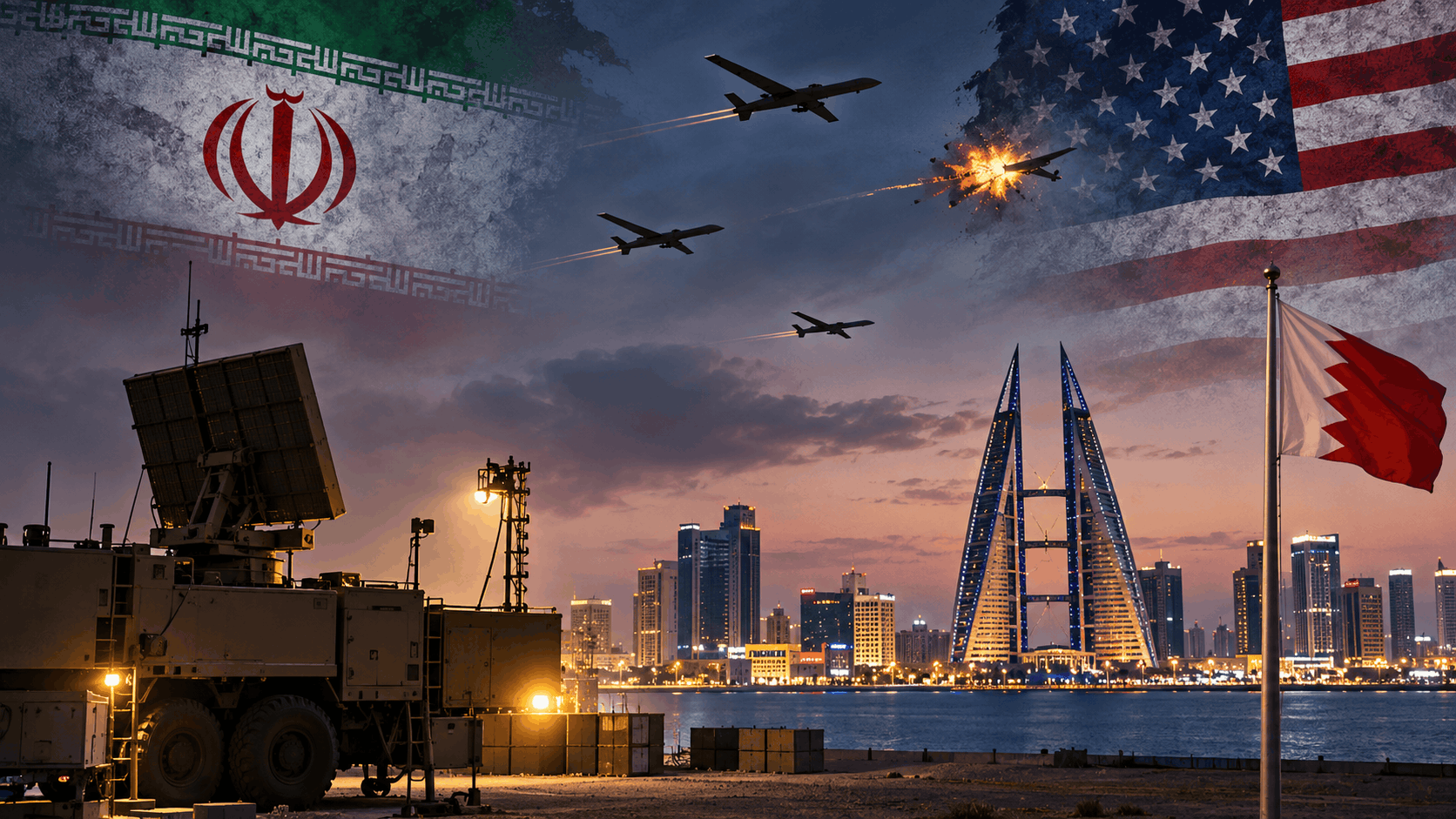
On November 15, Iran’s Islamic Revolutionary Guard Corps (IRGC) claimed responsibility for launching six drones against an American air-defense radar system at Bahrain’s Al-Riffa helicopter base.
Tehran described the operation as retaliation for what it characterized as hostile American military activities. Bahrain, however, announced that its defense systems had intercepted the aerial threats before they reached their intended targets.
The confrontation intensified on November 17 when Iran claimed another drone operation against a U.S. radar installation at Sheikh Isa Air Base.
U.S. Central Command rejected Iranian claims of a successful strike, maintaining that the incoming drones had been intercepted without damage to American military equipment or injuries to U.S. personnel.
These competing accounts illustrate an increasingly dangerous feature of the conflict: military operations are becoming instruments of political communication, with each side attempting to establish credibility, demonstrate resolve, and shape international perceptions.
Yet beyond the competing military narratives lies a more consequential question. Can the United States and Iran continue exchanging limited strikes without eventually triggering a confrontation neither side can fully control?
Why Bahrain Matters to Washington and Tehran
Bahrain’s strategic importance extends far beyond its geographical size. The kingdom hosts the headquarters of the United States Navy’s Fifth Fleet, a cornerstone of American military operations across the Persian Gulf, Arabian Sea, and surrounding maritime corridors.
This military presence provides Washington with an operational platform for protecting shipping routes, monitoring regional threats, supporting allied governments, and projecting naval power near Iranian territory.
For Tehran, American installations in Bahrain represent visible symbols of Washington’s military influence in the Gulf.
Targeting radar systems, surveillance infrastructure, and other defensive assets potentially allows Iran to challenge American operational capabilities without necessarily attempting a direct confrontation with major U.S. naval formations.
Such operations also carry an unmistakable political message: American military facilities throughout the Gulf remain within reach of Iranian retaliatory capabilities.
However, the distinction between targeting American assets and endangering Bahraini sovereignty is far less clear in practice. Any attack launched against military installations on Bahraini territory exposes the kingdom’s population, infrastructure, and economy to potential consequences.
Bahrain’s government has therefore condemned the attacks and rejected the use of its territory as a battleground for external rivalries.
Its position reflects a broader dilemma confronting Gulf governments: maintaining close security relationships with Washington while attempting to avoid becoming direct participants in an expanding regional war.
Iran’s Military Strategy: Deterrence through Limited Escalation
Iran’s reported drone operations appear consistent with a strategy of imposing costs on American regional deployments while avoiding, where possible, the consequences of an unrestricted military confrontation.
Drones provide Tehran with a relatively flexible means of applying pressure. Compared with more complex conventional military operations, unmanned systems can be launched in limited numbers, directed toward specific installations, and employed repeatedly to test defensive preparedness.
Even unsuccessful attacks may serve strategic objectives by forcing adversaries to maintain heightened readiness, expend defensive resources, and reconsider the vulnerability of regional facilities.
Nevertheless, such tactics carry substantial risks.
The destruction of a radar installation could undermine surveillance capabilities, but an intercepted drone may achieve little beyond demonstrating hostile intent. Moreover, repeated attacks increase the possibility of civilian casualties, miscalculation, or retaliatory operations against Iranian territory.
The distinction between deterrence and provocation becomes particularly difficult when military commanders operate under pressure to demonstrate success.
Tehran may regard these operations as necessary responses to American military activities. Washington, by contrast, considers attacks against its installations unacceptable threats to personnel and regional security.
Both positions reinforce a familiar cycle in which one government’s defensive justification becomes another government’s reason for retaliation.
Trump’s Claims of Victory Face a Complicated Military Reality
The renewed attacks also complicate President Donald Trump’s public characterization of the war against Iran.
Trump has repeatedly suggested that American military operations have substantially weakened Iran’s capabilities and that Washington has achieved its principal military objectives.
Yet the persistence of Iranian drone operations raises questions about the distinction between destroying major military infrastructure and eliminating an adversary’s ability to conduct limited retaliatory attacks.
A weakened military organization does not necessarily become strategically irrelevant.
Iran may have suffered extensive damage to conventional capabilities while retaining sufficient drones, launch systems, intelligence networks, and operational flexibility to threaten American installations.
The latest confrontation demonstrates why declarations of military victory do not automatically produce lasting political settlements.
On November 17, the United States carried out strikes against an IRGC missile site on Iran’s Qeshm Island, describing the operation as self-defense following Iranian aggression against American assets.
The development underscored the continuing potential for reciprocal military action even as Washington maintains that Iran has been substantially defeated.
For the Trump administration, the strategic challenge is increasingly political as well as military.
Sustaining regional deployments, defending allied installations, and responding to recurring attacks all require resources and continued public justification.
American taxpayers ultimately bear the financial burden of prolonged military readiness, even when Washington avoids launching a major new offensive.
The administration must therefore reconcile its claims of military success with the continuing necessity of expensive deterrence operations and the absence of a comprehensive diplomatic settlement.
Gulf Monarchies Confront an Uncomfortable Security Dilemma
Bahrain’s experience highlights the vulnerability of Gulf States that depend heavily on American security guarantees.
Saudi Arabia, Qatar, Kuwait, and other regional governments maintain important defense relationships with Washington, but their economic interests depend equally on regional stability and uninterrupted commercial activity.
The November attacks prompted condemnation from Saudi Arabia, Qatar, Jordan, and Egypt, reflecting widespread concern that military operations against Gulf territory threaten regional sovereignty and security.
However, diplomatic solidarity does not eliminate the underlying strategic dilemma.
Gulf governments must calculate whether closer military coordination with Washington strengthens their security or increases their exposure to Iranian retaliation.
Iran, meanwhile, risks alienating neighboring states whose cooperation could prove essential to any eventual diplomatic settlement.
This contradiction is particularly significant because regional stability cannot be achieved solely through military superiority. It also requires arrangements that reduce the incentives for cross-border attacks and establish credible mechanisms for resolving disputes.
The Strait of Hormuz and the Economic Consequences of Escalation
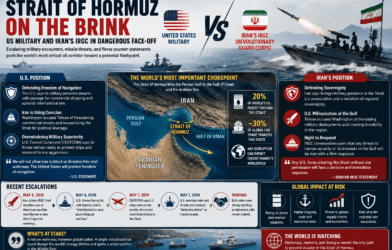
The confrontation in Bahrain cannot be separated from growing insecurity around the Strait of Hormuz, one of the world’s most strategically significant maritime corridors.
Iranian claims involving attacks on commercial vessels and naval mines have heightened uncertainty surrounding shipping operations, although several reported incidents remain independently unverified.
American officials maintain that designated southern shipping lanes have been cleared of mines, while Iranian authorities continue to challenge maritime movements they consider unauthorized.
According to CBS News reporting on November 17, oil prices remained approximately 40 percent above their prewar levels amid persistent disruptions and security concerns.
The economic implications extend beyond the Gulf.
Higher maritime insurance premiums, shipping delays, and uncertainty surrounding energy supplies can increase transportation and production costs internationally.
These pressures may eventually affect fuel prices, consumer goods, industrial activity, and household budgets.
For the United States, such consequences create a direct connection between Middle Eastern military decisions and domestic economic concerns.
A prolonged confrontation could therefore undermine the economic benefits that Washington hopes to secure from military success.
For Gulf economies, the danger is equally substantial. Governments seeking foreign investment, infrastructure development, tourism growth, and economic diversification cannot easily separate those ambitions from the security of their surrounding maritime environment.
Diplomacy Remains the Missing Element
Despite repeated military exchanges, diplomacy remains the most plausible route toward preventing a broader regional confrontation.
Reports of discussions involving Iran and Oman over maritime security suggest that limited channels for engagement remain available.
Nevertheless, negotiations over the larger conflict have struggled to overcome fundamental disagreements concerning Iran’s nuclear activities, American military operations, sanctions, and the conditions for a durable ceasefire.
Washington wants credible assurances that Iranian military and nuclear capabilities will not threaten American interests or regional allies.
Tehran seeks relief from military and economic pressure while resisting arrangements it regards as violations of its sovereignty.
Neither objective can be fully secured through intermittent drone attacks or retaliatory airstrikes.
A sustainable settlement would require enforceable security commitments, credible monitoring mechanisms, and regional diplomatic participation.
Without these elements, even temporary military pauses risk becoming intervals between renewed confrontations.
A Dangerous Test of Regional Stability
Bahrain’s interception of Iranian drones may represent an immediate defensive success, but it should not be mistaken for evidence that the broader crisis is approaching resolution.
The attacks demonstrate that Iran retains some capacity to challenge American military interests, while the subsequent U.S. response confirms Washington’s willingness to employ force when its regional assets are threatened.
For Bahrain, the central concern is preserving national sovereignty and civilian security amid a confrontation between more powerful adversaries.
For Washington, the challenge is translating military superiority into a stable political outcome. For Tehran, it is determining whether continued retaliation strengthens its bargaining position or deepens its diplomatic and military isolation.
Ultimately, the greatest danger is not necessarily a deliberate decision by either government to initiate another major war.
It is the possibility that repeated limited attacks, misinterpreted signals, and increasingly forceful retaliation will produce an escalation that neither side originally intended.
The lesson emerging from Bahrain is that military interception can prevent immediate destruction, but only effective diplomacy can prevent the next attack. Until Washington and Tehran establish a credible path toward de-escalation, the Gulf will remain vulnerable to a conflict whose consequences extend far beyond the battlefield.