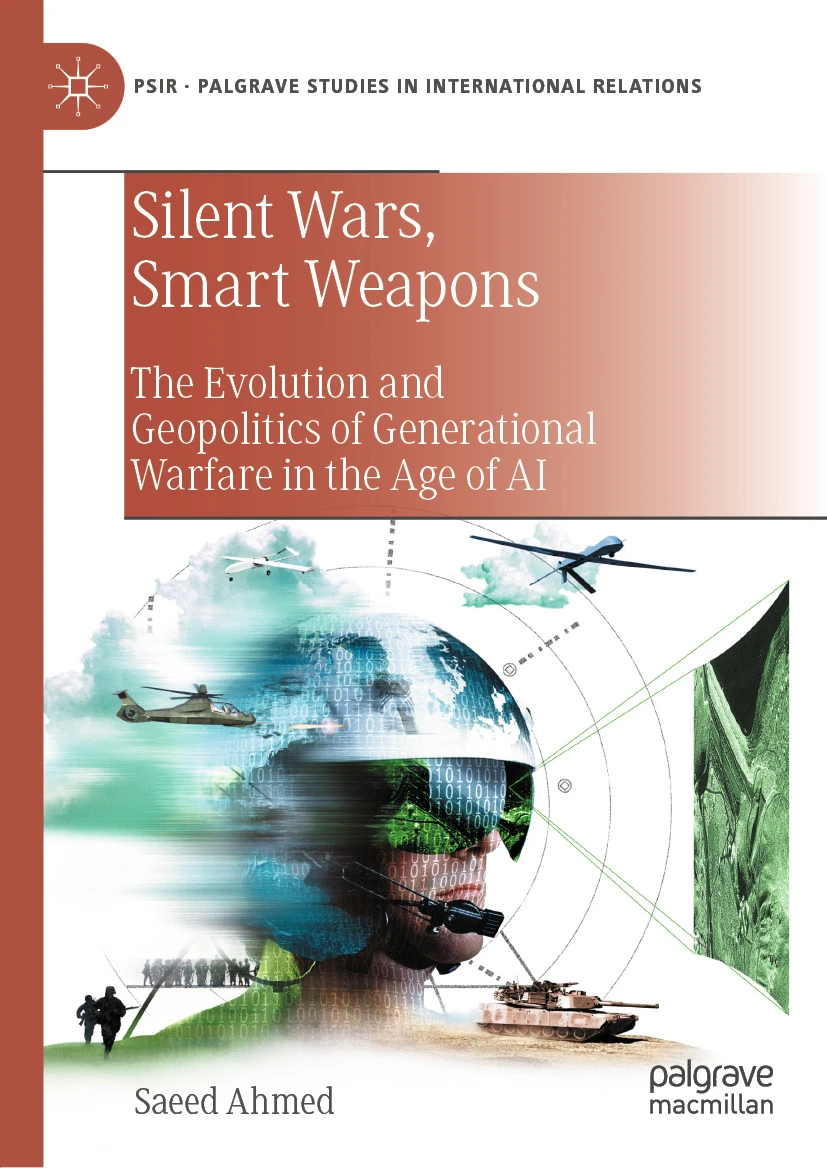
Book: Silent Wars, Smart Weapons: The Evolution and Geopolitics of Generational Warfare in the Age of AI
Author: Saeed Ahmed
Publisher: Palgrave Macmillan (2026)
Series: Palgrave Studies in International Relations
Review: The Variant | Where News Meets Knowledge
Rochester, NY: The future of warfare may not be defined by the thunder of artillery, the deployment of fighter jets or the movement of armies across international borders.
Instead, the next decisive confrontation could unfold silently through artificial intelligence, digital networks, psychological manipulation and the systematic control of information.
This unsettling possibility lies at the heart of Saeed Ahmed’s Silent Wars, Smart Weapons, and an ambitious examination of how warfare is evolving beyond conventional battlefields into the domains of human cognition, technological infrastructure and political legitimacy.
Across thirteen chapters, Ahmed traces the transformation of military conflict from the Napoleonic era to the emerging age of autonomous systems and quantum technologies.
His central argument is both provocative and timely: the struggle for global dominance is increasingly becoming a contest over who controls information, shapes perceptions and influences decisions.
Rather than treating artificial intelligence merely as another technological advancement, Ahmed places it within a broader geopolitical transformation that challenges traditional understandings of sovereignty, security and international power.
From Conventional Battlefields to Cognitive Warfare
One of the book’s strongest contributions is its historical examination of six generations of warfare.
Ahmed begins with the disciplined armies and state-centered conflicts of the first generation, progressing through industrialized warfare, mechanized military operations and the rise of asymmetric conflicts.
The fourth generation marks a significant departure from conventional military thinking. Conflicts in Vietnam and Afghanistan demonstrate that overwhelming military strength does not necessarily guarantee political victory.
Public legitimacy, ideological commitment and popular resistance can undermine even the most technologically advanced military forces.
The fifth generation shifts the battlefield toward information warfare, cyber operations, digital propaganda and the manipulation of public opinion.
However, Ahmed’s most compelling argument emerges in his examination of sixth-generation warfare, where artificial intelligence and cognitive systems could influence not only what people believe but also how they interpret reality and make decisions.
In this emerging environment, warfare may increasingly target the mechanisms of human judgment itself.
The implications are profound. Military superiority could become inseparable from the ability to manipulate information environments, anticipate political behavior and influence strategic decisions before conventional confrontation even begins.
America, China and Russia: Three Competing Models of Global Power
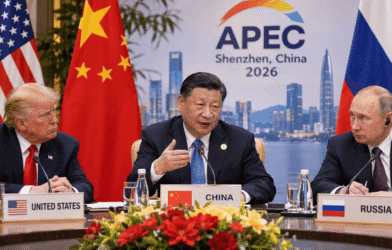
Ahmed’s comparative examination of the United States, China and Russia provides one of the book’s most engaging geopolitical dimensions.
The United States represents a model in which conventional military superiority increasingly operates alongside technological dominance.
Artificial intelligence, cloud computing, financial networks and privately controlled digital platforms have become important components of American global influence.
Ahmed raises an especially relevant question: when critical technological infrastructure is controlled by private corporations, how should governments define the boundaries between corporate influence and national sovereignty?
China presents a different strategic approach. Through its doctrine of the Three Warfares—psychological, public-opinion and legal warfare—Beijing seeks to influence geopolitical environments through institutional relationships, economic integration and information management.
Ahmed connects China’s expanding digital infrastructure and technological ambitions to a longer-term strategy of embedding influence within international systems.
Russia, meanwhile, emerges as a practitioner of strategic ambiguity, reflexive control and information operations. Its approach emphasizes exploiting uncertainty, shaping adversaries’ perceptions and complicating political decision-making.
The comparison reveals an important reality: contemporary great-power rivalry is no longer exclusively about military arsenals.
It increasingly involves competing systems of technological influence, institutional dependence and information control.
When Technology Becomes an Instrument of Geopolitical Control
Perhaps the book’s most significant contribution lies in its examination of the relationship between technological infrastructure and political sovereignty.
Data centers, artificial intelligence platforms, financial networks and communication systems are commonly presented as engines of economic progress. Ahmed challenges readers to recognize their potential strategic implications.
A country may possess territorial sovereignty while remaining dependent on foreign-controlled digital infrastructure for critical economic, administrative and communication functions.
Such dependencies can create vulnerabilities that traditional military assessments fail to capture.
Ahmed’s analysis suggests that technological interdependence may become a source of geopolitical coercion when access to essential systems can be restricted, monitored or manipulated.
For developing nations in particular, this argument raises important questions about digital independence, national security and the concentration of technological power among a limited number of governments and corporations.
The book therefore expands the definition of national security beyond military preparedness to include technological resilience, institutional autonomy and the protection of information systems.
Artificial Intelligence and the Quantum Frontier
Ahmed’s exploration of emerging technologies takes the discussion beyond present-day cyberwarfare and autonomous military systems.
Artificial intelligence, predictive analytics and machine-assisted decision-making could fundamentally alter the speed and character of strategic competition.
The book also examines quantum computing, secure communication, advanced sensing and cryptographic developments as potentially transformative forces in international security.
These technologies could influence intelligence gathering, strategic verification and deterrence.
Yet Ahmed’s discussion also highlights an important uncertainty: technological possibilities should not automatically be mistaken for established military capabilities.
The future geopolitical consequences of quantum technologies remain difficult to predict.
This distinction strengthens the book’s analytical credibility by leaving room for further investigation rather than presenting every emerging technology as an inevitable revolution.
The broader concern remains compelling. If technological decision-making advances faster than political institutions can regulate it, the international system may face increasingly serious challenges involving accountability, escalation and strategic stability.
A Bold Theoretical Framework — With Questions worth Debating
Beyond its geopolitical analysis, Silent Wars, Smart Weapons attempts to establish a broader intellectual framework for understanding modern conflict.
Ahmed engages with realism, idealism, constructivism and hegemonic stability theory while introducing his proposed Artificial Intelligence and Cognitive Systems Theory.
His Generational War Atlas and accompanying Analytical Translation Framework seek to connect historical developments, theoretical arguments and comparative indicators.
This interdisciplinary approach is one of the book’s strengths, allowing military history, political science, technology and moral philosophy to inform a common analysis.
Nevertheless, the framework invites legitimate criticism.
Warfare rarely evolves through clearly separated historical stages. Conventional military operations, insurgencies, cyber attacks and information manipulation frequently occur simultaneously.
Similarly, predictions about increasingly autonomous cognitive systems require careful empirical examination.
At times, the book’s extensive theoretical vocabulary may also challenge readers without an academic background in international relations or strategic studies.
These limitations do not undermine its central contribution. Rather, they demonstrate the difficulty of constructing a comprehensive framework for technologies and conflicts that are still evolving.
The book is most persuasive when its theoretical ambitions are treated as propositions for further research rather than definitive predictions about the future.
The Human Cost of Intelligent Warfare
Despite its technological focus, Ahmed’s most important questions concern human freedom, responsibility and accountability.
If algorithms increasingly determine which information citizens’ encounter, how can societies protect independent judgment?
If artificial intelligence influences military decisions, who bears responsibility when those decisions produce devastating consequences?
And if sophisticated information operations manipulate political behavior without openly identifiable acts of aggression, how should international law respond?
Ahmed addresses these concerns through a normative approach he calls Epistemic Humanism, emphasizing human dignity, cognitive freedom, moral responsibility and institutional accountability.
His discussion of peace engineering proposes stronger ethical safeguards, technological oversight, institutional auditing and international cooperation.
These proposals reflect an essential recognition: technological advancement without meaningful human oversight may create more sophisticated mechanisms of domination rather than a safer international order.
The challenge is therefore not simply to develop more intelligent systems, but to ensure that human judgment remains central to their governance.
Why This Book Deserves Attention
Silent Wars, Smart Weapons arrives at a time when artificial intelligence, cyber operations and technological competition are reshaping global security debates.
Its relevance extends well beyond military institutions.
For policymakers, it raises urgent questions about digital sovereignty, strategic dependence and institutional resilience.
For scholars, it offers an interdisciplinary framework that invites further empirical examination.
For journalists, it highlights a particularly troubling transformation: information is no longer merely the medium through which wars are reported; it can itself become an instrument of conflict.
The book’s greatest achievement is its ability to connect technological innovation with deeper questions about political power, legitimacy and human autonomy.
Rather than celebrating the emergence of increasingly sophisticated weapons, Ahmed challenges readers to consider the structures of influence those technologies create.
The Variant’s Verdict: A Timely Warning about the Future of Power
Saeed Ahmed’s Silent Wars, Smart Weapons is an intellectually ambitious and thought-provoking contribution to contemporary debates about warfare, geopolitics and technological transformation.
Its historical breadth, comparative analysis of major powers and examination of cognitive warfare make it particularly valuable for readers seeking to understand the changing architecture of international security.
Although some of its futuristic propositions remain speculative and its theoretical density occasionally limits accessibility, the book succeeds in raising questions that military strategists, political leaders and democratic societies cannot afford to ignore.
Its central warning is clear: future conflicts may be decided not only by those who possess the most destructive weapons, but also by those who control the systems through which societies receive information, interpret threats and make choices.
In a world increasingly shaped by algorithms, digital dependencies and contested narratives, the struggle for power may ultimately become a struggle over reality itself.
And that may be the most consequential battlefield of the twenty-first century.
Editorial note: This review has been rewritten and condensed from the supplied manuscript for publication in The Variant. Its assessments reflect the supplied review rather than an independent reading of the complete published book.