


Brussels, BE/Rochester, NY: Russia’s war against Ukraine has transformed European air defence from a specialist military concern into one of the continent’s most urgent strategic priorities.
Ballistic missiles launched against Kyiv, Kharkiv, Odesa and Ukraine’s energy network have demonstrated that even countries equipped with modern Western weapons can remain dangerously exposed when interceptor stocks are limited, radar coverage is uneven and the attacker can launch missiles, cruise weapons and drones simultaneously.
Europe’s answer is beginning to take shape through a new Integrated Anti-Ballistic Missile Coalition, established in Paris on July 13, 2026.
Ukraine joined Denmark, France, Germany, Italy, the Netherlands, Norway, Spain, Sweden and the United Kingdom in pledging to develop a shared European capability against ballistic missiles.
The initiative is explicitly defensive and is intended to combine Ukraine’s wartime experience with Europe’s industrial, technological and financial resources.
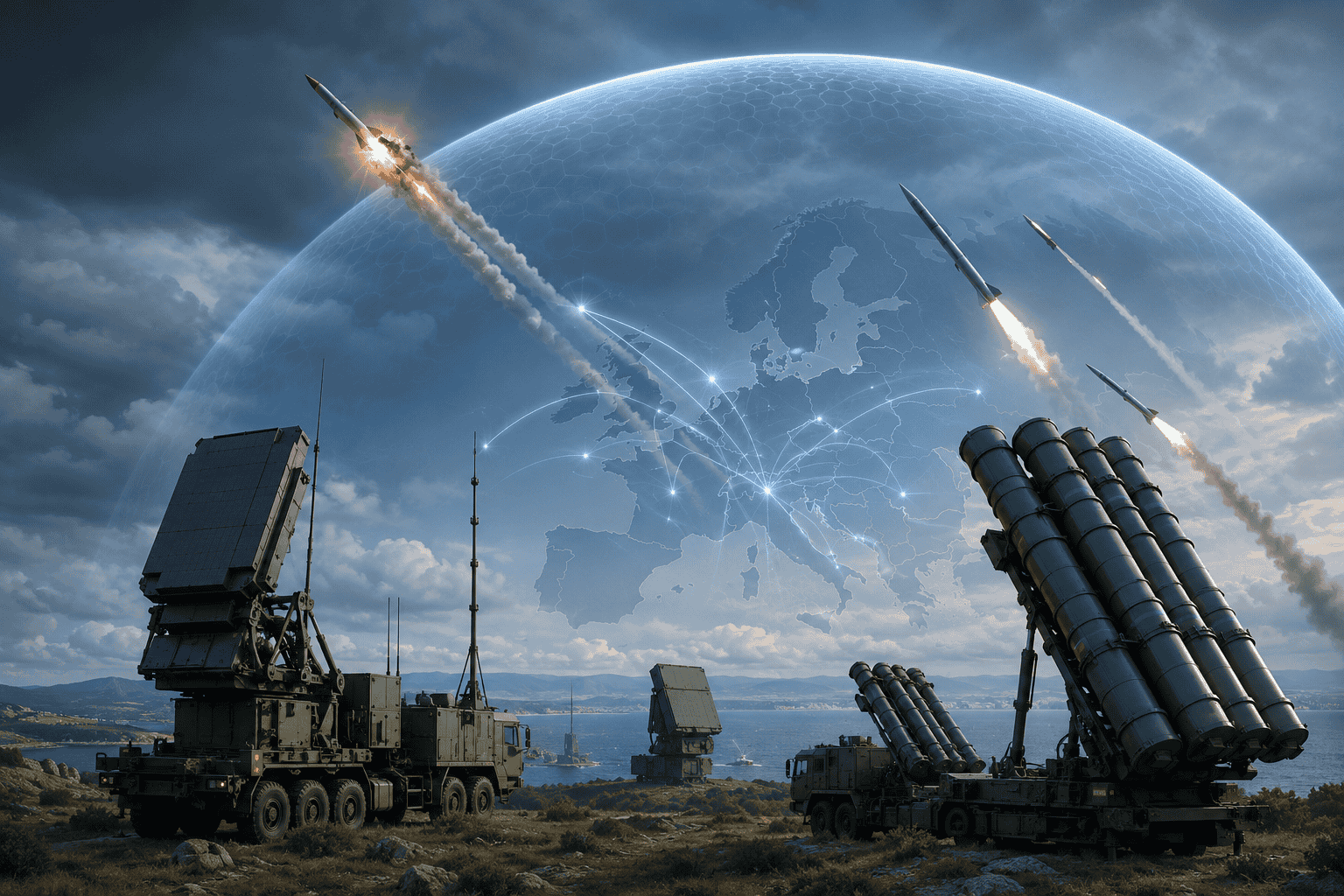
However, the phrase “European missile shield” can be misleading. Europe is not building a single dome comparable to a science-fiction force field.
What is emerging a layered network of radars, command centres, launchers and different types of interceptors designed to engage threats at different speeds, altitudes and stages of flight.
At the centre of the immediate plan is a Ukrainian-led programme called FREYJA. Alongside it, major European defence companies have announced a longer-term project, Bliksem EXO, designed to intercept more advanced missiles outside the atmosphere.
Together, the two projects reveal Europe’s emerging strategy: develop a relatively affordable battlefield interceptor quickly while simultaneously constructing an upper layer capable of confronting medium-range, intermediate-range and potentially hypersonic threats.
Why Russian ballistic missiles changed Europe’s calculations
Ballistic missiles are fundamentally more difficult to stop than drones or conventional cruise missiles. After launch, they accelerate rapidly, climb to high altitude and descend toward their targets at several times the speed of sound.
The defending system has only a short period to detect the launch, calculate the trajectory, identify the intended target and fire an interceptor.
Russia’s missile campaign against Ukraine has included Iskander-type ballistic missiles, air-launched weapons and increasingly sophisticated systems intended to complicate interception.
Moscow has also combined ballistic missiles with cruise missiles, decoys and large drone formations, attempting to overwhelm Ukrainian radar operators and exhaust expensive Western interceptors.
Ukraine has shown that ballistic missiles can be intercepted, particularly with the American-made Patriot system.
On July 14, Ukrainian authorities reported shooting down five Russian ballistic missiles during an overnight attack. Yet Patriot batteries and their interceptor missiles remain scarce, expensive and dependent on American production and political approval.
This dependence has created a strategic vulnerability for both Ukraine and Europe. A Patriot interceptor can cost several million dollars, while the number produced annually remains limited relative to the scale of wartime demand.
European NATO countries have placed more than $50 billion in air-defence orders since Russia’s 2022 invasion, but procurement has not yet produced the interceptor depth needed for a prolonged high-intensity conflict.
The war has therefore exposed two related problems. Ukraine needs far more interceptors immediately, while Europe needs the industrial capacity to defend itself without relying almost entirely on the United States.
FREYJA: Ukraine’s attempt to build a cheaper Patriot alternative
The Paris coalition will initially focus on FREYJA, an anti-ballistic missile programme proposed by Ukraine.
President Volodymyr Zelenskyy described the initiative as a coordinated political, governmental and industrial project capable of producing both the defence system and its interceptor missiles at scale.
The concept reportedly centres on the Ukrainian-developed FP-7.X interceptor, associated with the defence company Fire Point.
Available technical reporting suggests that it is intended to engage ballistic targets at an altitude of roughly 15 miles, or about 24 kilometers.
Ukraine is seeking European assistance with components including seekers, guidance, radar integration, propulsion, command-and-control software and mass production.
Patriot was designed as a high-performance, sophisticated system built under strict American supply chains. FREYJA is being presented as a weapon shaped by Ukraine’s wartime reality: it must be relatively affordable, mobile, easier to manufacture in larger numbers and capable of being upgraded rapidly in response to Russian countermeasures.
Ukraine has repeatedly demonstrated its ability to compress weapons-development cycles.
Battlefield feedback can move directly from air-defence crews to engineers, allowing software, sensors and guidance algorithms to be modified faster than under conventional peacetime procurement structures.
The coalition’s stated ambition is to develop a lower-cost, mass-producible capability within approximately a year. That timetable should be treated as an aspiration rather than a guarantee.
Developing a missile that can fly is much easier than creating a complete, dependable anti-ballistic system capable of identifying targets, resisting electronic warfare and achieving repeated interceptions under combat conditions.
An anti-ballistic battery requires much more than the interceptor itself. It needs long-range surveillance radar, fire-control radar, launch vehicles, secure communications, battle-management software and a network capable of receiving early-warning information from satellites and allied sensors.
Nevertheless, even a system with lower performance than Patriot could be strategically valuable if Europe can manufacture it in sufficient quantities. Missile defence is ultimately an economic contest.
A technically excellent interceptor available only in small numbers cannot protect dozens of cities, airfields, ports and power stations.
Bliksem EXO: Europe’s proposed upper defensive layer
Only one day after the coalition was announced, several major European aerospace and defence groups unveiled a complementary project known as Bliksem EXO.
The consortium includes Airbus Defence and Space, MBDA Deutschland, Safran, Thales and the Dutch-based aerospace company Destinus.
It plans to develop a sovereign European interceptor capable of destroying medium- and intermediate-range ballistic missiles outside the Earth’s atmosphere.
Bliksem EXO would use a “hit-to-kill” approach. Instead of relying primarily on an explosive warhead, the interceptor would collide directly with the incoming missile or warhead at extremely high velocity.
The energy generated by the impact would destroy the target in space before it descended toward European territory.
Under the proposed division of labour, Destinus would lead development of the kill vehicle, MBDA would work on the booster, launcher and missile canister, and Safran would provide seeker technology, while Airbus and Thales would contribute radar, command-and-control and system-integration capabilities.
Initial engineering work is expected to begin in August 2026, with a space-based test of the kill vehicle targeted for 2027.
The project would address one of Europe’s most serious weaknesses: limited protection against missiles travelling above the engagement envelope of systems such as Patriot or SAMP/T.
Yet Bliksem EXO remains an industrial proposal rather than a funded weapons programme. The participating companies have signed a letter of intent, but governments have not yet made binding procurement or financing commitments.
How the layered shield could work
Europe’s future missile shield would probably contain several interconnected defensive levels.
The lower layer would deal primarily with drones, aircraft and some cruise missiles, using systems such as IRIS-T, NASAMS, shorter-range missiles, guns and electronic warfare. The middle layer would include Patriot and the Franco-Italian SAMP/T family, capable of engaging aircraft, cruise missiles and certain short-range ballistic missiles.
FREYJA would attempt to expand this middle ballistic-defence layer by providing larger numbers of lower-cost interceptors. The next-generation SAMP/T-NG, equipped with upgraded radars and Aster interceptors, would supply another European-controlled capability against faster and more demanding targets.
Bliksem EXO would occupy the upper layer, attempting to destroy missiles outside the atmosphere before they enter their terminal descent.
European countries would then connect these weapons through NATO’s command-and-control structure, shared radar networks, satellite warning systems and national air-defence centres.
This architecture would not replace NATO’s existing ballistic-missile defence programme. NATO says its objective is to provide coverage and protection for European Allied populations, territory and forces against the growing ballistic-missile threat.
Any credible new European system would therefore need to operate within NATO’s Integrated Air and Missile Defence network.
It would also overlap with the German-led European Sky Shield Initiative, created in 2022 to coordinate the acquisition of air- and missile-defence systems among participating European countries. The new coalition differs in one important respect: it places joint development and European production—rather than primarily coordinated purchasing—at the centre of the plan.
Ukraine is becoming a defence laboratory for Europe
The initiative represents a notable reversal in the traditional relationship between Ukraine and its Western supporters.
For much of the war, Europe supplied weapons while Ukraine provided manpower and battlefield intelligence. Under FREYJA, Ukraine is offering Europe something more strategic: combat-tested engineering knowledge.
Ukrainian forces have accumulated extensive experience in distinguishing real missiles from decoys, repositioning batteries to avoid Russian attacks, integrating Western and Soviet-era sensors, operating under electronic warfare and managing scarce interceptor stocks.
That experience cannot be reproduced fully through exercises or simulations. A European-designed system tested in Ukraine would face real maneuvering missiles, saturation attacks, electronic interference and rapidly changing Russian tactics.
Europe may therefore use Ukraine not only as the first customer but as the programme’s primary operational testing ground.
This arrangement could accelerate development, although it also creates ethical and strategic questions. An immature system deployed during wartime could fail against live attacks, while technical defects could have immediate consequences for civilians.
Political and industrial rivalries remain a threat
Europe has a long history of creating multiple competing defence programmes rather than consolidating demand behind a common design.
France traditionally favours European strategic autonomy and weapons built by European companies.
Germany has often prioritised weapons that can be acquired rapidly, including American and Israeli systems. Eastern European governments tend to favour close integration with the United States because they regard the American security guarantee as indispensable.
The new coalition attempts to bridge those differences through technological openness and trusted industrial partnerships. But governments will still need to agree on financing, intellectual-property rights, production locations, export controls, operational authority and the distribution of contracts.
There is also the question of who would command the shield during a crisis. Missile defence operates within seconds. There is little time for political consultation once radar detects an incoming threat.
Europe will require predetermined rules governing which sensors provide warning, which battery fires, which country pays for the interceptor and which authorities can authorize engagement.
Without unified command-and-control, a collection of advanced national systems could still leave dangerous gaps. For ongoing coverage and detailed analysis of international affairs, visit The Variant regularly for the latest updates.


