


Courtesy: Reporting Contribution by Ghulam Murtaza [A Senior Journalist I Islamabad, Pakistan]
Rochester, NY/Islamabad, PK: Field Marshal Syed Asim Munir’s two-day official visit to Türkiye was more than a routine exchange between two traditionally friendly militaries. His meeting with Turkish President Recep Tayyip Erdoğan, alongside engagements with Türkiye’s defence and military leadership, took place at a moment of exceptional strategic pressure across the Middle East.
The United States-Iran conflict, insecurity surrounding the Strait of Hormuz, the risk of wider regional escalation and the emergence of Pakistan as an intermediary between Washington and Tehran formed the broader geopolitical background to the visit.
At the same time, Islamabad and Ankara have been expanding a defence relationship that already covers naval shipbuilding, military training, exercises, intelligence coordination and defence technology.
Official statements described the agenda in measured terms: regional security, bilateral cooperation and matters of mutual interest. No publicly released communiqué confirmed that Munir carried a specific American or Iranian message to Erdoğan.
Nevertheless, the timing, the presence of Türkiye’s intelligence chief at the presidential meeting and Munir’s recent involvement in US-Iran diplomacy make it reasonable to interpret the visit as part of a wider Pakistani effort to coordinate with influential regional capitals while reinforcing military ties.
A Carefully Timed Meeting at Ankara Airport
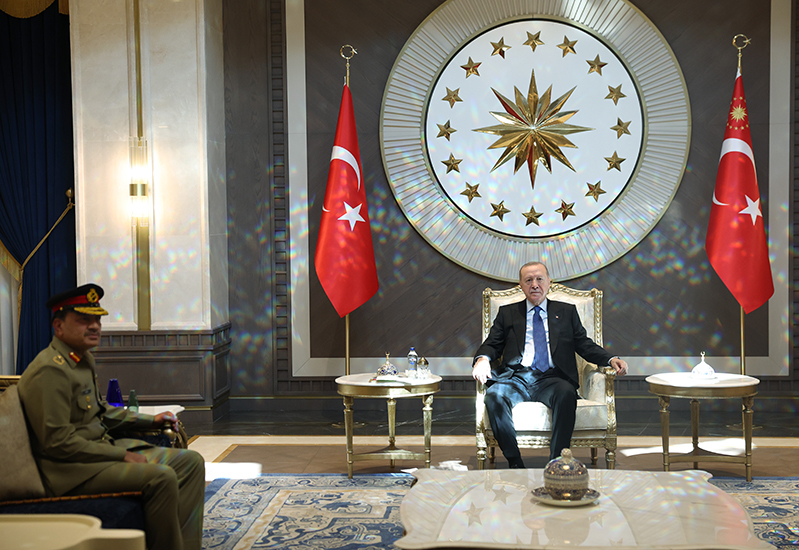
President Erdoğan received Field Marshal Munir at Ankara Airport on July 14 as the Turkish leader was preparing to leave for an official visit to Qatar.
Munir’s visit had begun the previous day and was scheduled to last two days. The airport setting may have been unusual, but the composition of the Turkish delegation gave the encounter considerable strategic importance.
Türkiye’s Vice President Cevdet Yılmaz, Chief of the General Staff General Selçuk Bayraktaroğlu and National Intelligence Organization director İbrahim Kalın attended the closed-door meeting. Their presence brought together Türkiye’s political executive, armed forces and intelligence establishment in a single engagement with Pakistan’s most powerful military official.
Pakistan’s military later said Munir met Erdoğan and Turkish Defence Minister Yaşar Güler to discuss regional security and matters of mutual interest. The Inter-Services Public Relations described the deliberations as reflecting a shared desire to develop a stronger strategic partnership in an evolving geopolitical environment.
The language was deliberately broad. It allowed both governments to acknowledge regional tensions without publicly detailing sensitive discussions. This is particularly relevant because Türkiye and Pakistan maintain important relations with Iran, Saudi Arabia, Qatar and the United States, but neither wants to appear formally aligned with one side of the current confrontation.
Munir’s Military and Ceremonial Activities
Munir’s programme extended beyond the meeting with Erdoğan. He held discussions with General Bayraktaroğlu on regional security and professional military matters.
The Turkish military chief presented him with the Turkish Armed Forces Distinguished Service Medal, officially recognizing his contribution to Pakistan-Türkiye military cooperation.
Munir also visited the headquarters of the Turkish Land Forces and met its commander, General Metin Tokel.
The meeting followed Tokel’s recent visit to Pakistan, during which he met Munir as well as Pakistan’s naval and air chiefs. These reciprocal visits suggest that the relationship is being developed across all services rather than confined to traditional army-to-army contacts.
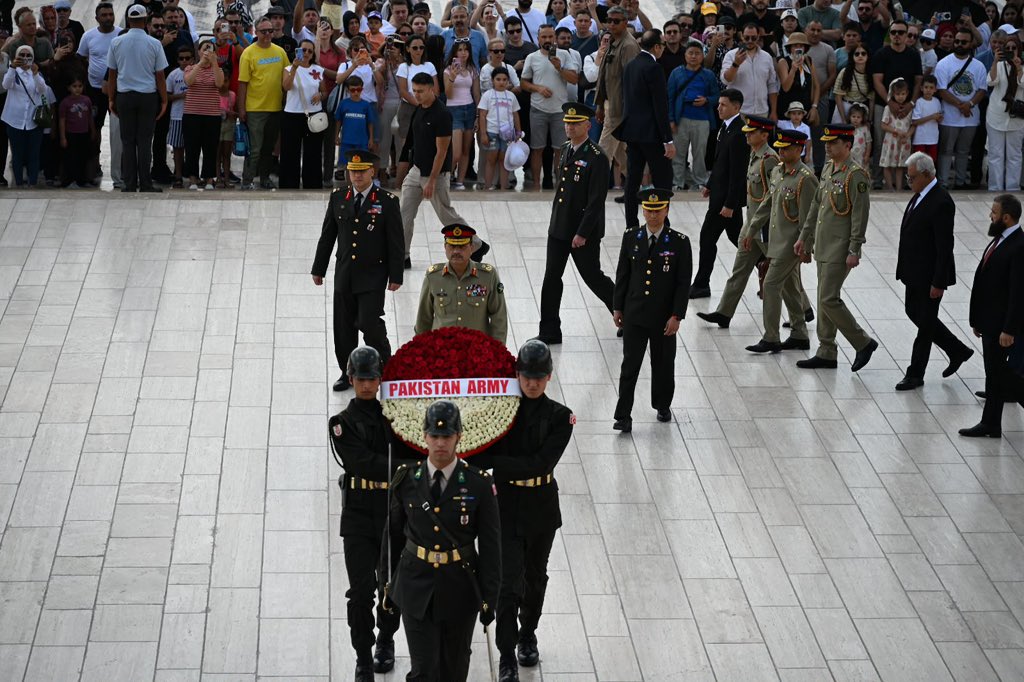
At Anıtkabir, the mausoleum of Mustafa Kemal Atatürk, Munir laid a wreath in a ceremonial tribute to the founder of modern Türkiye. Such visits are a standard element of high-level military diplomacy, but they also carry symbolic value by demonstrating respect for the Turkish state and its national history.
He was also received with military honours, including a tri-services guard of honour. Taken together, the medal, ceremonial reception and access to senior political, defence and intelligence officials demonstrated that Ankara viewed the visit as strategically significant rather than merely protocol-driven.
The Defence Partnership behind the Diplomacy
Pakistan and Türkiye have long described their relationship as fraternal, but the partnership has increasingly acquired a practical military-industrial foundation.
One of its most visible projects is the MILGEM corvette programme. Under a 2018 agreement, Turkish state-owned defence company ASFAT undertook the construction of four warships for the Pakistan Navy, with two built in Türkiye and two at Karachi Shipyard under a technology-transfer arrangement.
The programme is important because it combines weapons procurement with domestic industrial capacity and technical training.
The two countries also conduct joint exercises, maintain extensive military-training links and have explored cooperation in aerospace and unmanned systems.
Türkiye’s experience in armed drones, electronic warfare, naval production and battlefield communications makes it an attractive partner for Pakistan, which is seeking to diversify its defence suppliers and reduce dependence on any single foreign source.
For Türkiye, Pakistan offers a large professional military, experience in counterterrorism and conventional operations, access to South Asian markets and a strategic connection to China and the Arabian Sea. Pakistan’s military relationship with Saudi Arabia and other Gulf states also gives Ankara an indirect avenue into emerging regional security conversations.
Munir’s visit therefore appears to have operated on two levels. The first was immediate coordination over regional tensions. The second was the longer-term institutionalization of Pakistan-Türkiye defence cooperation through training, joint production, interoperability and regular leadership consultations.
The US-Iran Conflict in the Background
The strongest geopolitical context for the visit was the conflict between the United States and Iran. Pakistan has emerged as an important intermediary because it possesses channels with Washington, Tehran, Riyadh, Doha and Ankara while sharing a long border with Iran.
Prime Minister Shehbaz Sharif reportedly tasked Munir with maintaining behind-the-scenes contacts with American and Iranian political and military leaders. Pakistan subsequently helped facilitate rare direct contacts between the two sides, while Munir travelled to Tehran as part of efforts to preserve dialogue and arrange further negotiations.
Munir’s personal relationship with President Donald Trump has strengthened Pakistan’s access in Washington. Reuters reported that he had held several meetings with Trump and maintained contacts with senior US officials, including Vice President JD Vance, as Pakistan promoted itself as a channel for regional de-escalation.
Türkiye is equally relevant to such diplomacy. Ankara is a NATO member with an established relationship with Washington, but it has consistently preserved political and economic channels with Tehran. It also works closely with Qatar, which has frequently served as a mediator in regional crises.
That makes Türkiye an important consultation partner for Pakistan. Ankara can communicate with Western governments without being perceived in Tehran as a purely American proxy. Pakistan can similarly engage Iran without abandoning its defence relationships with Saudi Arabia or its renewed political access in Washington.
However, it must be emphasized that neither the Turkish presidency nor Pakistan’s military publicly stated that Munir and Erdoğan discussed a specific ceasefire formula, Iranian proposal or American negotiating position.
Any claim that Munir secured Turkish approval for a formal new alliance, delivered a secret message or finalized an Iran-related agreement would go beyond the confirmed record.
The more defensible interpretation is that the US-Iran confrontation formed a central part of the “regional security” environment discussed by the two sides, even though the operational details remained confidential.
Why Türkiye Matters to Pakistan’s Mediation Strategy
Türkiye gives Pakistan several forms of strategic support.
First, Ankara possesses diplomatic reach across NATO, the Muslim world, Central Asia, the Caucasus and the Middle East. Coordination with Erdoğan therefore helps Pakistan ensure that its mediation initiatives are not isolated from wider regional diplomacy.
Second, Türkiye has direct national interests in preventing a prolonged US-Iran war. A wider conflict could disrupt energy supplies, increase refugee pressure, destabilize Iraq and Syria and weaken regional trade routes. Ankara and Islamabad consequently share an interest in preventing the confrontation from expanding into a permanent regional war.
Third, both countries prefer regional arrangements in which middle powers retain room for independent action rather than being forced to choose rigidly between American, Iranian, Russian, Chinese or Gulf blocs.
Fourth, Pakistan may see Türkiye, Qatar, Saudi Arabia and Egypt as a loose diplomatic contact group capable of encouraging de-escalation. Reuters reported that the foreign ministers of Pakistan, Türkiye, Saudi Arabia and Egypt had already coordinated over efforts to end the Iran war.
Munir’s visit can therefore be understood as an effort to connect military diplomacy with the political contacts already being managed by Prime Minister Sharif and Foreign Minister Ishaq Dar.
Conclusion: A Visit with Wider Regional Meaning
Field Marshal Syed Asim Munir’s Türkiye visit consolidated one of Pakistan’s most important defence partnerships and gave Islamabad an opportunity to exchange assessments with a government that has influence in NATO, the Gulf and the broader Muslim world.
The confirmed activities were substantial: a closed-door meeting with President Erdoğan attended by Türkiye’s senior political, military and intelligence leadership; talks with Defence Minister Yaşar Güler; consultations with General Selçuk Bayraktaroğlu and General Metin Tokel; receipt of the Turkish Armed Forces Distinguished Service Medal; and a ceremonial visit to Anıtkabir.
In the context of the US-Iran conflict, the visit appears to have been part of Pakistan’s effort to maintain regional coordination, preserve its mediation credentials and prevent the emergence of a security crisis that could threaten its borders, economy and relations with the Gulf.
Yet the most important point is not that Pakistan and Türkiye have created a new military bloc or agreed upon a secret peace formula—neither claim has been officially established. The deeper significance is that Ankara and Islamabad are strengthening the mechanisms through which they can consult, cooperate and respond together as the regional order becomes more unstable.
Munir’s mission consequently represented both opportunity and warning: an opportunity for Pakistan to convert military relationships into diplomatic influence, and a warning that balancing Washington, Tehran, Riyadh and Ankara will require restraint, transparency and a clear understanding of the limits of Pakistan’s power.
Explore related stories, expert opinions, and exclusive insights to better understand the broader implications of today’s headlines.


