


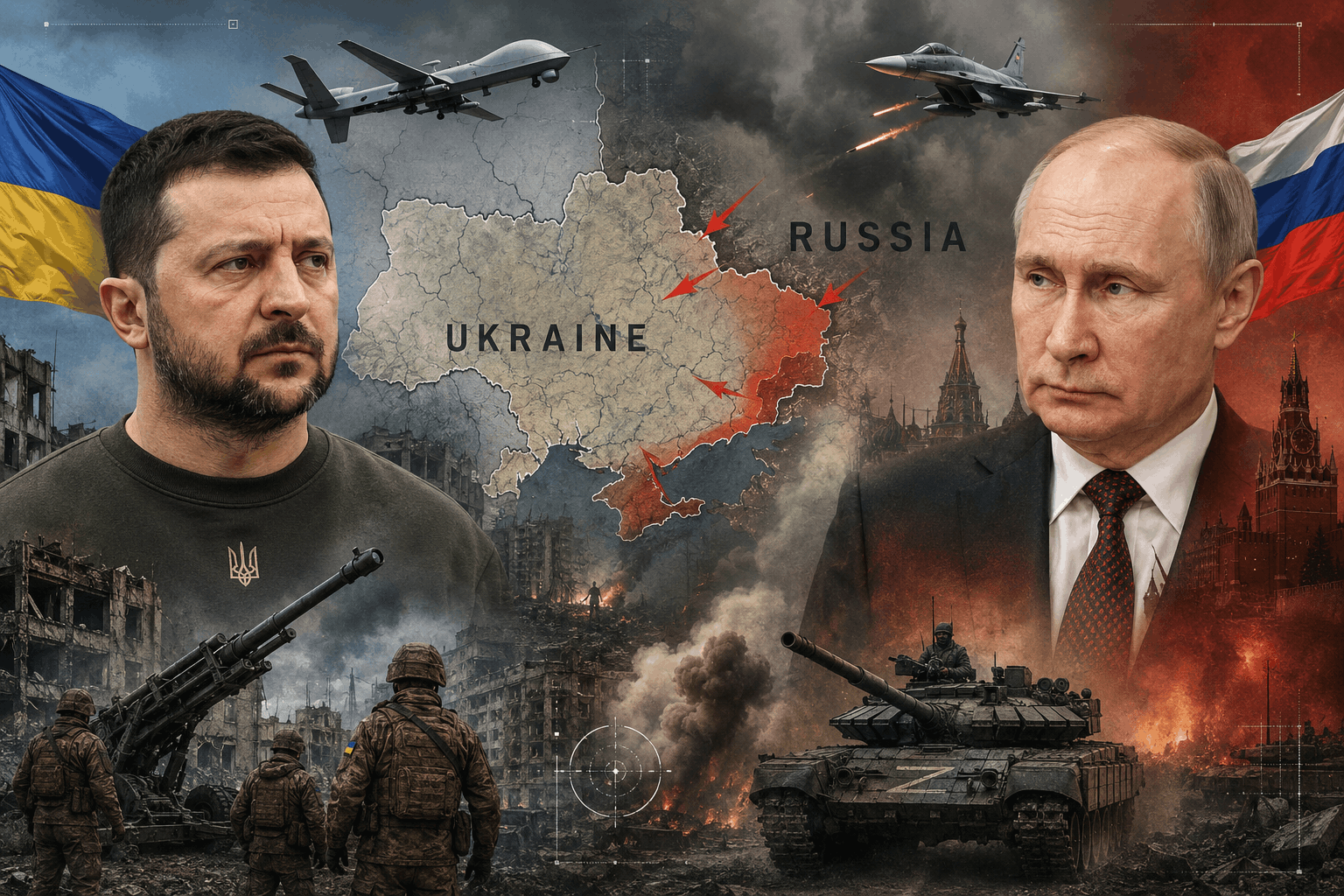
Kyiv, UA/Moscow, RU: More than four years after Russia’s full-scale invasion of Ukraine, the war remains locked in a costly struggle where military operations, political messaging, and international diplomacy are unfolding simultaneously.
Developments over the past five days suggest that while both Moscow and Kyiv continue to pursue their strategic objectives, neither side appears close to achieving a decisive breakthrough.
Instead, the conflict is increasingly characterized by attritional warfare, long-range missile and drone attacks, and competing narratives over who holds the strategic advantage.
Recent fighting has been concentrated across eastern and southern Ukraine, where Russian forces continue gradual offensive operations while Ukraine seeks to disrupt logistics, command centers, and military infrastructure through precision drone strikes.
Independent military assessments indicate that Russian forces have recorded modest territorial gains during the past week, though these remain relatively limited compared to the enormous costs incurred by both sides.
Zelenskyy: Russia Continues to Reject Diplomatic Efforts
President Volodymyr Zelenskyy has continued to argue that Ukraine remains committed to achieving a “just and dignified peace,” but insists that meaningful negotiations require Russia to demonstrate genuine willingness to end hostilities.
In one of his recent public addresses, Zelenskyy declared:
“Russia has long had every opportunity to turn to diplomacy and end its aggression.”
He further stated:
“This year alone, we have reached out to Russia dozens of times with proposals to stop this war—but all we got in return were refusals.”
Zelenskyy also argued that “Putin has no desire to end the war,” while emphasizing that Ukraine continues working with the United States, Türkiye, European partners, and Arab states to create conditions for future negotiations.
Alongside diplomatic appeals, the Ukrainian president has repeatedly stressed the urgent need for additional Western military assistance, particularly Patriot missile interceptors and expanded air-defense production.
Following another wave of Russian missile attacks, he warned that Russia continues to rely heavily on ballistic missiles and argued that stronger air defenses remain Ukraine’s highest military priority.
Putin Maintains Russia’s Military Objectives
President Vladimir Putin has shown little indication of changing Russia’s strategic objectives. Russian officials continue to argue that military operations are progressing according to plan and maintain that battlefield pressure strengthens Moscow’s negotiating position rather than weakens it.
The Kremlin has consistently presented the conflict as a matter of Russia’s national security and has maintained that the objectives announced at the beginning of what Moscow still describes as its “special military operation” remain unchanged.
According to recent Russian public statements, Putin continues to express confidence that Russia’s campaign is advancing successfully, insisting that military operations are “progressing according to plan.”
From Moscow’s perspective, continued battlefield pressure is viewed as essential to compelling Ukraine and its Western supporters to accept political terms more favorable to Russia.
Russian officials have also argued that Western military assistance merely prolongs the conflict rather than bringing peace.
Military Reality Remains One of Attrition
The battlefield picture over recent days illustrates the increasingly attritional nature of the war.
Russia continues relying on artillery, guided bombs, missile strikes, and infantry assaults to pressure Ukrainian defensive positions. Ukraine, meanwhile, increasingly depends on long-range drones, precision strikes against logistics hubs, and attacks on military infrastructure inside Russian territory.
Neither strategy has fundamentally altered the overall military balance.
Independent assessments suggest that Russian forces remain committed to positional warfare rather than rapid maneuver operations, while Ukraine continues attempting to impose higher logistical and economic costs on Russia through deep strikes.
This evolving battlefield demonstrates that technological adaptation—particularly the growing use of drones—has become as strategically important as conventional armored offensives.
Leadership Changes Reflect Kyiv’s Search for New Momentum
Another significant development has been President Zelenskyy’s restructuring of Ukraine’s senior military leadership.
The appointments appear designed to accelerate military modernization, improve coordination, and strengthen drone-centered operations following growing public debate over battlefield performance and command structures.
Supporters argue that the changes could improve operational flexibility, while critics caution that leadership reshuffles alone cannot overcome shortages in manpower, ammunition, and air-defense capabilities.
Russia has dismissed the changes, asserting that they will not alter battlefield realities.
Diplomacy Faces Familiar Obstacles
Despite renewed diplomatic discussions involving the United States and several international partners, prospects for an immediate ceasefire remain uncertain.
Ukraine insists that any settlement must preserve its sovereignty and territorial integrity while providing credible security guarantees.
Russia continues emphasizing recognition of what it describes as “new territorial realities” and broader security concerns regarding NATO.
These fundamentally different negotiating positions continue to leave little common ground.
Although international mediation efforts remain active, recent public statements from both governments suggest that military calculations continue to outweigh diplomatic flexibility.
International Support Remains a Decisive Variable
Western military assistance continues to play a central role in Ukraine’s ability to sustain defensive operations.
Recent discussions involving U.S. officials have focused on expanding Ukraine’s air-defense capabilities and accelerating defense-industrial cooperation, including the production of Patriot missile interceptors under license.
These initiatives underscore Washington’s continued strategic commitment while also reflecting growing emphasis on long-term defense production rather than emergency aid alone.
Meanwhile, European governments continue debating additional sanctions against Russia, even as differing national priorities have complicated consensus within the European Union.
Strategic Outlook
The developments of the past five days reinforce a broader conclusion that has increasingly defined the Ukraine-Russia war: neither side currently possesses the military capability to impose a decisive outcome, yet neither appears politically prepared to make the compromises necessary for a negotiated settlement.
Ukraine continues seeking stronger international military support while maintaining that diplomacy remains possible if Russia changes its position.
Russia, by contrast, appears determined to maintain military pressure in the belief that continued battlefield operations will eventually strengthen its leverage at any future negotiating table.
As long as these strategic calculations remain unchanged, the conflict is likely to continue as a prolonged war of attrition, marked by incremental territorial changes, expanding drone warfare, sustained missile campaigns, and persistent diplomatic efforts that have yet to bridge the deep political divide between Kyiv and Moscow.
The coming months may therefore be shaped less by dramatic battlefield breakthroughs than by each side’s ability to sustain military, economic, and political resilience over the long term.
The Variant delivers more than news—providing the context and analysis needed to understand complex global events.


