


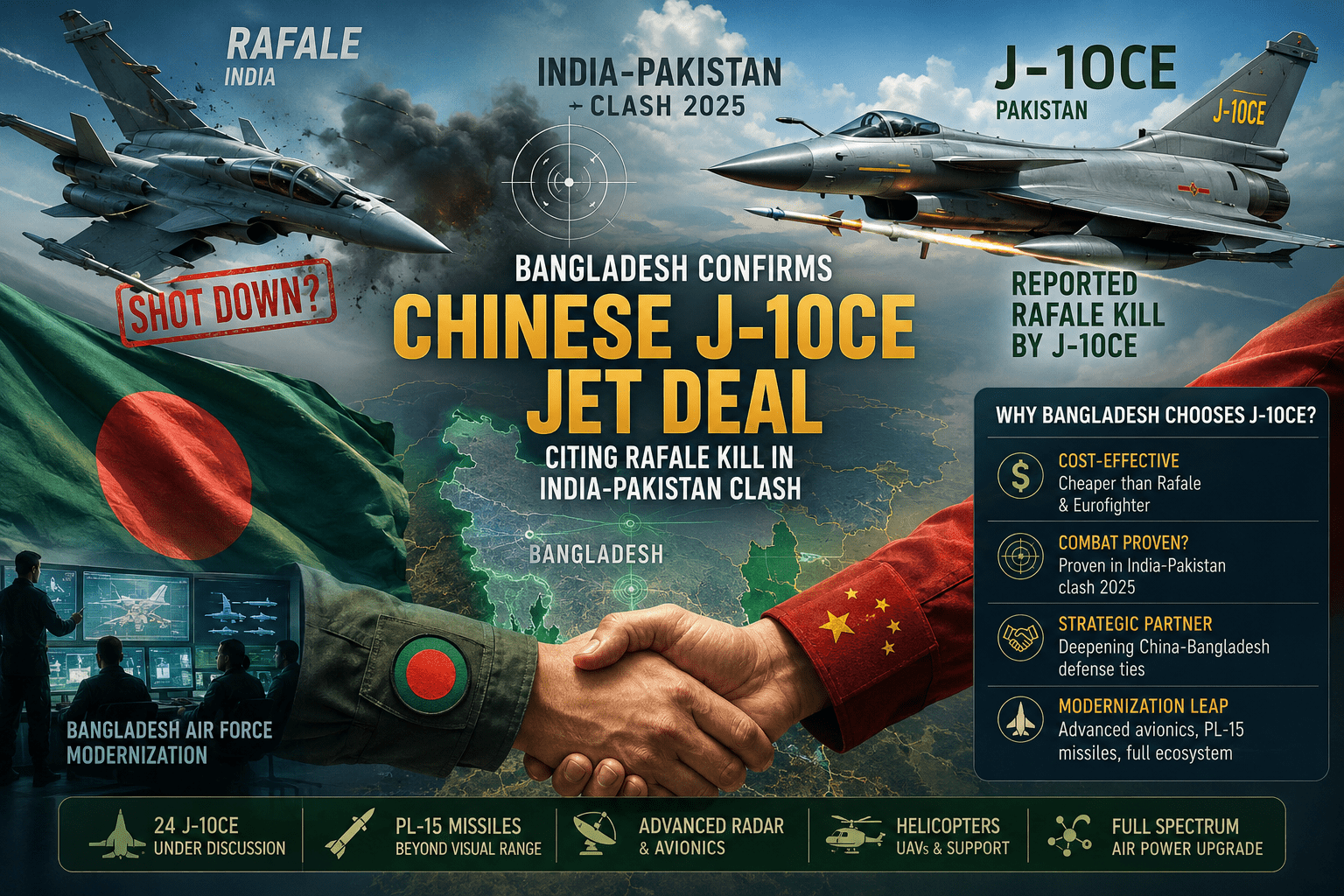
Dhaka, BN: Bangladesh’s decision to move toward acquiring China’s J-10CE fighter is more than an air-force modernization program.
It signals a potentially important shift in South Asia’s defense market: Chinese combat aircraft are increasingly being evaluated not simply as lower-cost alternatives to Western fighters, but as systems with a claimed—and increasingly influential—combat record.
However, the word “deal” needs qualification. Bangladeshi officials have confirmed that negotiations have taken place and a draft agreement has been prepared and submitted for approval.
The final numbers of aircraft, price and delivery timetable have not been publicly confirmed. Reuters reported that Bangladesh has been considering as many as 24 J-10CEs.
The decisive factor is the May 2025 India-Pakistan confrontation. Bangladesh Prime Minister’s Information and Broadcasting Adviser Zahid Ur Rahman explicitly linked Dhaka’s interest to the Chinese fighter’s reported battlefield performance.
Rahman said Bangladesh had closely observed the conflict and referred specifically to reports that an Indian Rafale had been shot down by a Chinese-made J-10. He also argued that Chinese fighters are considerably cheaper than comparable European platforms such as the Rafale and Eurofighter Typhoon.
That makes Bangladesh particularly significant for Beijing. Until now, Pakistan has been the only confirmed foreign operator of the export J-10CE. If Dhaka completes the acquisition, China would gain another important international customer for one of its most sophisticated export fighters.
The 2025 encounter also gave Chinese aerospace manufacturers something they historically lacked: combat credibility against a high-end Western-designed aircraft. Pakistan said its J-10CEs, operating with long-range PL-15 air-to-air missiles, were responsible for shooting down Indian aircraft.
It has previously reported that U.S. officials assessed that Pakistani Chinese-made aircraft brought down at least two Indian military aircraft, while the exact number and circumstances of the losses remain contested.
Therefore, it would be premature to describe every Pakistani claim about Rafale losses as independently established. What matters commercially, however, is that the battle has altered perceptions of Chinese air-combat technology.
Bangladesh Is Buying an Ecosystem, Not Just an Aircraft
The significance extends beyond the J-10CE itself.
Modern air combat depends on the interaction between AESA radar, electronic warfare, airborne early-warning aircraft, data links, ground-based sensors and beyond-visual-range missiles. The combination of the J-10CE and PL-15 therefore matters at least as much as the aircraft’s aerodynamic characteristics.
Bangladesh is also discussing Chinese attack helicopters, VIP helicopters and UAV systems. This suggests Dhaka is considering a broader modernization of its military aviation architecture rather than an isolated fighter purchase.
China already has an enormous advantage here. It has supplied Bangladesh with combat aircraft, naval vessels, tanks and missile systems for decades and remains Dhaka’s largest military-equipment supplier.
Consequently, selecting another Chinese platform potentially reduces training, logistics and integration difficulties compared with introducing an entirely new Western ecosystem.
For New Delhi, the development deserves attention, although it should not automatically be interpreted as Bangladesh preparing for military confrontation with India.
India already faces Chinese military power along its northern frontier and Pakistan’s increasingly Chinese-equipped air force in the west. A Bangladesh Air Force operating J-10CEs and PL-15-class weapons would introduce another sophisticated Chinese combat system on India’s eastern flank.
The political context is equally important. Rahman portrayed Bangladesh’s ability to consider such purchases as evidence of Dhaka’s greater freedom to make independent foreign and defense-policy decisions following the political transformation of 2024.
That rhetoric suggests the procurement has diplomatic symbolism alongside military utility: Dhaka wants greater strategic autonomy and does not want its defense relationships constrained by Indian sensitivities.
Yet India retains overwhelming conventional military superiority over Bangladesh. A few dozen J-10CEs would not fundamentally overturn that balance. Their greater importance would be deterrence, modernization and Bangladesh’s ability to impose higher operational costs on any potential adversary.
China’s Biggest Victory Could Be Commercial
For Beijing, Bangladesh could become a valuable international advertisement.
Chinese fighters have historically struggled against American, European and Russian aircraft in export markets because prospective customers questioned combat experience, interoperability, engine reliability and long-term support.
The J-10CE now has a different narrative.
Its appearance in the India-Pakistan conflict—and reports associating it with Indian aircraft losses—has provided China with a powerful marketing argument. At the 2026 Singapore Airshow, China’s J-10C attracted significant attention as Beijing pushed more aggressively into international aerospace markets.
Bangladesh becoming another operator could produce a demonstration effect. Middle-income countries unable or unwilling to pay for Rafales, Eurofighters or advanced American fighters may increasingly examine Chinese alternatives.
The attraction is straightforward: relatively advanced radar and missile technology, fewer Western political restrictions, competitive financing and potentially substantially lower acquisition costs.
That does not mean Chinese fighters are about to displace Western aircraft globally. Questions about engines, maintenance, electronic warfare, real-world sortie rates and long-term logistical support remain important. But the perception barrier surrounding Chinese military aviation appears to be weakening.
Pakistan Also Emerges as an Indirect Winner
There is another dimension often overlooked: Pakistan.
If Bangladesh ultimately purchases the J-10CE partly because of its assessment of Pakistan’s 2025 combat experience, Islamabad’s air force effectively becomes an unofficial showcase for Chinese military technology.
Pakistan and Bangladesh have also been expanding military contacts. Earlier discussions between their air chiefs included training, aerospace cooperation and possible procurement of the Pakistan-China JF-17 Thunder.
A Bangladesh J-10CE fleet could consequently create opportunities for greater Pakistani involvement in training, operational doctrine and exercises, even though China would remain the principal supplier.
The Larger Strategic Picture
Bangladesh’s J-10CE decision therefore represents something larger than the purchase of another fighter aircraft.
The 2025 India-Pakistan confrontation may have become an unexpected turning point for China’s defense-export industry.
For decades Beijing tried to convince international customers that Chinese aircraft could compete technologically with Western systems. Pakistan’s battlefield experience gave China something brochures and air shows could not provide: a combat narrative.
Bangladesh now appears prepared to translate at least part of that narrative into procurement policy.
If the deal receives final financial and governmental approval, the real strategic consequence will not simply be additional fighters over Bangladesh.
It will be evidence that China is moving from being primarily the supplier of affordable military hardware to competing for customers seeking sophisticated, combat-associated weapons systems.
For India, that means Chinese military technology is spreading deeper into its immediate neighborhood. For Pakistan, it strengthens the credibility of the Chinese weapons ecosystem it has embraced. And for Beijing, Bangladesh could become the second major showcase proving that the J-10CE’s most consequential victory may ultimately occur not in the skies over South Asia, but in the global arms market.
Stay ahead of emerging trends and international developments with trusted reporting and analysis from The Variant.


