


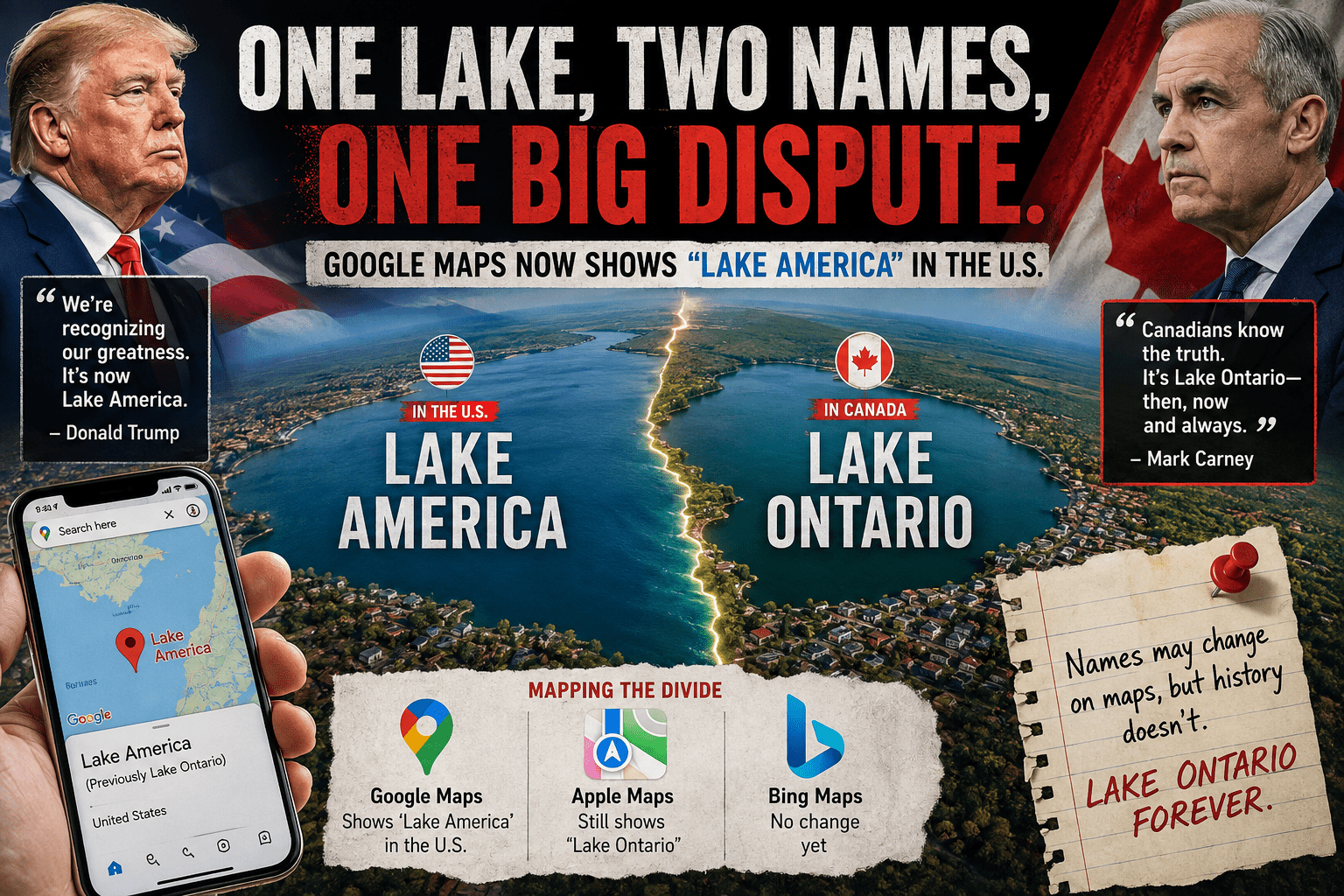
Washington, D.C/Toronto, CA: Google Maps has begun displaying “Lake America” instead of “Lake Ontario” to users in the United States, following the Trump administration’s formal change to the U.S. Geographic Names Information System, or GNIS. The development may appear at first to be a symbolic dispute over cartography, but its political significance is considerably larger.
The change illustrates how President Donald Trump’s “America First” approach is extending beyond tariffs, defense spending and trade negotiations into national symbols and geographic terminology. It also demonstrates the enormous influence private technology companies now exercise over how political decisions become embedded in everyday digital life.
Google confirmed on August 29 that because GNIS had formally changed the U.S. name, its maps would follow the federal designation. American users will therefore see Lake America; Canadians will continue to see Lake Ontario, while users elsewhere will generally see both names.
Apple Maps, meanwhile, was still displaying Lake Ontario as of August 30. Reports also indicate that some other mapping providers have not adopted the Trump administration’s terminology.
Trump Turns Geography Into “America First” Politics
President Trump signed the executive order on August 27, directing the Interior Department, working with the U.S. Board on Geographic Names, to rename Lake Ontario as “Lake America” for U.S. federal purposes.
The White House justified the decision by emphasizing American economic, environmental and strategic contributions to the Great Lakes.
Trump’s order argues that the United States provides substantial security and environmental investment, citing U.S. Coast Guard icebreaking capabilities and nearly $4 billion in American investment in protecting the Great Lakes freshwater ecosystem during the past decade.
Trump also connected the decision—at least rhetorically—to his increasingly confrontational relationship with Ottawa.
Speaking after signing the order, Trump said:
“Canada has been ripping us off for a long time on trade, very sadly.”
He further argued that Canada wants to be treated “like a state” while not actually being one, although he insisted that the renaming was not intended to send a particular geopolitical message.
The president described the designation as effective immediately and compared it with his earlier decision to rename the Gulf of Mexico as the Gulf of America for U.S. federal usage.
The political context is impossible to ignore. The lake dispute comes amid a serious deterioration in U.S.–Canadian trade relations, including reciprocal tariffs following the breakdown of negotiations.
What might otherwise have remained an obscure geographic naming decision has therefore become another instrument in a broader political confrontation.
Canada: “Then, Now and Always”
Canada’s response has been unusually direct.
Prime Minister Mark Carney rejected the new designation while emphasizing the Indigenous origins of the historic name.
Carney noted that Ontario derives from the Wendat word “Ontari’io” and that the name predates both Canadian Confederation and the U.S. Declaration of Independence.
His conclusion was unmistakable:
“Canadians also know that naming reality means calling it Lake Ontario — then, now and always.”
Ontario Premier Doug Ford has gone even further.
Ford unveiled a large bilingual sign declaring “Lake Ontario: Now and Always,” and said:
“President Trump can call it whatever he wants, but I can tell you, the rest of the world will always call it Lake Ontario.”
Ford also described Trump’s signing ceremony as resembling something from Saturday Night Live and insisted that a name used for hundreds of years would survive the controversy.
Canadian Industry Minister Mélanie Joly was similarly categorical: “We’ll always call it Lake Ontario. Period.”
The dispute even created an awkward technological problem inside Canada. Some Ontario government and commercial websites using embedded Google mapping technology temporarily displayed “Lake America.”
Ontario Minister Stephen Crawford said the provincial government was reviewing affected websites to ensure they identify the lake by what Ontario considers its correct name: Lake Ontario.
Google Is Following Government Data — but the Consequences Are Political
It would be misleading to portray Google’s action simply as an endorsement of Trump’s politics.
Google says it follows official geographic naming databases and uses localized labels when governments disagree over place names. Once GNIS formally adopted Lake America, Google’s existing policy effectively triggered the American map change.
That produces an extraordinary modern situation: the same physical lake now has different primary identities depending on where a person opens Google Maps.
An American may see “Lake America.” A Canadian sees “Lake Ontario.” Someone elsewhere may see both.
This demonstrates that digital maps are no longer merely representations of geography. They increasingly reflect political jurisdiction.
And because Google Maps is embedded in websites, transportation applications, businesses and government services, a federal naming decision can spread far beyond federal maps. The accidental appearance of “Lake America” on some Ontario websites illustrates precisely that problem.
Washington Can Change Its Maps — Not Canada’s
The crucial distinction is between U.S. federal recognition and internationally accepted geography.
Trump has substantial authority over terminology used by the executive branch and federal geographic databases. His administration can therefore instruct federal agencies to use Lake America in maps, contracts, databases and communications.
But Washington cannot compel Ottawa to rename the Canadian portion of a shared international body of water.
Nor can an American executive order force foreign governments, international institutions, publishers or independent mapping companies to adopt the terminology.
Even inside the United States, political resistance is significant.
New York Governor Kathy Hochul responded simply:
“New York won’t be calling it that.”
Vermont’s Republican Governor Phil Scott called the decision “petty and disappointing,” arguing that Washington and Ottawa should instead be negotiating ways to strengthen their economies.
That opposition matters because New York actually borders the lake. It means Americans themselves may encounter competing terminology: federal institutions and Google Maps using Lake America while state officials, Canadians and potentially other organizations continue saying Lake Ontario.
The Indigenous Dimension Makes the Controversy More Complicated
The historical argument is perhaps Canada’s strongest response.
“Ontario” is not fundamentally a modern Canadian nationalist invention. Its roots are Indigenous and centuries old. That makes replacing it with “America” politically different from simply modernizing an administrative designation.
Indigenous opposition has consequently emerged.
Grand Chief Pierre Picard of the Wendat Nation condemned the decision, saying:
“President Trump is trying to erase our history.”
He described himself as “outraged, appalled, shocked” by the decision.
That criticism complicates the White House’s attempt to frame the change simply as recognition of America’s economic contribution. The argument is no longer merely America versus Canada; it also involves the historical identity of Indigenous peoples whose geographic terminology predates both countries.
A Symbolic Move with Real Diplomatic Costs
The greatest consequence may therefore have little to do with maps.
For decades, the U.S.–Canada relationship rested on an assumption that disagreements over trade, defense and border policy occurred inside an unusually stable alliance. Trump has increasingly challenged that assumption.
The renaming transforms a shared natural resource into another symbol of competition.
From Trump’s perspective, this may be deliberate. His political strategy frequently turns abstract policy disputes into simple, memorable symbols. “Lake America” communicates his broader argument about American power far more effectively to supporters than pages of trade statistics.
But symbolism works in both directions.
For Canadians, Lake Ontario has now become an equally powerful symbol of sovereignty and resistance to American pressure.
That could make resolving the underlying trade dispute harder rather than easier. Leaders who might compromise quietly over tariffs face greater political difficulty doing so once negotiations become associated with national dignity.
The Bigger Question: Who Controls the Digital Map?
There is another important lesson.
Twenty years ago, Washington could rename something in a federal database without immediately changing what hundreds of millions of people saw on their phones.
Today, a government database can influence Google Maps almost immediately.
The result is a new relationship between state power and technological power. Governments determine official terminology; technology companies distribute that terminology at global scale.
Google’s attempt to solve the dispute through geographic localization—Lake America in the United States, Lake Ontario in Canada and both elsewhere—is technically pragmatic. Politically, however, it creates multiple digital realities around the same geographic feature.
Lake Ontario or Lake America? The Dispute Is Only Beginning
The Trump administration has successfully accomplished something important domestically: Lake America is now an official U.S. federal designation and has entered one of the world’s most influential digital mapping platforms.
But that should not be confused with universally renaming the lake.
Canada rejects the designation. Ontario rejects it. Indigenous leaders have criticized it. New York’s governor rejects it. And not every major mapping platform has followed Google.
The result is therefore not one new name replacing another. It is the creation of competing geographic narratives.
For Trump, “Lake America” reinforces an America First philosophy built around sovereignty, economic contribution and national power. For Canada, retaining “Lake Ontario” has become an assertion that history and sovereignty cannot be rewritten by an executive order issued in Washington.
The irony is that a lake shared peacefully for generations has suddenly become a political border in cyberspace.
And while Google can change what Americans see on their screens almost overnight, changing what Canadians—and perhaps much of the world—call Lake Ontario may prove considerably harder.
Explore related stories, expert opinions, and exclusive insights to better understand the broader implications of today’s headlines.


