


Rochester, NY: The 2026 United States midterm elections have delivered far more than an electoral defeat for President Donald Trump. They represent a profound political warning to the Republican Party, a rejection of divisive political rhetoric, and a potentially historic transformation in the relationship between American democracy, religious minorities, and political power.
At the center of this transformation stands an extraordinary political development: the electoral success of Muslim American candidates, several of whom endured years of hostility, religious stereotyping, and political attacks from Trump and his allies.
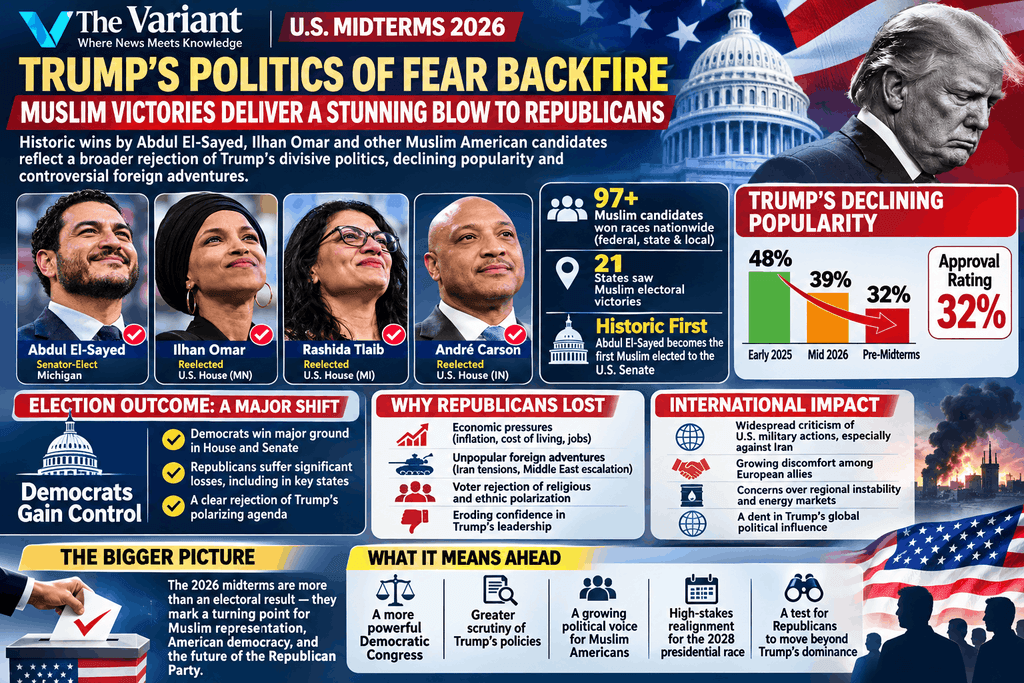
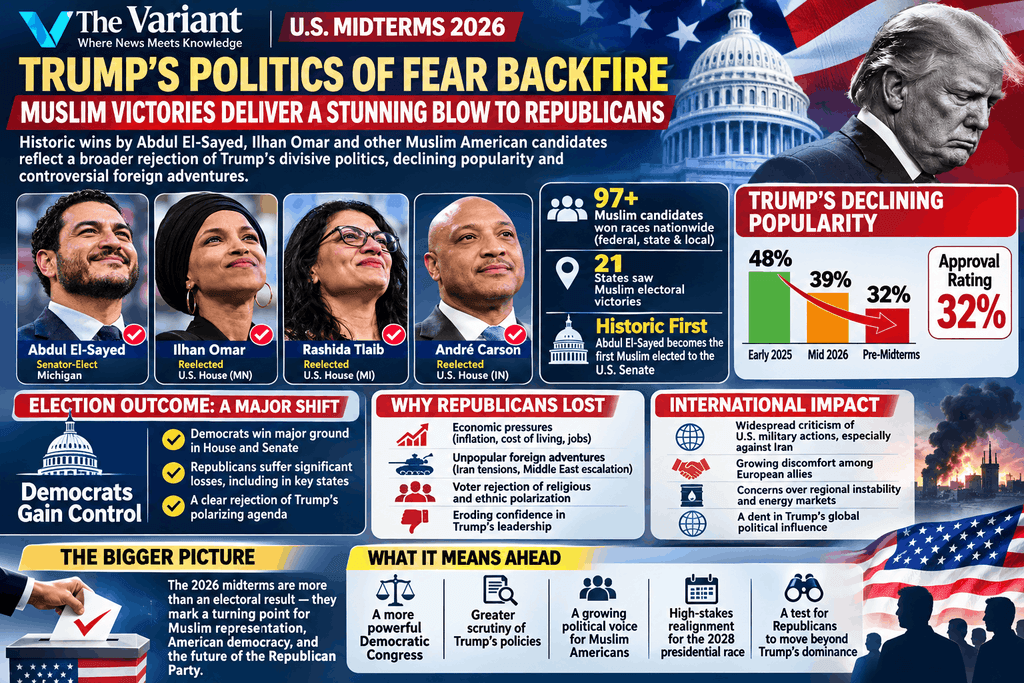
The victory of Abdul El-Sayed in Michigan, alongside the reelection of Ilhan Omar and Rashida Tlaib, carries a message extending far beyond individual congressional districts.
The American electorate has demonstrated that political identity cannot indefinitely substitute for public policy, that religious prejudice does not guarantee electoral success, and that voters increasingly expect their leaders to address economic insecurity rather than manufacture cultural enemies.
Democrats captured both chambers of Congress, with gains extending into traditionally Republican territory. The magnitude of the reversal suggests that Trump’s difficulties are no longer confined to Democratic strongholds but have penetrated constituencies that previously sustained Republican political dominance.
Abdul El-Sayed: A Historic Victory against Religious Prejudice
Perhaps the most symbolically significant result emerged from Michigan, where Abdul El-Sayed defeated Republican Mike Rogers to become the first Muslim elected to the United States Senate.
His victory is particularly remarkable because his campaign encountered aggressive attacks questioning his religion, patriotism, and alleged associations with extremism. Trump and prominent Republican figures attempted to portray him as a national security threat, despite the absence of evidence establishing terrorist connections.
Rather than surrendering to this political pressure, El-Sayed emphasized healthcare affordability, economic justice, and opposition to excessive corporate influence in American politics.
His victory demonstrated that voters could distinguish legitimate disagreements over policy from attempts to discredit a candidate through religious identity.
Michigan, with its politically influential Arab American and Muslim communities, has become an important illustration of changing electoral dynamics. Nevertheless, El-Sayed’s success cannot be attributed exclusively to Muslim voters. His coalition also reflected broader dissatisfaction with Republican economic policies and the administration’s handling of international conflicts.
The significance of this outcome is unmistakable: a candidate targeted by religious suspicion has secured a place in one of America’s most powerful political institutions.
Ilhan Omar: Political Intimidation Meets Electoral Resistance
Ilhan Omar’s reelection to a fifth congressional term in Minnesota offers another compelling example of the limits of Trump’s confrontational political strategy.
For years, Omar has remained among Trump’s most frequently criticized political opponents, facing attacks over her Somali heritage, Muslim identity, immigration background, and outspoken positions on American foreign policy.
Her latest victory came amid renewed scrutiny and an investigation by the Trump administration concerning alleged immigration violations, allegations Omar has disputed.
Yet voters in Minnesota’s Fifth Congressional District returned her to Congress, reinforcing her political standing despite the controversy surrounding her.
Omar’s victory should not be interpreted as nationwide endorsement of every position she holds. Her district remains strongly Democratic. Nevertheless, her continued electoral success challenges the assumption that sustained attacks from the White House necessarily destroy a political opponent’s credibility.
Indeed, the strategy of making Omar a symbol of political hostility may have strengthened her relationship with constituents who view such attacks as discriminatory or excessive.
Muslim Representation Is Becoming a National Political Force
The success of Muslim candidates extends well beyond Michigan and Minnesota.
Rashida Tlaib retained her congressional seat in Michigan, while André Carson of Indiana and Lateefah Simon of California also secured reelection. Newcomers Adam Hamawy in New Jersey and Darializa Avila Chevalier in New York joined the growing group of Muslim elected representatives.
According to preliminary tracking released by the Council on American-Islamic Relations on November 5, at least 97 Muslim candidates secured victories across federal, state, and local elections in 21 states, with additional races awaiting final determination.
These results indicate a growing political presence that cannot reasonably be dismissed as an isolated development.
However, the electoral achievements of Muslim Americans should not be reduced to a single religious voting bloc. Their political priorities, ideological positions, and constituencies differ considerably.
Their collective significance lies instead in the normalization of Muslim participation in American public institutions, where candidates increasingly compete on governance, economic opportunity, civil liberties, and foreign policy.
America’s constitutional promise of religious freedom becomes more meaningful when citizens from historically marginalized communities can attain public office despite campaigns questioning their belonging.
Trump’s Declining Popularity: A Warning Republicans Can No Longer Ignore
The Republican defeat was preceded by unmistakable warning signs.
A Reuters/Ipsos survey conducted shortly before the elections placed Trump’s approval rating at just 32 percent, marginally above a record low of 31 percent. The same survey showed Democrats leading Republicans by 47 percent to 36 percent among registered voters on the congressional generic ballot.
These figures reveal the vulnerability of a political movement that has increasingly tied its electoral identity to one individual.
For years, Trump successfully mobilized supporters through nationalism, immigration restrictions, cultural confrontation, and promises of economic revival. Yet the 2026 results suggest that his personal political brand has become a liability in competitive constituencies.
The consequences extend beyond the presidency. Republican candidates who closely identified themselves with Trump suffered defeats even in states previously considered reliably conservative.
The party must now confront a difficult question: can it recover its broader electoral appeal without reconsidering the policies and political rhetoric that contributed to its losses?
Foreign Military Adventures Have Become a Domestic Electoral Burden
The Republican setback cannot be understood without examining the international consequences of Trump’s presidency.
The war with Iran, escalating tensions across the Middle East, uncertainty surrounding Ukraine, and confrontational trade policies have weakened the administration’s claim that its foreign policy protects ordinary Americans from unnecessary international entanglements.
The contradiction is particularly damaging because Trump previously presented himself as an opponent of costly foreign interventions.
Instead, the Iran conflict has generated criticism over military expenditure, energy prices, regional instability, and its consequences for American households.
According to Associated Press polling, approximately six in ten voters considered the military action against Iran wrong.
International criticism has also reached political movements once sympathetic to Trump. European right-wing leaders have begun distancing themselves from his administration, with politicians in Germany, France, and Italy pointing to the Iran war and rising living costs as important factors behind Republican losses.
The broader lesson is that military strength does not automatically produce political legitimacy. A foreign intervention becomes increasingly difficult to defend when citizens believe its financial and human costs outweigh its strategic benefits.
The Road to 2028: A Republican Identity Crisis
The Democratic takeover of Congress will significantly complicate Trump’s remaining presidential agenda, particularly through legislative scrutiny, budget negotiations, and congressional investigations.
However, the results do not mean Trump has lost the presidency or that Republicans are destined to lose the 2028 election.
Presidential authority over diplomacy and national security remains substantial, while Democrats must demonstrate that electoral victory can translate into effective governance.
Nevertheless, Republicans face an increasingly urgent strategic dilemma. Continued dependence on Trump’s personality risks alienating moderate voters, while distancing themselves from him could fracture the party’s conservative base.
The success of Muslim candidates adds another dimension to this crisis. Religious polarization may energize certain political constituencies, but it can also mobilize voters who reject discrimination and political exclusion.
Conclusion: America Has Delivered a Verdict on Political Leadership
The most enduring significance of the 2026 midterm elections may not be the defeat of individual Republican candidates, but the warning delivered to an entire political philosophy.
Abdul El-Sayed’s historic Senate victory, Ilhan Omar’s political resilience, and the growing representation of Muslim Americans demonstrate that religious identity need not prevent political advancement, even in an environment marked by hostility and suspicion.
At the same time, Republican losses expose the political consequences of declining presidential popularity, economic frustration, and internationally controversial military policies.
The American electorate has not delivered a single, uniform ideological verdict. But it has sent an unmistakable message: political loyalty cannot indefinitely replace accountability, foreign military power cannot compensate for domestic economic insecurity, and the politics of fear cannot guarantee electoral victory.
For Donald Trump, this is a serious personal political setback. For Republicans, it is a structural warning. And for American democracy, the election offers an opportunity to reaffirm a principle more powerful than partisan identity: public office must ultimately be earned through the confidence of voters, not through the exclusion of political opponents.
The central question is no longer whether Trump can dominate the Republican Party. It is whether the Republican Party can regain the confidence of America without remaining politically dependent on Donald Trump.
Editorial analysis based on election reporting and polling available November 6, 2026. Some races remain subject to final certification. The interpretations expressed are editorial judgments.
For ongoing coverage and detailed analysis of international affairs, visit The Variant regularly for the latest updates.


