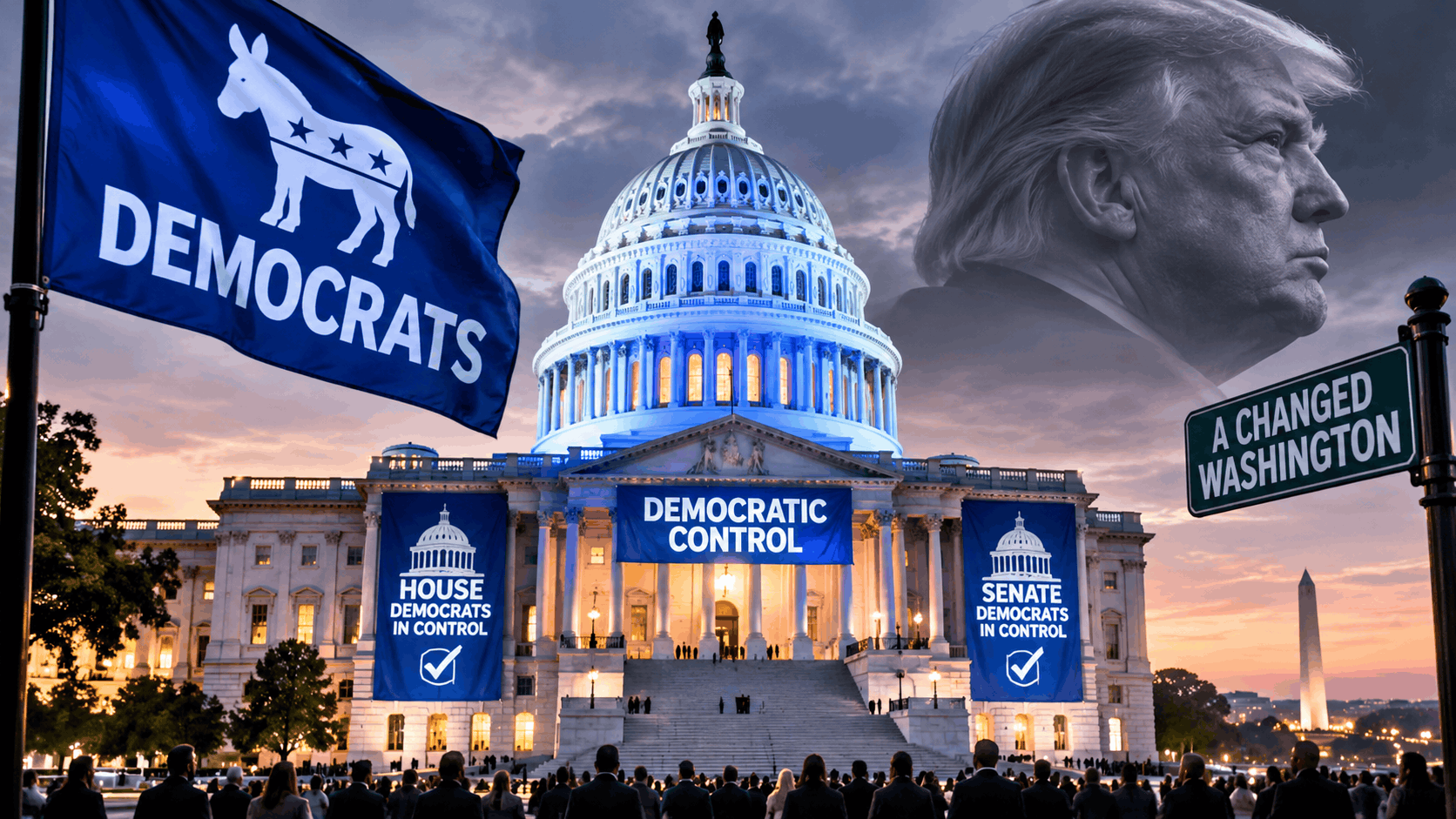
Washington, D.C: The 2026 midterm elections have fundamentally altered America’s political balance. Democrats have captured both chambers of Congress, Republicans face an internal reckoning, and President Donald Trump appears determined to confront rather than accommodate his opponents.
Yet the real test of this political earthquake will be whether Washington’s new power structure can deliver economic relief, institutional accountability and effective governance.
When Congress returned to Washington following the November 3 midterm elections, it encountered a political landscape dramatically different from the one lawmakers had left behind.
Democrats were celebrating a historic electoral resurgence, Republicans were confronting the collapse of their congressional majorities, and President Donald Trump was signaling that electoral defeat would not necessarily translate into political retreat.
The elections represented more than a routine midterm correction against an incumbent president. They exposed widespread dissatisfaction with economic conditions, the administration’s handling of the Iran war, and concerns about government accountability.
Democrats captured both the House of Representatives and Senate, establishing the conditions for a significant institutional confrontation during the remaining two years of Trump’s presidency.
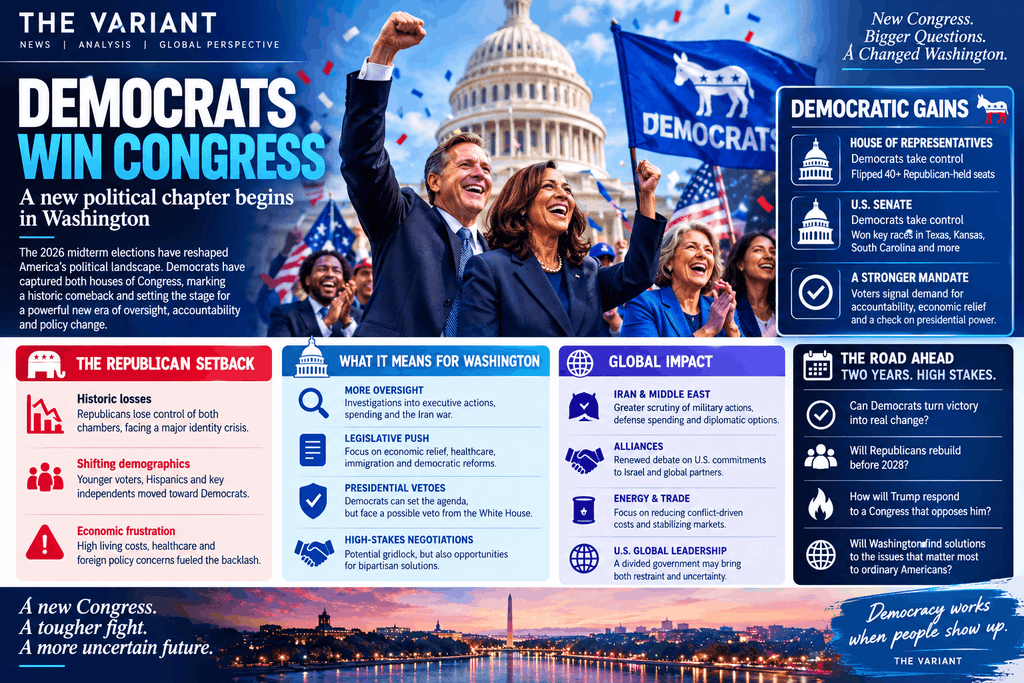
The scale of the Democratic victory is particularly revealing. According to CBS News, Democrats flipped more than 40 Republican-held House districts, including constituencies previously considered reliably conservative.
The Senate results were equally consequential, with Democratic victories in traditionally Republican territory, including Texas, Kansas and South Carolina.
However, electoral triumph does not automatically constitute a lasting political realignment. Midterm elections frequently serve as referendums on presidential performance, and American voters have repeatedly demonstrated their willingness to punish whichever party controls Washington.
The central question is whether Democrats have secured a durable national coalition or merely benefited from a powerful wave of dissatisfaction with Republican governance.
Trump’s Defiance: Political Strength or Strategic Miscalculation?
President Trump’s response has reinforced the confrontational character of his political leadership. Rather than treating the results as a reason to substantially reconsider his governing agenda, he has sought to distance himself from Republican defeats while emphasizing his willingness to resist Democratic initiatives.
His public embrace of presidential veto power illustrates the approach. Trump has indicated that a Democratic-controlled Congress should not expect automatic cooperation from the White House. His selection of Stephen Miller as White House chief of staff further suggests an administration preparing for ideological confrontation rather than bipartisan accommodation.
From Trump’s perspective, confrontation may serve a recognizable political purpose.
Maintaining an uncompromising posture could reassure his core supporters, preserve his influence over the Republican Party and allow him to portray congressional Democrats as obstacles to his agenda.
Yet this strategy carries substantial risks.
The Republican defeat suggests that political messaging capable of mobilizing a loyal base is not necessarily sufficient to win competitive districts.
Independents, younger voters and some traditionally Republican constituencies appear increasingly concerned about practical governance rather than permanent partisan conflict.
Trump retains the presidency and substantial executive authority. But his ability to convert political demands into legislation will diminish sharply when the new Congress convenes on January 3, 2027.
The distinction between retaining executive power and commanding national political consent may become the defining challenge of his remaining term.
The Economic Revolt behind the Democratic Wave
Perhaps the most important lesson of the midterms is that economic frustration can overwhelm ideological loyalty.
Trump returned to the White House in 2025 promising economic revival, lower prices and greater prosperity.
Yet the 2026 election became a referendum on whether those promises had translated into measurable improvements in ordinary Americans’ lives.
The Associated Press voter survey found that approximately two-thirds of voters believed Trump’s policies had worsened the economy. Roughly seven in ten believed Congress was failing to provide adequate checks on presidential authority.
These findings challenge the assumption that the Republican defeat was driven exclusively by ideological opposition to Trump.
For millions of Americans, politics increasingly revolves around grocery bills, housing costs, healthcare expenses, fuel prices and financial insecurity.
International conflicts and tariff policies also become domestic political liabilities when households perceive them as contributing to higher costs.
The demographic shifts were striking.
Seven in ten voters younger than 30 supported Democratic House candidates, while approximately six in ten Hispanic voters backed Democrats.
The results suggest that parts of the coalition that supported Trump in 2024 have become less dependable for Republicans.
Nevertheless, Democrats should resist interpreting these figures as unconditional support. Economic dissatisfaction can change political loyalties rapidly, and voters who abandoned Republicans in 2026 may just as readily reconsider their choices in 2028.
Republicans Confront an Identity Crisis
The electoral defeat has exposed a fundamental dilemma within the Republican Party: whether to maintain unwavering loyalty to Trump or develop a broader political identity capable of attracting voters beyond his most committed supporters.
The leadership struggle reflects that uncertainty. House Speaker Mike Johnson’s decision to step aside from Republican leadership has opened competition between Steve Scalise and Jim Jordan, while Senate Republican leader John Thune is expected to continue leading his party in the minority.
One faction may conclude that Republicans lost because they failed to communicate Trump’s achievements effectively.
Another may argue that excessive dependence on presidential loyalty, controversial candidates and confrontational messaging alienated moderate voters.
Neither explanation alone is sufficient.
Republicans continue to possess substantial organizational strength, committed voters and influence across numerous states.
Their long-term recovery will depend on whether they can reconcile conservative policy priorities with credible economic solutions and a more inclusive electoral strategy.
The party’s most difficult challenge may be learning to distinguish loyalty to a political leader from the broader interests of its electorate.
A Democratic Victory without a Blank Check
For Democrats, capturing Congress presents both an extraordinary opportunity and an immediate test of political maturity.
Hakeem Jeffries is positioned to become the first Black speaker of the House, while Chuck Schumer is seeking to lead the new Senate majority.
Yet tensions between progressive and moderate Democrats indicate that electoral success has not resolved the party’s internal ideological disagreements.
Progressives are likely to demand aggressive investigations, institutional reforms and stronger economic protections. Moderates may emphasize legislative stability, affordability and cooperation where possible.
These competing priorities could complicate the party’s governing agenda.
A Democratic Congress can investigate executive conduct, exercise oversight, control legislative priorities and scrutinize federal spending. But it cannot independently enact ordinary legislation over a determined presidential veto without the constitutionally required two-thirds support in both chambers.
Consequently, Democrats must balance accountability with practical governance.
If congressional investigations become substitutes for economic policymaking, voters may conclude that Washington has merely exchanged one form of political confrontation for another.
Iran, the Middle East and the Foreign Policy Reckoning
The Iran war has emerged as a significant factor in the Republican defeat, transforming foreign policy from a distant strategic issue into a domestic electoral concern.
For voters already worried about inflation, the economic consequences of military conflict, particularly energy costs and uncertainty surrounding international trade, have added another dimension to dissatisfaction with Washington.
The approaching congressional transition could produce greater scrutiny of military operations, defense spending and America’s commitments in the Middle East.
One immediate controversy concerns Defense Secretary Pete Hegseth, who faces an impeachment initiative over his Pentagon leadership and the Iran war.
Republican Representative Thomas Massie has pushed the measure despite resistance from party leadership.
However, congressional opposition does not automatically mean a reversal of American foreign policy.
The president retains significant constitutional authority over diplomacy and military command, while Congress possesses important powers over appropriations, legislation and oversight.
The new balance may encourage greater debate over military objectives, diplomatic alternatives, relations with Israel and the broader strategic consequences of prolonged regional instability.
For America’s allies and adversaries, the crucial question is whether divided government will produce greater strategic restraint or greater uncertainty.
The Final Republican Legislative Window
Before Democrats assume control in January, Republicans face a compressed legislative calendar.
Congress must address government funding before a mid-December deadline, consider the annual defense authorization legislation, debate energy infrastructure permitting and potentially accelerate judicial confirmations.
Seattle Post-Intelligencer
This lame-duck period creates unusual political incentives. Republicans may seek to preserve remaining legislative opportunities, while Democrats will be reluctant to endorse measures they believe contradict the electoral mandate.
A government shutdown or prolonged budget confrontation would reinforce public perceptions of dysfunction at precisely the moment voters are demanding more effective leadership.
Both parties therefore face an immediate choice between political positioning and institutional responsibility.
The Road to 2028: A Warning, Not a Final Verdict
The midterm results undoubtedly weaken Trump’s political position, but they do not predetermine the 2028 presidential election.
American political history demonstrates that electoral coalitions are fluid, economic conditions can change, and congressional victories do not guarantee presidential success.
Democrats must now demonstrate that they can translate opposition into constructive policy.
Republicans must decide whether electoral recovery requires changes in leadership, messaging, candidate selection or policy priorities.
Meanwhile, the remaining uncertainty in several congressional races, including Alaska’s unresolved Senate contest, underscores the importance of distinguishing confirmed political control from final seat totals.
The 2026 elections have created a new political reality, but the consequences will depend on decisions made during the next two years.
Conclusion: Washington Has Changed, but Has American Politics?
The return of Congress marks the beginning of a consequential struggle over the direction of American democracy.
Trump remains president, Democrats will control Congress, and Republicans face the difficult task of rebuilding their national appeal.
Each political actor possesses substantial power, but none can reasonably claim an unrestricted mandate.
The voters’ message appears more complex than a simple rejection of one president or endorsement of another party.
It reflects frustration with economic insecurity, concern about government accountability and growing impatience with political conflict that produces few tangible improvements.
For Trump, the challenge is recognizing that political defiance does not necessarily translate into electoral strength.
For Republicans, it is rebuilding credibility without abandoning their governing principles. For Democrats, it is proving that congressional power can produce results rather than merely intensify partisan warfare.
Ultimately, the significance of the 2026 midterms will not be measured solely by the number of seats Republicans lost or Democrats gained.
It will be measured by whether America’s political institutions can respond to the public’s demand for affordable living, responsible leadership and a more accountable government.
Washington has changed hands. Whether it changes direction remains the defining question of American politics.