Calgary, AB/Rochester, NY: The assassination of Ali Larijani removes a key architect of strategy and diplomacy in the midst of war. The balance of power shifts toward the IRGC as political moderates lose influence. Analysts warn the strike may weaken Iran’s coherence while increasing chances of escalation.
The killing of Ali Larijani has emerged as one of the most consequential turning points in the ongoing U.S.–Israel war on Iran—not simply because of who he was, but because of what he represented inside the Iranian system. His assassination in a targeted airstrike in Tehran on March 17, 2026, has exposed deep structural vulnerabilities in Iran’s leadership at a moment of existential crisis.
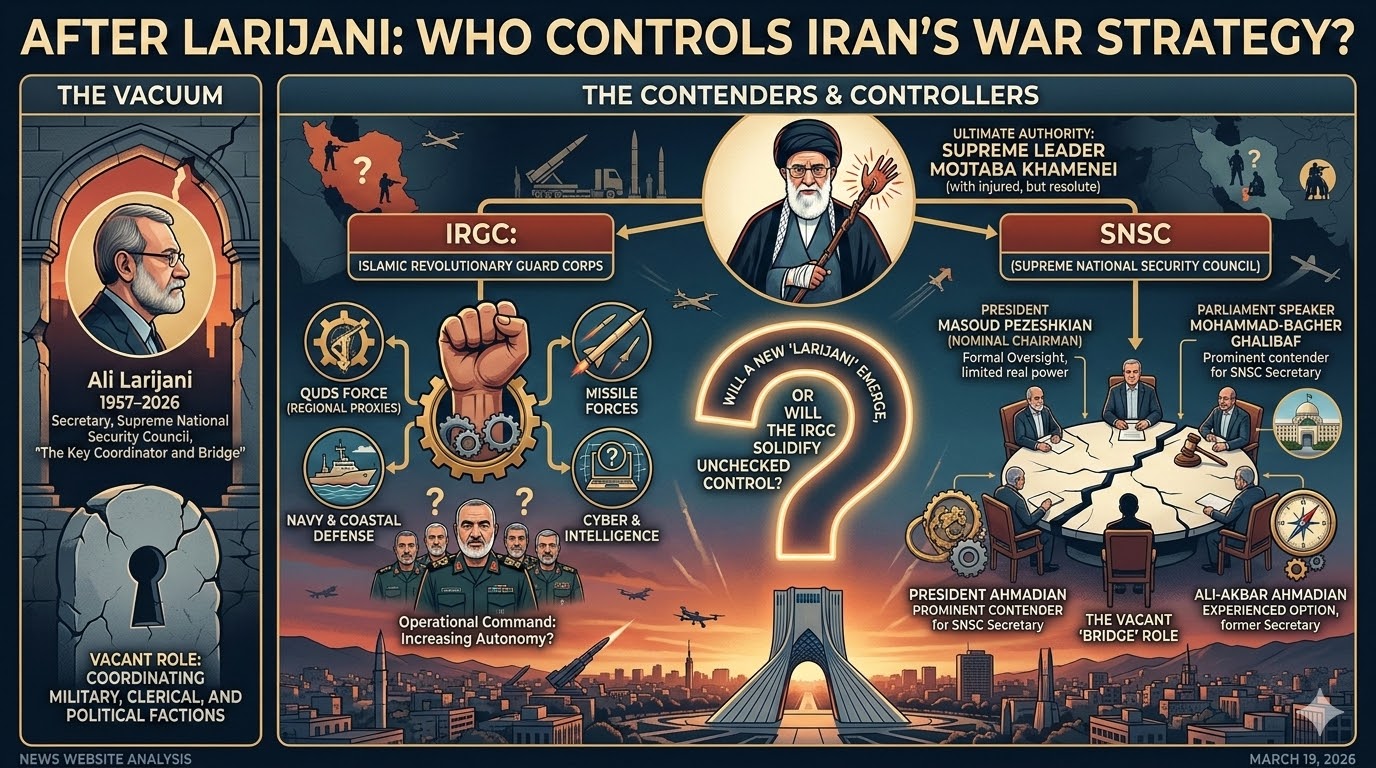
Larijani was not just another senior official. He was widely seen as the regime’s central strategist after the earlier killing of Ali Khamenei, acting as a bridge between Iran’s political elite, clerical establishment, and military command. His removal has therefore created a vacuum that is both institutional and strategic.
A System under Strain
Iran’s political system is designed for resilience, with overlapping power centers intended to ensure continuity even under crisis. Yet the scale and speed of leadership losses—Khamenei, Larijani, and other senior figures—have pushed that system to its limits.
According to recent analysis, Iran now faces a shrinking pool of experienced decision-makers capable of managing both war strategy and state governance simultaneously. This is not merely a crisis; it is a crisis of coherence.
Key positions are being filled rapidly, sometimes temporarily, leading to what U.S. officials have described as a leadership structure where top roles have effectively become “temporary assignments” under constant threat.
The result is a fragmented decision-making environment, where long-term strategic planning is increasingly difficult and reactive responses dominate policy.
The Rise of the Military State
One of the most immediate consequences of Larijani death is the consolidation of power by the Islamic Revolutionary Guard Corps (IRGC). With fewer political heavyweights capable of balancing military influence, the IRGC is tightening its grip over national decision-making.
This shift carries profound implications. Larijani was known as a pragmatic conservative—someone who could engage in diplomacy while maintaining ideological loyalty. His absence removes a moderating force within the system.
In his place, figures with stronger military credentials, such as Mohammad Bagher Qalibaf, are gaining prominence. However, analysts note that while such figures may command operational authority, they lack Larijani’s ability to unify competing factions within Iran’s complex power structure.
The emerging structure is therefore more centralized—but also more rigid, less flexible, and potentially more prone to escalation.
Shrinking Diplomatic Space
Perhaps the most critical impact of Larijani’s killing is the narrowing of Iran’s diplomatic options.
Larijani had long been a key figure in nuclear negotiations and backchannel diplomacy, trusted not only within Iran but also by international actors. His removal significantly weakens Tehran’s ability to engage in credible negotiations at a time when de-escalation channels are urgently needed.
Analysts warn that his absence “casts a deep shadow over diplomacy,” reducing the chances of a negotiated settlement to the war.
This has immediate consequences. Without experienced intermediaries, communication between Iran and global powers becomes more fragmented, increasing the risk of miscalculation.
Retaliation without Restraint
The leadership vacuum is not only constraining Iran’s options—it is also shaping the nature of its response.
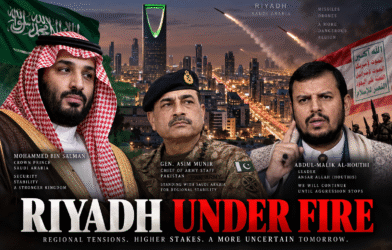
Following Larijani’s assassination, Iran launched missile and drone attacks against Israel and regional targets, signaling that retaliation remains central to its strategy. At the same time, statements from Iran’s new leadership, including Mojtaba Khamenei, emphasize revenge and deterrence rather than negotiation.
This reflects a broader shift: decision-making is becoming more reactive, driven by military imperatives and political survival rather than calibrated strategy.
The Strait of Hormuz Factor
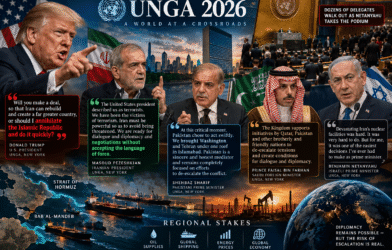
The consequences of this constrained decision-making are most visible in the Strait of Hormuz crisis.
Iran has increasingly relied on asymmetric tactics—attacking shipping lanes, threatening global oil flows, and leveraging its geographic position to impose economic costs on its adversaries. Since the war began, more than 20 attacks on merchant vessels have been recorded, with tanker traffic dropping dramatically.
These actions reflect a strategic calculation shaped by limited options. Unable to match U.S. and Israeli military superiority directly, Iran is turning to economic disruption as its primary leverage.
A Paradox of Weakness and Escalation
The killing of Larijani has weakened Iran—but in a way that may make the conflict more dangerous.
On one hand, the regime’s ability to coordinate complex political and military strategies has been significantly reduced. On the other, the shift toward a more militarized and less flexible leadership increases the likelihood of aggressive, high-risk actions.
Experts warn that leadership decapitation strategies often produce this paradox: rather than collapsing the system, they harden it, empower more radical actors, and reduce the space for compromise.
Conclusion: Fewer, Greater Risk
The assassination of Ali Larijani has done more than remove a key figure—it has fundamentally altered Iran’s strategic landscape.
Decision-making is now more centralized in military hands, diplomacy has been weakened, and policy options have narrowed to a limited set of high-risk choices. In this environment, Iran’s actions are likely to become less predictable and more confrontational.
In effect, the war has entered a new phase—one defined not by strategic clarity, but by constrained, institutional strain, and the growing dominance of force over diplomacy.