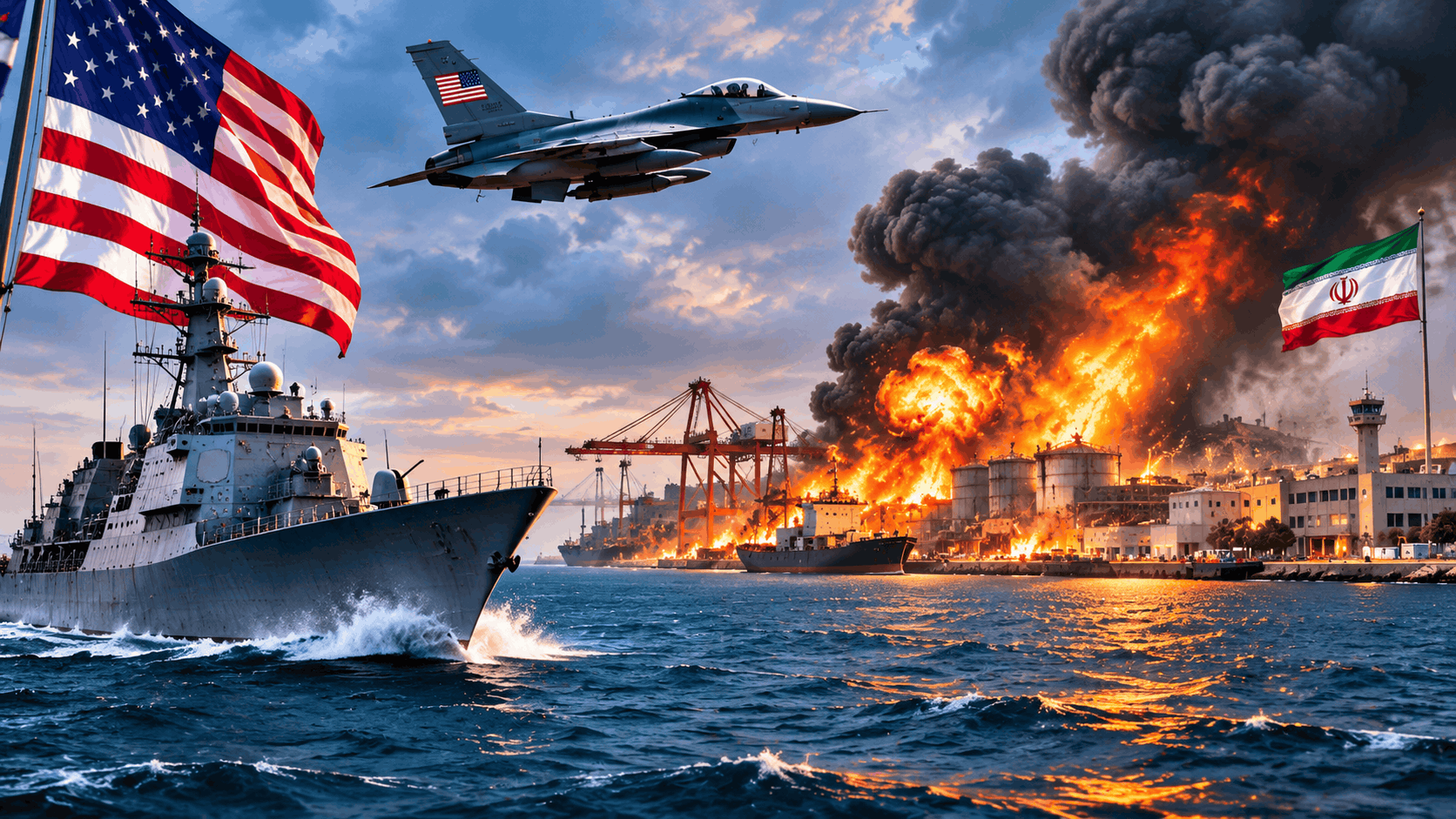
Washington, D.C./Doha, QA: The United States’ latest military strikes against Iranian air-defense infrastructure on November 6, 2026, have once again demonstrated how quickly an apparently limited military engagement can deepen an already dangerous confrontation in the Middle East.
President Donald Trump confirmed that American forces had targeted an Iranian anti-aircraft installation near Qeshm Island, describing the operation as minor and suggesting that the military objective had been accomplished within minutes.
Yet behind the administration’s characterization lies a broader strategic reality: the confrontation between Washington and Tehran remains unresolved, and even carefully restricted military operations carry consequences far beyond their immediate targets.
Iranian state media reported two explosions in the Suza area of Qeshm Island, a strategically significant territory situated near the Strait of Hormuz.
Iranian authorities also claimed that their air-defense forces had intercepted and destroyed an American MQ-1 drone, although that particular claim was not independently established by the available reporting.
The contrasting accounts illustrate the competing military and political narratives surrounding the confrontation, with Washington emphasizing the precision of its strikes and Tehran seeking to demonstrate that its defensive capabilities remain operational.
The significance of the November 6 operation cannot be measured simply by the size of the targeted installation or the duration of the American attack. It must instead be examined within the wider framework of military escalation, regional energy security, domestic American political pressures, and diplomatic efforts to prevent the conflict from expanding.
Qeshm Island: A Strategic Flashpoint at the Entrance to the Persian Gulf
Qeshm Island occupies an exceptionally sensitive geographical position. Located near the northern approaches to the Strait of Hormuz, Iran’s largest island is situated close to a maritime passage through which substantial volumes of internationally traded petroleum and liquefied natural gas normally move.
The island’s military importance extends beyond its location. Reporting has identified underground missile infrastructure and naval facilities there, making it relevant to Iran’s defensive posture and its ability to influence maritime operations around the strait.
Its proximity to commercial shipping routes also means that military activity in the surrounding area can generate immediate concern among shipping operators, insurers, energy traders, and regional governments.
The November 6 strikes were not an isolated incident. American forces had conducted additional operations around Qeshm earlier in the week.
On November 2, U.S. officials described strikes against Iranian positions as defensive measures following an alleged attack on an American aircraft. The recurrence of military engagements in the same geographical area indicates that Qeshm has become an important point of friction between the two countries.
From Washington’s perspective, targeting an air-defense installation can serve several purposes. It may reduce an immediate threat to American aircraft, demonstrate the ability to operate within contested airspace, and discourage Iranian forces from engaging U.S. military assets. Such operations can also communicate that Washington retains the capacity to strike selected targets without initiating a larger campaign.
For Tehran, however, the same operation carries a fundamentally different interpretation. An American strike on Iranian territory challenges national sovereignty and raises concerns about whether limited attacks could gradually develop into a more extensive campaign against Iran’s military infrastructure.
This difference in perception is central to the danger of escalation. What Washington considers a controlled military response may be interpreted in Tehran as part of a sustained effort to weaken Iran’s defensive capabilities?
Trump’s Limited-Strikes Strategy: Deterrence without Full-Scale War?
President Trump’s description of the operation as minor reflects an approach in which military force is employed selectively while diplomatic channels remain available.
Following the strikes, Trump indicated that Washington continued communicating with Tehran and suggested that a negotiated agreement remained possible.
The combination of military pressure and diplomatic engagement reveals the administration’s attempt to preserve coercive leverage without necessarily committing to another major phase of combat operations.
This approach presents both potential advantages and considerable risks.
Limited strikes can allow a government to respond to perceived threats while avoiding the immediate military and economic costs associated with a broader offensive. They can also provide policymakers with flexibility, enabling further diplomatic negotiations while demonstrating that military options remain available.
Nevertheless, limited military operations do not automatically produce limited political consequences.
Iran may respond through direct military action, increased pressure on commercial shipping, or actions involving regional partners and aligned armed groups.
Even if neither Washington nor Tehran seeks a major escalation, repeated exchanges increase the possibility that a miscalculation, an unexpected casualty, or an attack on critical infrastructure could trigger a wider confrontation.
The effectiveness of Trump’s approach therefore depends not only on American military superiority but also on whether Iranian decision-makers interpret U.S. actions as deterrence rather than preparation for a broader offensive.
An additional complication is the absence of a clearly defined political endpoint. Destroying an air-defense installation may accomplish a tactical objective, but it does not necessarily resolve disagreements over Iran’s nuclear activities, regional military influence, sanctions, or maritime security.
Without an accompanying diplomatic framework, repeated limited strikes risk becoming a substitute for political progress rather than a means of achieving it.
Iran’s Military Response and the Battle for Strategic Credibility
Iran’s claim that its forces intercepted an American MQ-1 drone forms part of a wider contest over military credibility.
According to reporting attributed to the Islamic Revolutionary Guard Corps, Iranian air-defense forces claimed to have destroyed the aircraft over Qeshm Island.
Iranian officials also asserted that numerous American unmanned aircraft had been brought down during the broader confrontation. Those cumulative figures remain Iranian military claims rather than independently verified losses.
The distinction matters because military communications during an active conflict serve domestic and international audiences simultaneously.
For Iranian leaders, publicizing successful interceptions can reinforce confidence in national defenses and counter the perception that American or Israeli operations have rendered Iran militarily vulnerable.
For Washington, emphasizing the rapid destruction of an Iranian installation supports the argument that American forces retain substantial operational advantages.
Neither narrative alone provides a complete assessment of battlefield conditions.
Iran’s air-defense infrastructure has faced significant pressure during earlier military operations, including the June 2025 Israeli bombardment and subsequent phases of the current confrontation, according to U.S. assessments.
However, the destruction or degradation of individual systems does not necessarily eliminate Iran’s capacity to rebuild defenses or conduct asymmetric operations.
The Washington Post
The more important strategic question is whether Iran can maintain sufficient military capability to impose costs on American operations while avoiding a confrontation that would threaten its own critical infrastructure.
That calculation is especially complicated around the Strait of Hormuz, where relatively limited military capabilities can generate disproportionate economic disruption.
The Strait of Hormuz: Where Military Escalation Becomes a Global Economic Threat
The Strait of Hormuz represents the most internationally consequential dimension of the confrontation.
The waterway connects the Persian Gulf with the Gulf of Oman and provides access to global markets for major energy exporters, including Saudi Arabia, Iraq, Kuwait, Qatar, and the United Arab Emirates.
Military operations near Qeshm Island therefore affect more than the immediate security relationship between Iran and the United States. They introduce uncertainty into a maritime environment essential to international energy trade.
The economic consequences do not require the complete closure of the strait.
Even intermittent attacks on vessels, increased military patrols, threats against tankers, or restrictions on navigation can raise insurance premiums, complicate shipping schedules, and increase transportation costs.
Energy markets respond not only to actual supply interruptions but also to expectations of future disruption. If traders believe that further attacks could interfere with oil exports, prices may incorporate a geopolitical risk premium even before substantial physical shortages emerge.
For the United States, these developments create a difficult domestic economic challenge.
Higher crude oil prices can contribute to increased gasoline and diesel costs, affecting household transportation expenses and commercial freight operations. Rising fuel costs can subsequently influence food distribution, manufacturing, aviation, and other sectors dependent on transportation.
The consequences are particularly sensitive in an environment where American consumers are already concerned about living costs.
For Asian economies heavily dependent on imported energy, prolonged instability around Hormuz could place additional pressure on trade balances, industrial production, and currency markets. European economies would also remain exposed through global energy pricing and international supply-chain disruptions.
The central economic danger is that a relatively small military engagement near Qeshm could generate uncertainty far exceeding the immediate physical damage caused by the strike.
The Domestic Political Dimension: Trump Faces a Changed Washington
The November 6 operation also occurred at a politically consequential moment in the United States.
The strikes followed the November 3 midterm elections, in which Republicans suffered major congressional losses. Associated Press reporting connected part of the electoral dissatisfaction to public concerns over the administration’s handling of the Iran conflict and the economic effects of elevated fuel prices.
The changed congressional balance creates additional questions about the administration’s future military and diplomatic decision-making.
Although the president exercises substantial authority over military operations, Congress retains constitutional powers concerning war, appropriations, and oversight.
A Congress controlled by the opposition can seek additional information about military objectives, question the administration’s legal justification for continued operations, examine expenditures, and debate restrictions on future military activity.
The War Powers Resolution and the broader constitutional division of military authority may become increasingly relevant if limited strikes continue or expand.
The administration has previously framed operations against Iran as defensive actions intended to protect American forces and regional interests.
In a September 3 communication to Congress, Trump described earlier military action against Iran as limited and undertaken under his constitutional authority as commander in chief.
However, the political debate extends beyond the legality of individual strikes.
Congressional scrutiny may increasingly focus on whether military action is advancing a coherent strategy, what conditions would permit a negotiated settlement, and how the administration intends to protect American economic interests from the consequences of continued hostilities.
For ordinary Americans, the central questions are likely to concern security, military costs, and whether prolonged confrontation will translate into higher household expenses.
The administration’s ability to explain the relationship between military operations and achievable diplomatic objectives will therefore remain important.
Diplomacy Under Pressure: Can Washington and Tehran Negotiate While Exchanging Fire?
The November 6 strikes occurred alongside continuing efforts to develop a diplomatic arrangement.
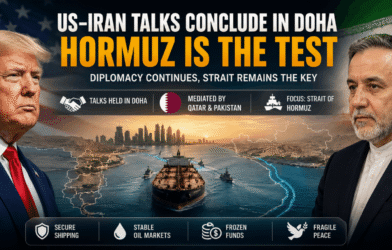
Qatar has been involved in mediation, with proposals reportedly addressing restrictions on maritime activity, frozen Iranian assets, international nuclear inspections, and possible arrangements for reopening the Strait of Hormuz.
One reported framework envisaged initial reciprocal measures followed by broader negotiations concerning Iran’s nuclear program and highly enriched uranium stockpile. The International Atomic Energy Agency has identified a stockpile of 440.9 kilograms of uranium enriched to 60 percent, a level significantly above that required for ordinary civilian nuclear power generation.
These diplomatic discussions highlight the underlying difficulty of resolving the conflict.
Washington seeks security assurances concerning Iran’s nuclear activities and regional military behavior. Tehran, meanwhile, has demanded sanctions relief, access to frozen assets, compensation, and changes to American military and economic pressure.
The two sides therefore approach negotiations with fundamentally different priorities.
Military pressure may strengthen bargaining leverage in some circumstances, but it can also reduce trust and make concessions politically difficult.
For Iranian officials, agreeing to American demands immediately after an attack could be portrayed domestically as capitulation.
For the Trump administration, offering significant concessions while Iranian forces continue challenging American military assets or commercial shipping could generate criticism from Congress and regional partners.
Diplomacy consequently faces a narrow and complicated path.
A sustainable arrangement would likely require credible verification, reciprocal commitments, mechanisms for handling violations, and a shared understanding of how military incidents will be managed during negotiations.
Without those safeguards, even a temporary reduction in hostilities could remain vulnerable to renewed confrontation.
Israel, Gulf States, and the Wider Regional Security Equation
The confrontation also has implications for Israel and the Gulf Arab states, although their security priorities are not identical.
Israel remains concerned about Iran’s nuclear capabilities, missile infrastructure, and relationships with armed groups across the Middle East.
American military action against Iranian defensive installations may therefore affect Israeli assessments of Iran’s remaining military capabilities and the risks associated with future operations.
Gulf governments face a different combination of strategic concerns.
Countries such as Saudi Arabia, the United Arab Emirates, Qatar, Bahrain, and Oman have strong interests in maintaining secure maritime routes, protecting energy infrastructure, and preventing military escalation that could expose their territories or commercial facilities to retaliation.
Their relationships with Washington are important, but so is their geographical proximity to Iran.
For these governments, a prolonged military confrontation presents risks that extend beyond traditional defense considerations. Investment confidence, tourism, aviation, international commerce, and major infrastructure projects can all be affected by perceptions of regional instability.
This explains why diplomatic mediation and military deterrence often proceed simultaneously in the Gulf.
Regional governments may support measures intended to protect maritime navigation while also encouraging negotiations designed to prevent further attacks.
The challenge is ensuring that military operations intended to strengthen regional security do not unintentionally undermine the economic stability that regional governments are seeking to preserve.
The Risk of Escalation through Miscalculation
Perhaps the most important lesson from the November 6 strikes is that escalation does not always result from a deliberate decision to begin a larger war.
It can develop through a sequence of individually limited actions.
An American aircraft encounters Iranian defenses. Washington responds against an air-defense installation. Iran attempts to demonstrate that its military capabilities remain intact. Additional aircraft or vessels enter contested areas, creating new opportunities for confrontation.
Each side may believe that its response is measured and necessary. Yet the cumulative effect can be an increasingly unstable military environment.
The danger becomes particularly serious when military activity takes place close to commercial shipping lanes, civilian infrastructure, and energy facilities.
A strike that damages critical infrastructure causes significant civilian casualties, or leads to the loss of American personnel could fundamentally change the political calculations of both governments.
Equally important is the risk that regional armed groups might undertake operations that Washington attributes to Iranian direction, creating disputes over responsibility and appropriate retaliation.
Reducing these risks requires more than public statements about restraint. It requires reliable military communication, clear operational boundaries, and diplomatic channels capable of functioning during periods of heightened tension.
Conclusion: Tactical Success Cannot Replace a Political Settlement
The November 6 American strikes against Iranian air-defense infrastructure on Qeshm Island illustrate the central contradiction shaping the current U.S.–Iran confrontation.
Washington continues to demonstrate its capacity to conduct targeted military operations, while Tehran seeks to preserve deterrence and resist pressure over its security and nuclear policies. Both governments have incentives to avoid an uncontrolled regional war, yet their continued military exchanges create recurring opportunities for escalation.
The immediate operation may have been limited in duration and scope, but its significance extends into several interconnected arenas: the security of the Strait of Hormuz, the future of nuclear diplomacy, congressional oversight in Washington, regional military calculations, and the cost of energy for consumers around the world.
The decisive question is not whether the United States can destroy an individual Iranian air-defense installation. It is whether military pressure can contribute to a verifiable and durable political arrangement without producing a broader conflict.
For Iran, preserving national security while avoiding further damage to its infrastructure remains a central challenge. For the United States, the task is to reconcile deterrence, diplomatic objectives, regional commitments, and domestic economic concerns.
The experience of repeated military engagements demonstrates that tactical operations and strategic outcomes are not interchangeable.
A limited strike can remove an immediate military threat. It cannot, by itself, resolve the underlying political disagreements that sustain a confrontation.
Ultimately, the significance of November 6 will be determined less by the number of installations destroyed than by what follows: renewed military exchanges, a negotiated reduction in hostilities, or a more comprehensive diplomatic settlement.
The enduring question for Washington and Tehran is whether military force will remain an instrument supporting diplomacy—or whether diplomacy will continue to struggle under the weight of military escalation.