


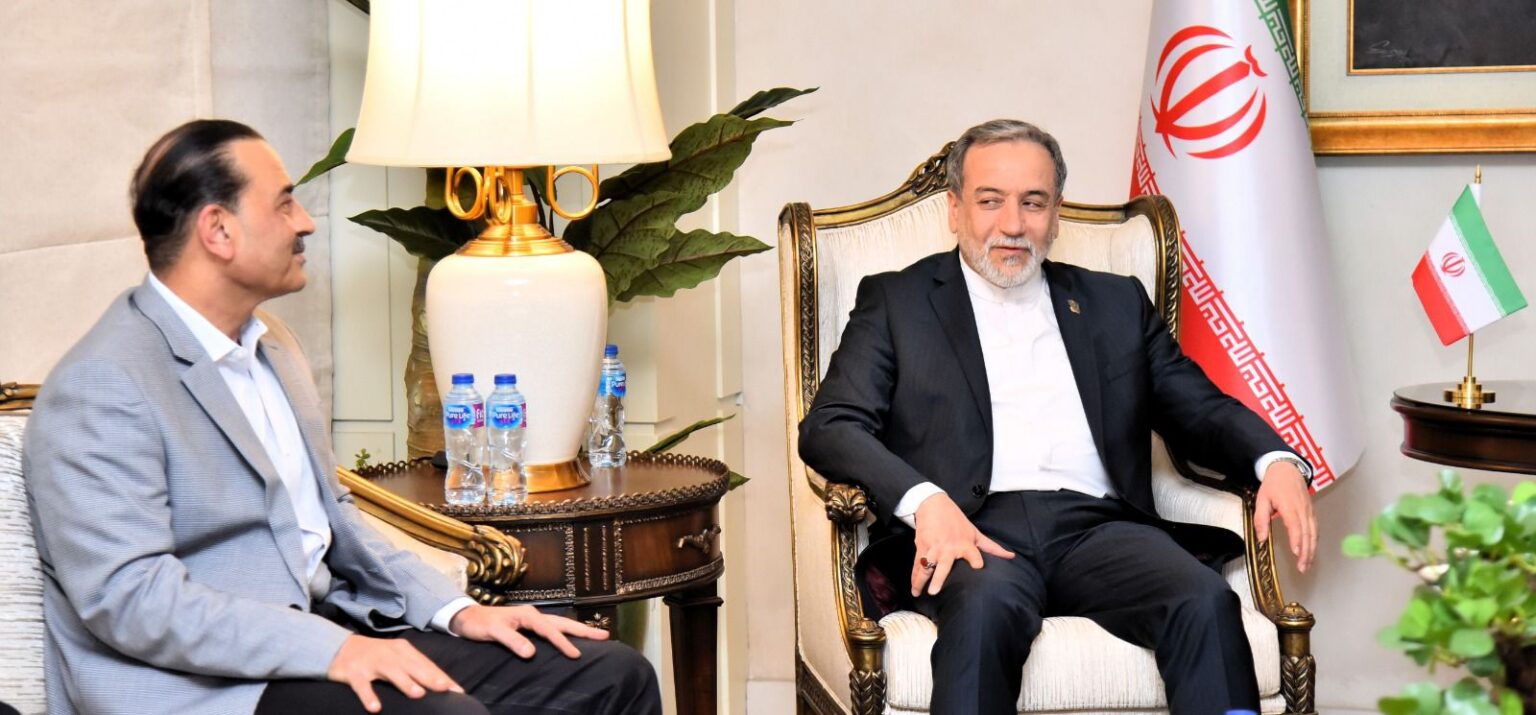
Rochester, NY: The recent visit of Abbas Araghchi to Islamabad cannot be dismissed as routine diplomatic engagement, sharply reduced three-member delegation, the carefully curate meetings, and the sequencing of parallel diplomatic activity point toward a controlled and deliberate backchannel operation rather than a conventional state visit.
Unlike previous Iranian engagements with Pakistan, which often included economic, border, and energy-focused teams, this visit carried the hallmark of urgency and confidentiality.
Minimal personnel typically indicate message delivery rather than negotiation—a sign that Tehran’s objective was precise, time-sensitive, and possibly linked to ongoing regional tensions involving Washington.
Araghchi’s meeting with the chief of Pakistan’s defense forces; General Asim Munir is perhaps the most telling aspect of the visit. In Pakistan’s power hierarchy, such interactions signify more than protocol.
The military establishment in Pakistan remains the primary architect of strategic and security policy, particularly in matters involving Iran, Afghanistan, and the United States.
This meeting suggests that Tehran’s concerns extend beyond diplomacy into security coordination, possibly linked to border stability, proxy dynamics, or maritime tensions around the Gulf.
It also reinforces the notion that any meaningful message intended for Pakistan must pass through Rawalpindi, not just Islamabad.
A Carefully Timed Diplomatic Convergence
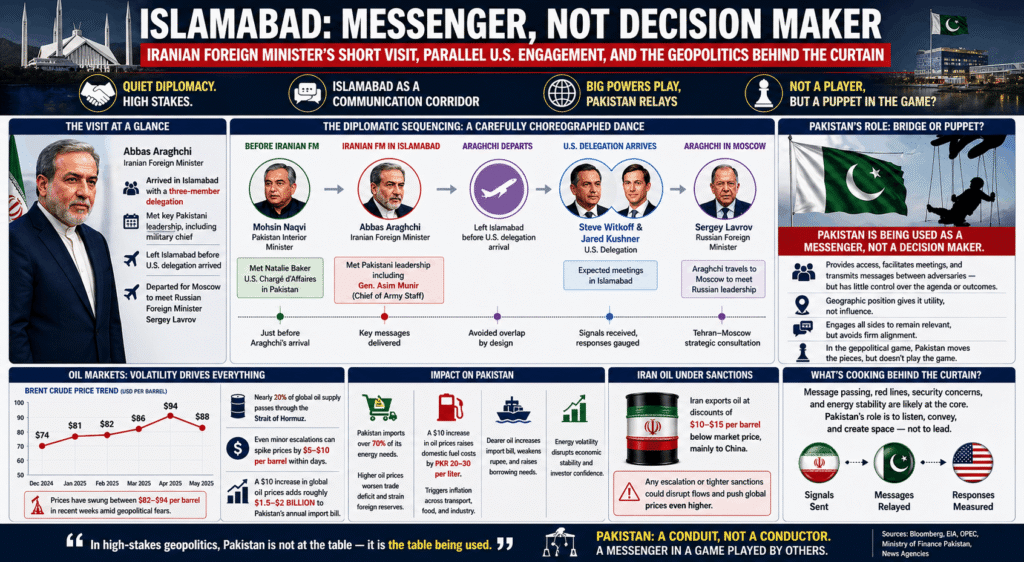
The timeline of events reveals a deeper pattern. Just before Araghchi’s arrival, Mohsin Naqvi the federal interior minister held discussions with Natalie Baker, deputy chief of mission at US Embassy in Pakistan.
Shortly afterward, a U.S. delegation led by Steve Witkoff and Jared Kushner was expected in Islamabad.
Araghchi’s decision to leave before their arrival is not accidental—it reflects diplomatic choreography.
This sequencing allows Pakistan to act as a relay point, where messages are delivered, interpreted, and potentially passed along without direct confrontation between adversaries.
It is a classic model of indirect engagement, often used when tensions are too high for direct dialogue.
Following Islamabad, Araghchi’s immediate departure to Moscow to meet Sergey Lavrov further connects this visit to a broader geopolitical circuit.
Tehran appears to be aligning its messaging across key capitals—Islamabad as the intermediary, and Moscow as the strategic partner.
Oil Markets and the Economic Undercurrent
Beyond diplomacy, the visit must be understood in the context of energy geopolitics. Iran sits on one of the world’s largest oil reserves, and any escalation involving Tehran has immediate consequences for global oil markets.
In recent weeks, Brent crude prices have fluctuated between approximately $82 and $94 per barrel, driven largely by fears of disruption in the Strait of Hormuz—a chokepoint through which nearly 20% of global oil supply passes. Even minor escalatory signals from Iran or the United States can trigger price spikes of $5–10 per barrel within days.
For Pakistan, which imports over 70% of its energy needs, such volatility is economically devastating. A $10 increase in global oil prices can add nearly $1.5–2 billion annually to Pakistan’s import bill, further straining foreign exchange reserves and inflation levels.
Domestic fuel prices, already sensitive, often rise by PKR 20–30 per liter in response to sustained global increases, triggering ripple effects across transport, food, and industrial sectors.
Iran, meanwhile, has been exporting oil under sanctions at discounted rates—often $10–15 below market price—to countries like China. Any shift in sanctions enforcement or regional escalation could either restrict this flow or force prices upward globally.
In this context, Araghchi’s visit may also carry economic signaling: reassurance to partners, warnings to adversaries, and coordination with intermediaries like Pakistan regarding potential supply disruptions or alternative trade channels.
Pakistan’s Strategic Position: Bridge or Bystander?
Islamabad’s role in this unfolding scenario appears increasingly transactional. While Pakistan benefits from its geographic and diplomatic positioning as a bridge between competing powers, its influence over outcomes remains limited.
The convergence of Iranian, American, and Russian diplomatic movements around Pakistan underscores its utility—but also its constraints. Islamabad facilitates, hosts, and relays, but does not set the agenda.
Its leadership engages all sides, yet avoids firm alignment, reflecting a foreign policy driven more by necessity than strategic autonomy.
The visit of Abbas Araghchi, when viewed alongside the parallel U.S. engagement and the Moscow connection, reveals a layered diplomatic maneuver rather than a standalone event.
Pakistan’s involvement, while central in appearance, remains peripheral in substance.
Islamabad is not shaping the narrative—it is enabling it. Acting as a quiet corridor for communication between adversaries, Pakistan occupies the role of a messenger rather than a decision-maker.
In a geopolitical environment defined by great power competition and energy volatility, this position offers relevance but not control.
Ultimately, the events in Islamabad suggest that something significant is indeed unfolding behind closed doors—but the script is being written elsewhere, and Pakistan is merely delivering the lines.
For more news, expert commentary, and strategic analysis, explore the latest reports and features published by The Variant.


