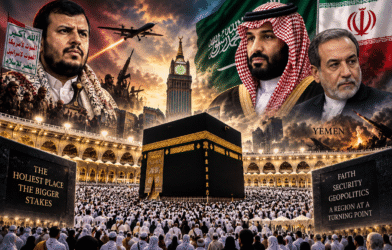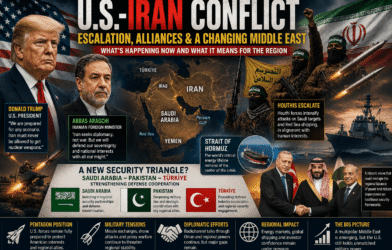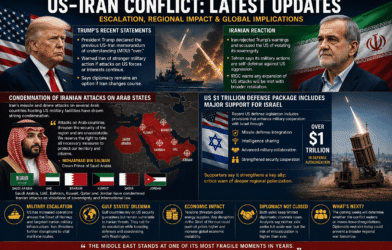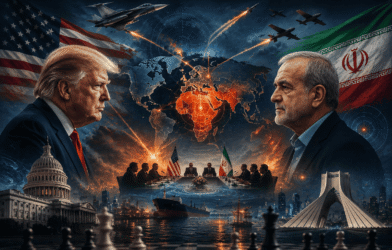
New York City/Doha, Qatar/Riyadh, Saudi Arabia: In 2026, the Middle East war has expanded beyond direct engagements between Iran and the US, into a more perilous phase.
Retaliation from Iran has hit the Gulf States that host American military bases hard, Saudi Arabia is once again the scene of missile and drone assaults, and the war in Yemen has resurfaced as a key battleground.
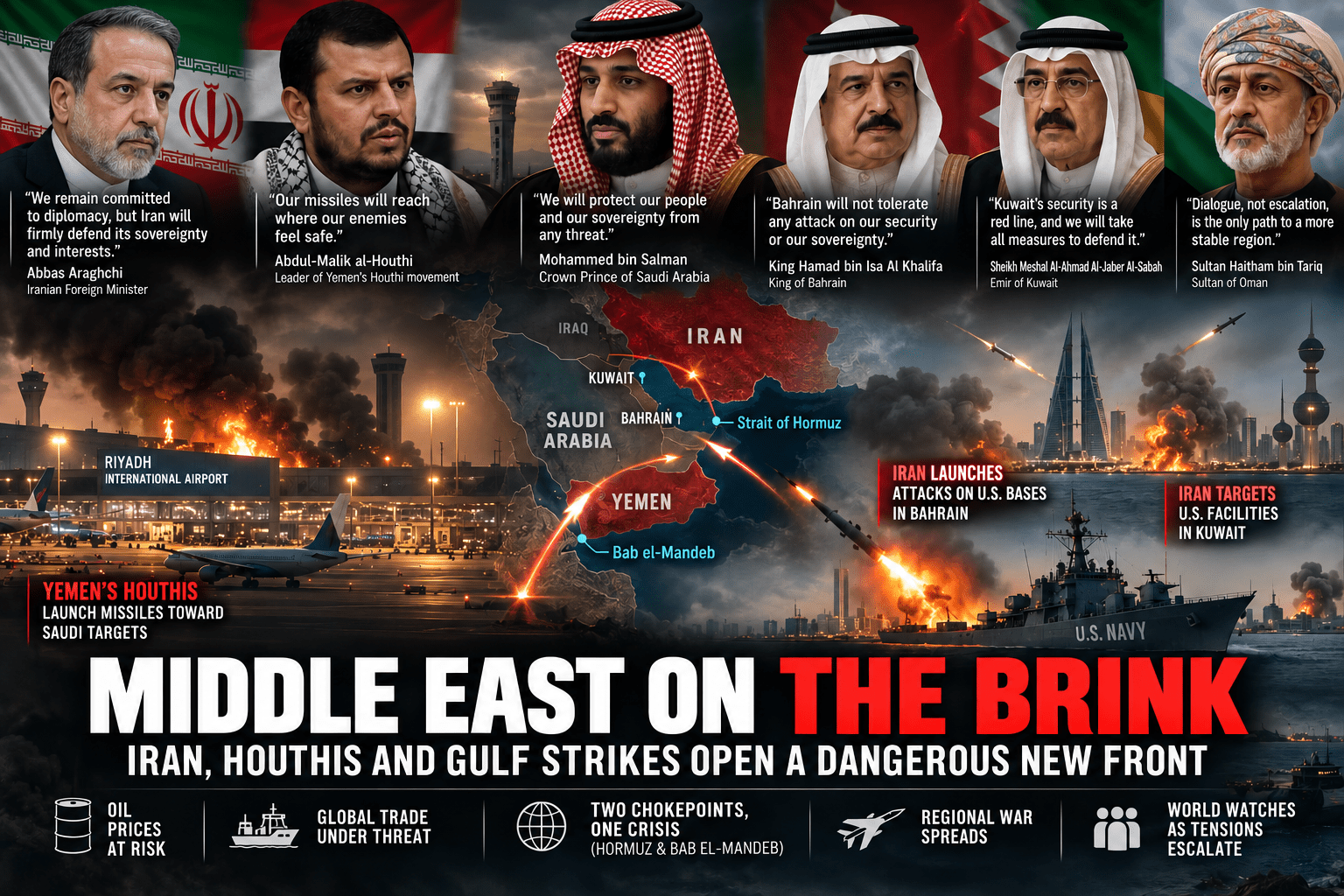
The convergence of two of the world’s most crucial maritime chokepoints, Bab el-Mandeb and the Strait of Hormuz, into a single regional conflict makes these events all the more noteworthy.
Attacks against Saudi Arabian installations associated with Saudi Aramco were carried out by Houthi troops, who are connected with Iran, on September 8.
The targets included Abha International Airport, King Khalid Air Base near Khamis Mushait, and Najran and Jizan.
Multiple energy installations caught fire, and over 70 citizens were injured, according to Saudi officials. The Saudi capital characterized the assaults as an escalation of tensions and an affront to Saudi sovereignty.
In what he called a wide-ranging military action, Houthi spokesperson Brigadier General Yahya Saree stated that the organization had used dozens of ballistic missiles and drones.
Reiterating his earlier warning, Saree accused Saudi Arabia of reviving the conflict and said:
“We will respond firmly to any aggression directed toward our country and its people.”
An even more stern threat came from senior Houthi leader Nasruddin Amer, who told Saudi Arabia that the days of strikes on Yemen being met with “no response” were over.
The Houthis claim Saudi military intervention in Yemen is the reason for their actions. Riyadh has been accused by the Houthi authorities of giving up on attempts to establish a political road plan for Yemen, and the Houthi authorities have justified their reaction as they see fit.
Return of Saudi Airstrikes to Yemen
Yemeni military supported by Saudi Arabia have retaliated militarily.
Saudi air force is playing a significant role once again, and fighting has extended too many areas in Yemen. As the Houthis push down the Red Sea coast of Yemen, Saudi attacks have attacked Houthi-controlled locations, including Mokha airport.
Most notably, Houthi troops reached Perim Island, strategically positioned in the Bab el-Mandeb Strait between Yemen and Africa.
Because of Bab el-Mandeb’s critical role in international shipping—connecting the Red Sea with the Gulf of Aden—the development significantly increases the geopolitical stakes.
The Houthis have threatened “escalation for escalation” while insisting sea transportation remained secure for firms other than Saudi boats.
This makes the Yemen crisis much more than another round of the country’s ongoing civil war.
Gaining power around two critical gates for global oil and commercial shipping might be achieved if the Houthis can increase their military influence around Bab el-Mandeb and Iran can sustain pressure around Hormuz.
This would benefit Tehran and its regional allies.
Threats to Saudi Arabia are emanating from both Yemen and other armed organizations in the area.
Saudi officials claimed drones fired from Iraq attacked the kingdom’s critical East-West oil pipeline, forcing its temporary shutdown.
Because it bypasses the Strait of Hormuz, the pipeline has grown in significance as a means for Saudi petroleum to reach ports on the Red Sea.
According to Riyadh, the assault damaged and injured people along the pipeline that runs between the Riyadh and Medina districts.
Meanwhile, Saudi Arabia said that it would back Baghdad’s efforts to stop additional assaults coming from Iraqi territory and had decided not to react immediately at the request of Iraq’s prime minister.
Because of Iranian pressure near Hormuz, the East-West pipeline and the Red Sea are becoming more significant, and because of Houthi advances toward Bab el-Mandeb, the alternative western export route is threatened. This combination is strategically problematic for Saudi Arabia.
Iran and the United States Involve Bahrain and Kuwait in Their Conflict
Iran has also ramped up its campaign of retaliation against American military installations in the Gulf.
During the renewed September conflict, Iran stated it struck U.S. military forces in Bahrain, Kuwait, Jordan and Iraq’s Kurdistan area after U.S. attacks against Iranian targets.
Iran claimed responsibility for the attacks on Bahrain’s Sheikh Isa Air Base and Kuwait’s Ali Al Salem Air Base, claiming they were targeting American infrastructure. As part of the offensive, Kuwait said it shot down missiles and drones belonging to Iran.
Bahrain holds significant strategic significance since it contains the headquarters of the U.S. Navy’s Fifth Fleet.
The strikes carried out by Iran in September were vehemently denounced by the Gulf Cooperation Council.
The attacks on Bahrain, Kuwait, and Jordan were characterized by GCC Secretary-General Jasem Mohamed Albudaiwi as an affront to regional stability and sovereignty.
However, Iran has maintained time and time again that Gulf States who have granted American soldiers access to their land are inherently complicit in American military actions against Iran.
That posture poses a severe strategic conundrum for Bahrain, Kuwait and other Gulf friends of Washington: American bases offer a vital security cover, but in an escalating U.S.-Iran confrontation, those same facilities might make their territory targets for Iranian reprisal.
Support for Saudi Arabia Galvanizes Gulf States
An unusually wide range of regional voices have condemned the most recent Houthi assaults.
As a “reprehensible act of aggression” that endangers civilians, Qatar denounced the attacks. These actions were condemned by Bahrain as a “dangerous escalation” and a breach of international law.
Oman decried assaults on citizens, economic infrastructure and commercial ships while urged measures to establish circumstances for calm and dialogue.
Pakistan was also in support of Saudi Arabia. The Houthi strike was characterized by Prime Minister Shehbaz Sharif as “cowardly,” and he cautioned that actions like this endanger both innocent lives and regional stability.
This battle between Iran and the Houthis has the potential to destabilize the whole Arabian Peninsula, according to these remarks, which show that even Gulf states that have always wanted to keep in touch with Tehran are worried.
Iranian Capital Cautions against Using Military Force in Yemen
Iran has openly sought to distance itself from the Houthi military’s decision-making process in order to maintain its diplomatic posture.
Instead of a blockade or military actions, Iran’s foreign ministry has urged for talks to settle the problem in Yemen. In response to claims that it was orchestrating the most recent Houthi offensive, Tehran remained silent.
There is a divergence of opinion in Washington. According to U.S. Secretary of State Marco Rubio, “clearly the Iranian hand” was responsible for some of the most recent Houthi actions.
Differences are important. Although the Houthis and Iran are inseparable, it would be a simplification to see all Houthi actions through the lens of an Iranian command, as the group has its own political, military, and territorial goals inside Yemen.
President Trump Refrains from Initiating New Direct War
The escalation is also making President Trump of the United States face a tough decision.
Reuters states that Saudi Crown Prince Mohammed bin Salman requested Trump to provide American military support in the fight against the Houthis.
So far, Washington has offered intelligence support but has refrained from intervening directly.
Subsequently, Trump verified that he had spoken with the crown prince of Saudi Arabia and claimed that the Houthis had contacted his government in an effort to forestall direct U.S. intervention.
The computation makes sense. U.S. forces currently engaged in conflict with Iran would face yet another battlefield if they launched a significant offensive against the Houthis.
But a Houthi effort to control Bab el-Mandeb is also too big for Washington to turn a blind eye to.
Sustained interruption is a worldwide security concern, not just a Middle Eastern one, since the canal is responsible for almost 12% of the world’s commerce (according to data quoted by Reuters).
So, the coming strategic picture is far broader than the conflict in Yemen itself.
Disruption of the Strait of Hormuz has been accomplished by Iran. Saudi Arabia’s East-West pipeline, which aimed to lessen reliance on Hormuz, has suddenly come under threat as the Houthis concurrently increase their military presence near Bab el-Mandeb.
Worries over the availability of energy were already high before news of a new assault on a ship navigating the Strait of Hormuz surfaced.
This forms a remarkable geopolitical triangle, with Bab el-Mandeb on the western side, Saudi Arabia’s cross-country oil infrastructure in the middle, and Hormuz on the eastern side.
Power over or interference with any of these pathways may affect energy markets throughout the world. Concurrent unpredictability in all three areas increases Iran’s possible leverage and puts tremendous pressure on Saudi Arabia and other Gulf oil exporters.
The Front Lines in a Regional Conflict Are Becoming More and Vaguer
So, one missile attack is hardly the most important development.
Conflicts that were once separate are now entwined.
An integrated regional battlefield is taking shape, including the U.S.-Iran clash, the civil war in Yemen, the Saudi-Houthi rivalry, assaults by armed groups associated with Iran, and the security of monarchies in the Gulf.
Saudi Arabia faces the risk of becoming re-ensnared in the Yemen conflict, which it had spent years attempting to limit.
With American military bases on their territory, Bahrain and Kuwait run the risk of becoming retribution zones.
The expanding confrontation raises the prospect of a coordinated reaction from the Gulf States and adds pressure points for Iran.
Territorial advancements near Bab el-Mandeb provide the Houthis influence over one of the world’s most significant maritime lanes, which might be more useful than another missile attack.
Is Saudi Arabia and Iran capable of stopping this cycle from become self-sustaining?
That is the urgent issue.
The informal limits that have kept the Saudi-Houthi rivalry limited for years may vanish entirely if assaults on Saudi land persist and Riyadh reacts by bombing Yemen to greater and greater extent.
By that moment, the Middle East would be confronted with a regional war spanning many fronts, extending from the Strait of Hormuz to the Gulf, Saudi Arabia, Yemen, and the entry of the Red Sea, rather than just an escalation of the Iran-US conflict.
For readers seeking clarity beyond the headlines, The Variant offers context-driven journalism and expert analysis.