


Rochester, NY: The latest annual findings from the Federal Bureau of Investigation, presented through its Internet Crime Complaint Center (IC3), offer one of the clearest and most data-driven pictures of how cybercrime is evolving in the United States.
The 2025 reporting cycle, based largely on 2024 data, shows that cybercrime is no longer a marginal or technical issue—it has become a major economic and social threat affecting individuals, businesses, and critical sectors at an unprecedented scale.
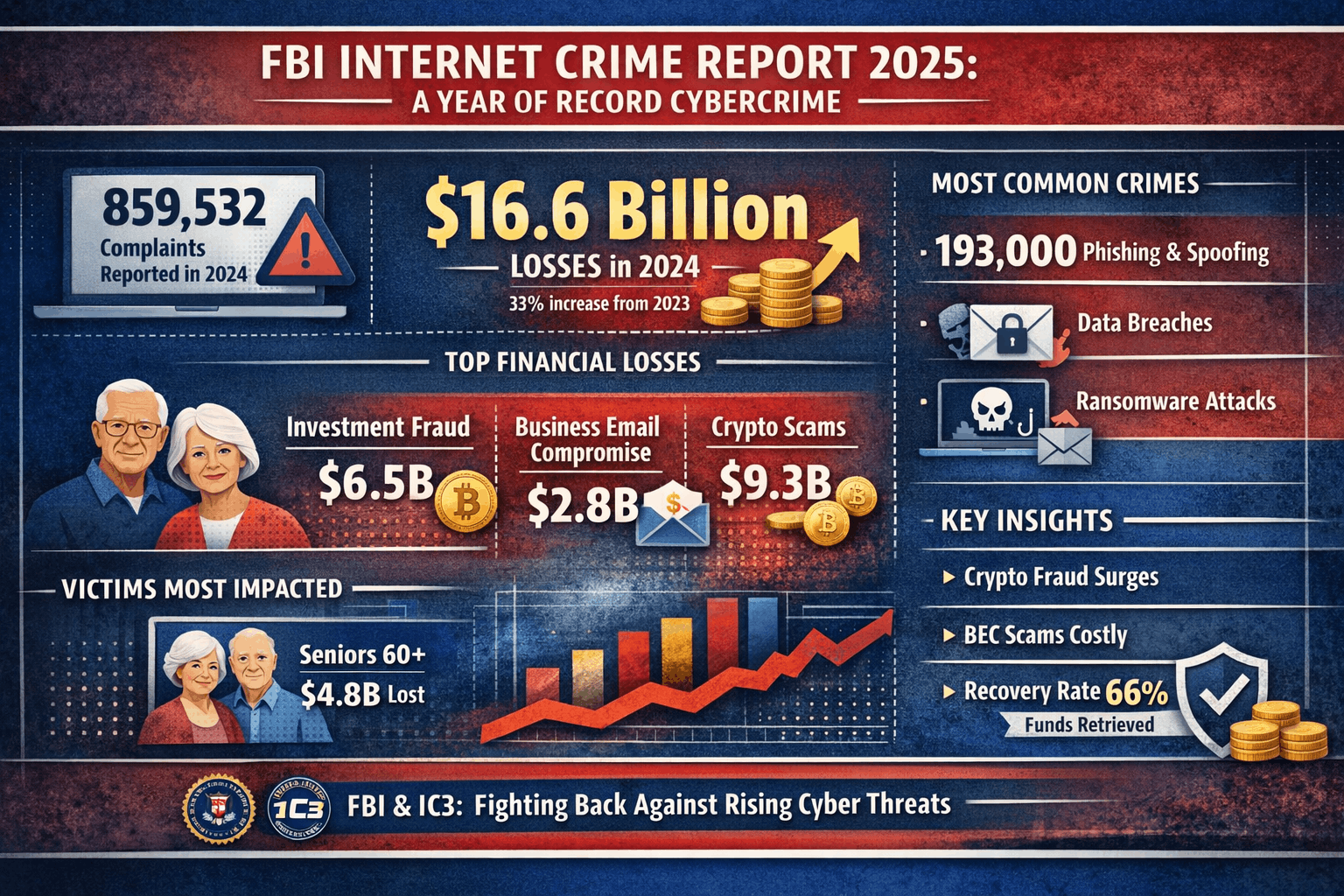
According to the report, the IC3 received 859,532 complaints of suspected internet crime in a single year, reflecting the massive volume of cyber incidents now occurring across the country. Out of these, more than 256,000 cases involved actual financial losses, indicating that a significant portion of cyber incidents are not just attempts but successful attacks.
What makes these numbers more alarming is the financial impact. The total reported losses exceeded $16.6 billion, marking a 33 percent increase compared to the previous year, and setting a new historical record.
This figure alone highlights a critical shift: while the number of complaints has remained relatively stable compared to earlier years, the financial damage per incident is rising sharply. The average reported loss per victim stood at approximately $19,372, showing that cybercrime is becoming more targeted, more sophisticated, and more financially devastating.
A deeper look into the report reveals that cybercrime is heavily concentrated in certain categories. In terms of sheer number of cases, phishing and spoofing attacks were the most common, with nearly 193,000 complaints, followed by extortion and personal data breaches.
These types of crimes often rely on deception rather than technical complexity, exploiting human trust through fake emails, messages, or websites. This suggests that despite advances in cyber security technology, human vulnerability remains one of the weakest points in the digital ecosystem.
However, when measured by financial damage rather than frequency, the picture changes significantly. Investment fraud emerged as the most costly category, accounting for more than $6.5 billion in losses.
A large portion of this was linked to crypto-currency-related schemes, where victims are lured into fake investment platforms or manipulated through long-term social engineering tactics. In fact, crypto-related fraud alone accounted for approximately $9.3 billion in losses, showing how digital assets have become a major tool for cybercriminals.
Another major contributor to financial losses was business email compromise (BEC), a type of fraud where attackers impersonate executives or trusted partners to trick companies into transferring funds.
Although BEC accounted for a relatively smaller number of complaints, it caused around $2.7–$2.8 billion in losses, making it one of the most financially damaging cyber threats. This highlights a key trend in cybercrime: fewer attacks can still cause enormous financial harm if they are precisely targeted.
Other sectors also experienced significant losses. Tech support scams resulted in approximately $1.46 billion in losses, while data breaches contributed to losses exceeding $4.4 billion, reflecting the high value of stolen personal and corporate data in underground markets.
Ransomware attacks, although fewer in number, continued to pose a serious threat to critical infrastructure and businesses, with reported cases increasing by more than 11 percent year-on-year.
The report also sheds light on demographic and sectoral impacts. Individuals aged 60 and above were the most financially affected group, with losses reaching nearly $4.8 to $5 billion, underscoring how cybercriminals often target vulnerable populations.
At the same time, sectors such as healthcare, finance, and critical infrastructure faced growing risks due to their reliance on digital systems and the high value of their data. Cyber incidents in these sectors are not only costly but can also disrupt essential services.
Beyond raw numbers, the IC3 report reflects the growing role of collaboration between the FBI and its partner agencies. The IC3 itself acts as a centralized platform where complaints from individuals, businesses, and international partners are collected and analyzed.
With millions of complaints stored in its database since its establishment, the system allows law enforcement agencies to identify patterns, track criminal networks, and coordinate responses across jurisdictions.
However, the report also acknowledges a major limitation: cybercrime remains significantly underreported, meaning the real scale of the problem is likely far greater than official figures suggest.
Another important operational insight comes from the FBI’s recovery efforts. Specialized teams, such as the IC3 Recovery Asset Team, have been able to intervene in financial fraud cases, sometimes freezing and recovering stolen funds.
In some instances, recovery success rates have reached around 66 percent for certain fraud types, demonstrating that timely reporting can make a critical difference.
What emerges from the report is a clear pattern of evolution in cybercrime. Traditional hacking methods are increasingly being replaced or supplemented by social engineering tactics, where manipulation and psychological pressure are used to deceive victims.
At the same time, the integration of emerging technologies such as crypto-currency has provided criminals with new ways to move and hide money, making investigations more complex.
In conclusion, the FBI’s Internet Crime Report 2025 is not just a statistical document but a reflection of a rapidly changing threat landscape. The record-breaking $16.6 billion in losses, combined with hundreds of thousands of complaints, signals that cybercrime has become a major economic challenge comparable to traditional forms of organized crime.
Yet, the report also points toward solutions. Increased public awareness, faster reporting, stronger cyber security practices, and closer cooperation between government agencies and private organizations can significantly reduce risks.
The message is clear: as society becomes more digitally connected, cyber security is no longer optional—it is a fundamental requirement for economic stability and public safety.


