


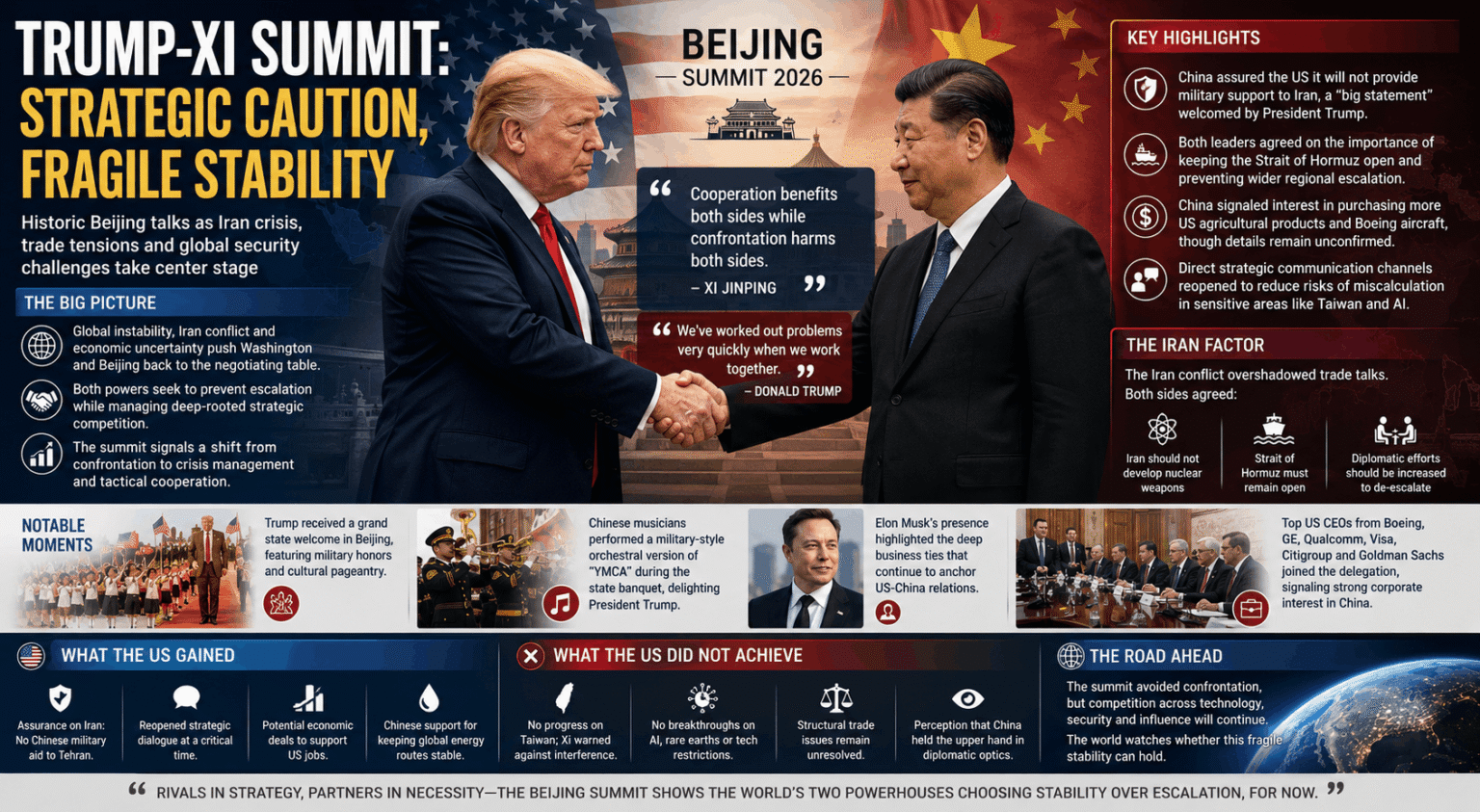
Rochester, NY: The completion of U.S. President Donald Trump’s high-profile visit to China marked one of the most closely watched diplomatic engagements of 2026. Trump Leaves Beijing with Symbolic Wins!
The summit between Trump and Chinese President Xi Jinping came at a moment when the global order was already under strain because of the Iran war, economic instability, tensions over Taiwan, artificial intelligence competition and uncertainty in global energy markets.
The visit was wrapped in extraordinary symbolism, lavish ceremony and repeated public displays of personal chemistry between the two leaders, but the deeper question after the conclusion of the summit remains whether either side truly secured a strategic victory.
A Visit Delayed by War and Global Crisis
Originally expected earlier in the year, Trump’s Beijing trip was postponed because of the rapidly escalating Iran conflict.
By the time Air Force One landed in Beijing, Washington needed Chinese cooperation more than before. Oil markets were volatile, the Strait of Hormuz remained under threat, and the U.S. administration wanted assurances that Beijing would not openly support Tehran militarily.
China entered the summit from a position of relative calm. Beijing projected itself as a stabilizing force while the United States appeared heavily occupied by Middle Eastern tensions and domestic economic pressures.
Several analysts noted that this changed the tone of the summit significantly compared with earlier Trump-era encounters with China.
The Grand Beijing Reception and Diplomatic Theatre
Trump was greeted in Beijing with a full state welcome. Chinese military honors, ceremonial guards, children waving American and Chinese flags and a carefully choreographed reception outside the Great Hall of the People demonstrated Beijing’s intention to present the summit as a meeting between equals.
One of the interesting moments during the visit came during the state banquet when Chinese musicians reportedly performed a military-style orchestral version of “YMCA,” a song closely associated with Trump campaign rallies.
The moment quickly spread across international media and social platforms, symbolizing the unusual mix of diplomacy and political theater surrounding the visit.
Another widely discussed moment occurred when Trump and Xi revisited their long personal relationship during public remarks. Xi stated that “cooperation benefits both sides while confrontation harms both sides,” emphasizing that China and the United States should be “partners rather than adversaries.”
Trump responded warmly, saying that he and Xi had “worked out problems very quickly” whenever tensions emerged.
Observers noticed that Trump adopted a more measured and restrained tone than in many previous foreign visits. He avoided direct attacks on China during public appearances and limited confrontational rhetoric regarding tariffs and Taiwan.
Some American commentators interpreted this as tactical diplomacy, while critics viewed it as a sign that Washington currently needs Beijing’s cooperation on Iran and global energy stability.
The Business Delegation and the Economic Agenda
A major feature of the visit was the presence of influential American business leaders accompanying Trump’s delegation. Executives linked to companies such as Boeing, GE Aerospace, Qualcomm, Visa, Citigroup and Goldman Sachs participated in meetings with Chinese officials.
Elon Musk also drew significant attention during the visit. Musk’s presence was symbolically important because Tesla remains deeply connected to the Chinese market. Chinese media highlighted Musk warmly, viewing him as an example of continued U.S.-China economic interdependence despite political rivalry.
Trump publicly claimed that China had agreed in principle to purchase hundreds of Boeing aircraft and large quantities of American agricultural products. He presented these announcements as proof that his diplomacy could reduce economic tensions while creating American jobs.
However, Chinese officials stopped short of publicly confirming the full scale of the deals. This created skepticism among analysts who argued that many agreements appeared more aspirational than finalized.
Financial markets also reacted cautiously, with investors looking for concrete policy commitments rather than symbolic announcements.
What the United States Gained From the Visit
From Washington’s perspective, the visit achieved several tactical gains even if it failed to deliver historic breakthroughs.
The most important achievement was likely China’s public and private reassurance regarding Iran. Trump stated after the meetings that Xi assured him China would not provide military equipment to Iran. Trump described this as “a big statement.”
This assurance matters because U.S. officials feared Beijing could indirectly strengthen Tehran during the ongoing conflict. Preventing Chinese weapons transfers to Iran became one of the central hidden objectives of the summit.
The United States also succeeded in reopening direct strategic communication channels with Beijing at a dangerous geopolitical moment. Even without major agreements, sustained dialogue reduced the immediate risk of misunderstanding between the world’s two largest powers.
Economically, Trump gained an opportunity to project optimism at home by emphasizing potential trade deals and business cooperation.
At a time when inflation and war pressures were affecting his domestic standing, the Beijing visit allowed him to present himself as an international dealmaker once again.
Diplomatically, Washington also benefited from Xi’s willingness to discuss keeping the Strait of Hormuz open. Stability in the Gulf remains essential for global oil supplies and the American economy.
What the United States Lost or Failed to Achieve
Despite the ceremonial success, Washington left Beijing without major strategic concessions from China.
The Taiwan issue remained unresolved. Xi strongly warned Trump that mishandling Taiwan could lead to conflict. Trump avoided fully endorsing a pending major arms package for Taiwan during the summit, which some American hawks interpreted as a concession to Beijing.
The United States also failed to secure broad commitments regarding artificial intelligence regulation, rare earth exports or long-term trade restructuring. Structural disputes between both powers remain fundamentally unchanged.
Another limitation for Washington was perception. Several international analysts argued that China appeared more confident and strategically patient throughout the summit, while Trump appeared focused on short-term stabilization. Beijing successfully projected itself as calm and indispensable in resolving global crises.
Critics within the United States also questioned whether Trump gave too much diplomatic legitimacy to Xi without obtaining verifiable concessions in return. Some American media described the summit as heavy on symbolism but light on measurable outcomes.
Xi Jinping’s Strategic Objectives
For Xi Jinping, the summit served several broader goals.
First, China wanted to stabilize relations with Washington without sacrificing core national interests. Xi consistently framed cooperation as essential for global stability while firmly defending China’s positions on Taiwan and regional sovereignty.
Second, Beijing aimed to present itself internationally as a responsible global power capable of mediating crises. Xi reportedly indicated willingness to help reduce tensions surrounding Iran and the Strait of Hormuz, positioning China as a diplomatic stakeholder rather than merely an economic actor.
Third, China sought economic reassurance. The presence of top American CEOs allowed Beijing to demonstrate that despite political rivalry, major U.S. corporations still see China as essential for business growth.
Marco Rubio and the Strategic Messaging
Marco Rubio played a central role behind the scenes before and during the summit. Rubio publicly acknowledged before the visit that Iran would dominate discussions with Chinese officials.
Rubio maintained a harder tone toward Beijing than Trump during several earlier statements, especially regarding Chinese ties with Iran and Taiwan. Yet during the summit, the administration appeared united around the goal of preventing escalation rather than intensifying confrontation.
Analysts noted that Rubio’s diplomacy reflected Washington understands that direct U.S.-China hostility during the Iran conflict would be strategically dangerous.
The Iran Question — What Did Trump and Xi Finally Agree On?
The Iran issue became the defining geopolitical topic of the summit.
Trump entered Beijing seeking guarantees that China would not militarily assist Iran and that Beijing would support keeping global energy routes open. Xi, meanwhile, wanted to avoid a broader regional war that could damage China’s energy security and economic interests.
In the final outcome, both leaders appeared to agree on several core principles without signing a formal Iran accord.
They agreed that Iran should not obtain nuclear weapons that the Strait of Hormuz should remain open for international shipping, and that wider regional escalation would be catastrophic for the global economy.
Xi reportedly offered to help facilitate diplomatic efforts aimed at reducing tensions. Trump publicly praised Xi’s willingness to “be of help whatsoever” regarding peace efforts.
However, important differences remained unresolved. China did not commit to ending Iranian oil purchases, and Beijing avoided fully aligning itself with Washington’s pressure campaign against Tehran. China’s position remained focused on de-escalation rather than strategic alignment with U.S. regional objectives.
Final Assessment — A Stabilization Summit Rather Than a Historic Breakthrough
In the end, Trump’s China visit can best be understood as a stabilization summit rather than a transformative diplomatic breakthrough.
The United States achieved limited but important tactical gains, particularly regarding communication with Beijing on Iran and economic signaling. China succeeded in projecting itself as calm, influential and globally indispensable while avoiding major concessions.
Neither side fundamentally changed its position on Taiwan, trade competition or long-term strategic rivalry. Yet both leaders appeared determined to prevent current tensions from spiraling into direct confrontation.
The summit ultimately demonstrated an uncomfortable reality shaping international politics in 2026: Washington and Beijing increasingly view each other as rivals, but global crises — from Iran to energy security to economic instability — make complete confrontation too dangerous for either side to risk.
Stay Tuned The Variant US!


