


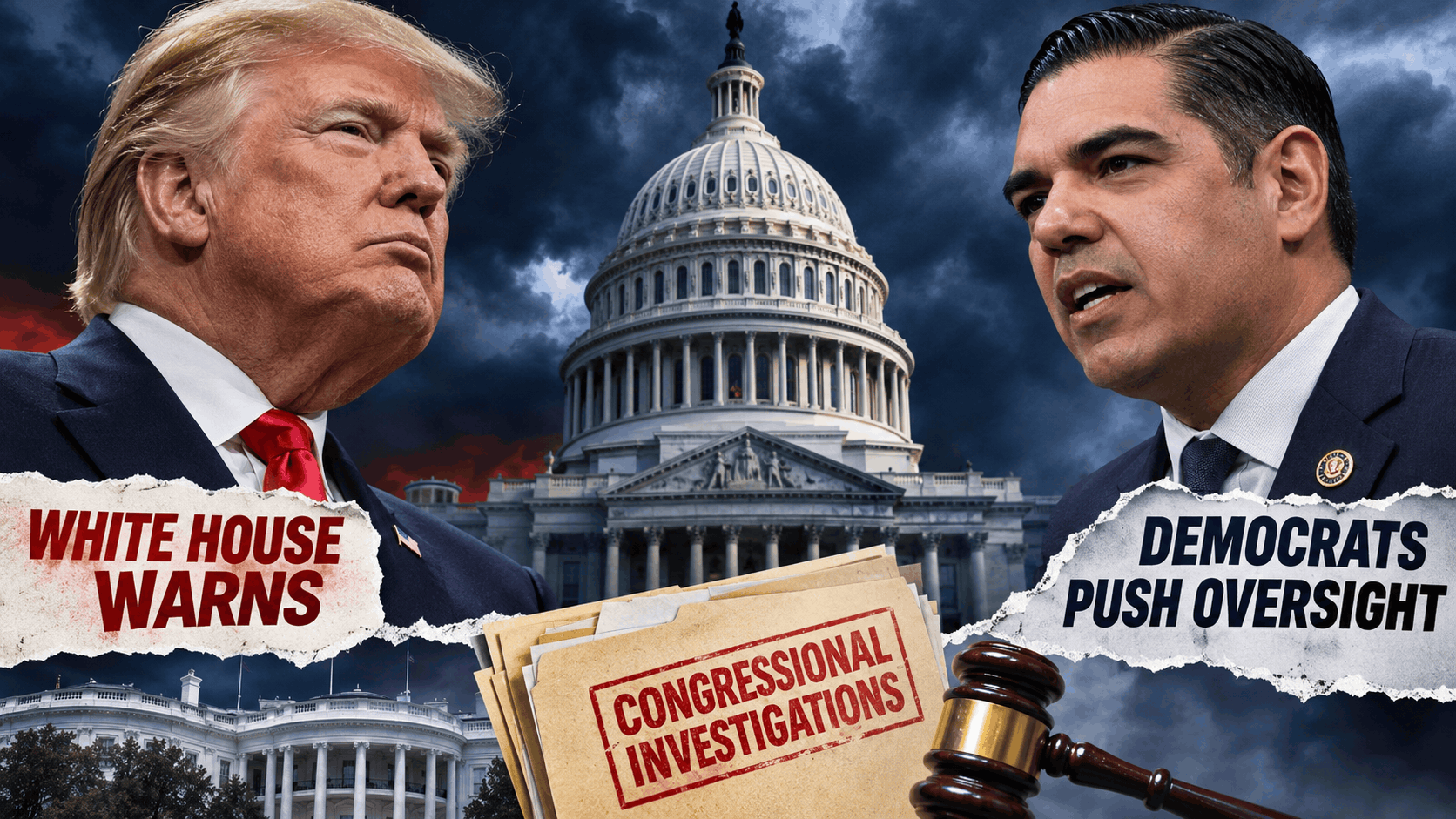
Washington, D.C: The political confrontation between President Donald Trump and congressional Democrats is entering a potentially decisive phase, with the White House signaling that it will closely scrutinize Democratic plans to investigate the administration once the new Congress convenes in January 2027.
At the center of this emerging conflict is a letter from White House counsel Will Scharf to Democratic Representative Robert Garcia of California, who is positioned to assume leadership of the powerful House Oversight Committee.
According to the media reports, the Trump administration is “monitoring” what Scharf described as Democrats’ “abusive and capricious threats” to initiate congressional investigations.
Although the language may appear to be another episode in Washington’s increasingly confrontational political environment, its constitutional significance extends considerably beyond partisan rhetoric.
The dispute reflects a fundamental struggle over the boundaries of presidential authority, Congress’s investigative responsibilities, and the extent to which an administration can resist scrutiny from a politically hostile legislature.
For Trump, whose political identity has long been shaped by confrontation with institutional opponents, the prospect of aggressive Democratic oversight represents a significant challenge. For Democrats, the opportunity to investigate executive decisions offers a powerful instrument to examine government conduct and potentially influence the administration’s remaining two years.
The resulting confrontation could become one of the defining institutional battles of Trump’s second presidency.
The White House Warning: Legal Defense or Political Intimidation?
The wording attributed to Scharf is particularly consequential because it originates from the White House counsel’s office, an institution responsible for advising the presidency on legal and constitutional matters.
Describing prospective investigations as abusive and capricious before their precise scope, evidence, or procedural foundations have been established raises important questions about the administration’s approach to congressional oversight.
From the White House’s perspective, the warning can be understood as an effort to prevent politically motivated investigations designed primarily to embarrass the president, disrupt executive operations, or generate damaging headlines.
Republicans have repeatedly argued that congressional investigative powers can be misused for partisan purposes. They point to previous investigations involving Trump as evidence that legislative oversight sometimes becomes indistinguishable from political warfare.
Democrats, however, are likely to interpret the administration’s language differently.
A warning that the executive branch is monitoring congressional investigative plans may be perceived as an attempt to discourage lawmakers from exercising constitutional responsibilities.
Yet the legal distinction is essential. A White House warning, however confrontational, does not automatically constitute unlawful interference. Equally, congressional investigations are not inherently legitimate merely because they are initiated by an opposition party.
Their legitimacy depends on legislative purpose, procedural safeguards, evidentiary foundations, and respect for constitutional limitations.
The central question is therefore whether the administration intends to challenge specific abuses of investigative authority or resist oversight as a matter of political principle.
A Warning That Goes Beyond Political Rhetoric
The controversy intensified after reports revealed that Scharf’s November 9 letter went beyond questioning Democrats’ motives.
It suggested that certain investigative actions, including unlawful subpoenas intended to deprive individuals of constitutional rights, could warrant further investigation and potentially involve criminal conduct.
Garcia responded forcefully, rejecting the administration’s interpretation and asserting Congress’s independent constitutional authority. He argued that lawmakers would not be deterred from investigating alleged corruption and abuses of power.
The exchange followed Garcia’s public warning that administration officials should prepare for aggressive oversight after the Democratic midterm victories. His confrontational language provided the White House with an opportunity to portray the incoming investigations as politically motivated.
Nevertheless, the letter’s significance lies in its suggestion that congressional investigators themselves could become subjects of executive-branch scrutiny. That possibility introduces a troubling institutional question: could the threat of prosecution discourage lawmakers from investigating the government they are constitutionally empowered to oversee?
Congressional Oversight and the Constitutional Separation of Powers
The American constitutional system distributes authority among three branches of government precisely to prevent excessive concentration of power.
Article I establishes Congress’s legislative responsibilities, while Article II assigns executive authority to the president.
Although the Constitution does not explicitly describe a comprehensive congressional investigative power, the Supreme Court has repeatedly recognized oversight as an essential component of legislative authority.
Congress may investigate executive agencies, examine government spending, request documents, summon witnesses, and issue subpoenas within established legal boundaries.
The Supreme Court has also emphasized that investigations must serve legitimate legislative purposes rather than function exclusively as instruments of punishment.
This distinction provides an important foundation for Scharf’s legal argument. However, the Congressional Research Service explains that legitimate legislative purposes are interpreted broadly, including examinations of existing laws, administrative performance, and possible legislative reforms.
Consequently, political disagreement with an investigation does not, by itself, make that investigation unconstitutional.
Robert Garcia and the Democratic Investigative Agenda
Garcia’s anticipated chairmanship could transform the House Oversight Committee into a central institution of Democratic resistance to Trump’s domestic and foreign policy agenda.
Potential investigations include immigration enforcement, the administration’s handling of Jeffrey Epstein-related records, allegations involving financial conflicts of interest, and relationships between government officials and private corporations.
Democratic lawmakers have also indicated interest in examining the administration’s conduct during the Iran conflict and its implications for federal spending and national priorities.
These investigations could expose administrative weaknesses, produce legislative recommendations, or reveal evidence requiring further examination.
However, the mere announcement of an investigation does not establish wrongdoing. Allegations must be tested against documentary evidence, credible testimony, and applicable law.
For Garcia, the challenge will be converting political momentum into credible institutional accountability.
An oversight strategy grounded in evidence could strengthen public confidence. One dominated by personal confrontation risks reinforcing the White House’s argument that Democrats are pursuing retaliation rather than reform.
Trump’s Political Vulnerability after the Midterm Elections
The confrontation cannot be separated from the changing political balance in Washington.
Democratic gains in the November 2026 midterm elections have altered the institutional environment confronting Trump. With Democrats preparing to control both chambers of Congress, the administration faces greater scrutiny and more difficult prospects for advancing its legislative priorities.
The political consequences could extend into the 2028 presidential election.
Congressional hearings have the potential to keep controversies involving immigration, executive authority, federal spending, and foreign policy at the center of national debate.
For Republicans, repeated investigations could complicate efforts to rebuild support among independent voters. Conversely, excessive partisan confrontation could strengthen Trump’s argument that Washington’s political establishment remains determined to undermine his presidency.
The decisive factor may be whether congressional investigations uncover substantive failures that affect ordinary Americans.
Public concern about living costs, government efficiency, immigration policy, and international instability could prove more politically consequential than personal disputes between senior politicians.
Immigration, Foreign Policy, and the Economic Consequences
Immigration enforcement may become one of the most contentious areas of Democratic oversight.
Congressional committees could examine detention conditions, deportation procedures, enforcement expenditures, due-process protections, and the treatment of asylum applicants.
Such inquiries would not automatically reverse executive immigration policies. Nevertheless, they could generate public pressure, influence appropriations, and provide evidence supporting legislative reforms or judicial challenges.
Foreign policy presents another potential battlefield.
Investigations into the administration’s handling of the Iran conflict, military expenditures, and relationships with Middle Eastern allies could test whether executive decisions have been accompanied by adequate congressional consultation and transparent assessments of their consequences.
The economic dimension is equally important.
Prolonged political conflict could complicate budget negotiations and federal appropriations, while heightened scrutiny of government spending could also identify inefficiencies.
The outcome will depend on whether congressional oversight improves policy decisions or becomes another source of legislative paralysis.
The Courts May Become the Final Arbiters
If the White House refuses to comply with congressional subpoenas, the dispute could move into federal courts.
Previous confrontations between the Trump administration and Congress demonstrate that litigation over executive privilege, testimony, and document production can continue for extended periods.
Judicial intervention may determine whether particular subpoenas serve legitimate legislative purposes and whether the executive branch has valid grounds to withhold requested information.
Lawmakers also possess significant protections under the Constitution’s Speech or Debate Clause, although those protections are not unlimited.
The administration cannot simply declare a lawful congressional investigation criminal because it considers the inquiry politically hostile.
Likewise, Congress cannot disregard constitutional rights or established legal limitations while exercising its investigative authority.
The courts may therefore play a decisive role in distinguishing legitimate institutional resistance from unlawful obstruction or abuse.
A Test of American Democracy beyond Trump and Garcia
The confrontation between Will Scharf and Robert Garcia represents more than a dispute over congressional subpoenas.
It illustrates the increasingly adversarial relationship between America’s political institutions at a moment when partisan polarization has weakened public confidence in government.
The White House has a legitimate interest in protecting executive functions against unlawful interference. Congress has an equally legitimate responsibility to investigate government conduct, expose misconduct where evidence supports it, and ensure public accountability.
Neither responsibility should become subordinate to partisan loyalty.
For Trump, cooperation with credible oversight could demonstrate institutional confidence, even amid fierce political disagreement. For Democrats, disciplined investigations supported by verifiable evidence could establish that their electoral victory represents a mandate for accountability rather than political revenge.
The danger arises when either branch treats constitutional checks as illegitimate simply because they are exercised by political opponents.
Conclusion: The Battle for Accountability Has Only Begun
The Scharf-Garcia confrontation offers an early indication of how turbulent Washington could become when the new Congress assumes power in January 2027.
The Trump administration appears determined to challenge what it regards as politically abusive investigations, while Democrats are preparing to use their newly acquired congressional authority to examine presidential decisions and executive conduct.
The resulting struggle could shape the remainder of Trump’s presidency, influence Republican and Democratic strategies for 2028, and establish important precedents concerning congressional oversight.
Ultimately, the most consequential question is not whether Trump can withstand Democratic investigations or whether Garcia can compel the White House to cooperate.
It is whether America’s constitutional institutions can exercise their powers without turning legitimate accountability into political punishment.
A democracy is not weakened when Congress investigates the president, nor when the president lawfully challenges congressional overreach. It is weakened when either branch attempts to place itself beyond constitutional scrutiny.
The coming confrontation will test whether Washington’s leaders recognize that distinction.


