


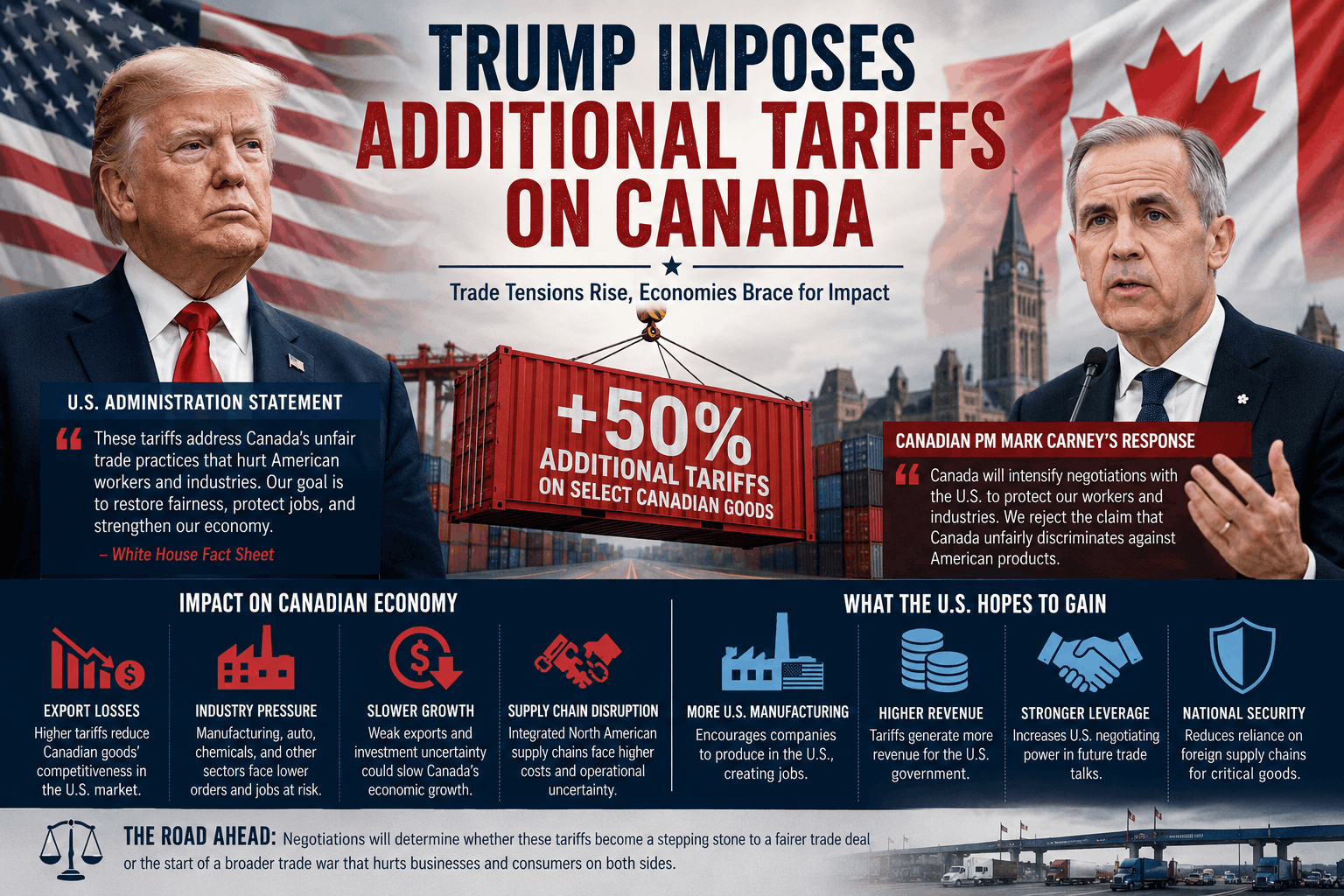
Washington, D.C/Ottawa, CA: The latest tariff measures announced by President Donald J. Trump mark another significant escalation in trade tensions between the United States and Canada.
In a White House fact sheet released alongside three presidential proclamations, the Trump administration announced additional 50% tariffs on selected Canadian goods under Section 338 of the Tariff Act of 1930.
The administration argued that the measures are a response to what it described as Canada’s “discriminatory treatment” of American products, particularly in sectors including automobiles, dairy, alcohol, and other manufactured goods.
According to the White House, the tariffs are intended to restore fairness in bilateral trade, protect American workers, and counter policies that Washington believes place U.S. businesses at a competitive disadvantage.
The decision comes at a particularly sensitive time. The United States and Canada remain each other’s largest trading partners, exchanging hundreds of billions of dollars in goods annually through deeply integrated supply chains established under the United States-Mexico-Canada Agreement (USMCA).
Any disruption therefore carries consequences extending well beyond customs duties, affecting manufacturers, exporters, consumers, and investors on both sides of the border.
The Trump Administration’s Position
President Trump has consistently argued that tariffs serve as an instrument to rebalance trade relationships that he considers unfair to American industry.
The White House stated that Canada has imposed policies that discriminate against U.S. commerce while granting more favorable treatment to other foreign competitors.
The administration contends that these additional duties are legally justified under Section 338 because Canadian actions allegedly burden American commerce in ways inconsistent with reciprocal trade principles.
Administration officials further emphasized that the tariffs are designed to encourage companies to manufacture more products inside the United States.
They argue that reducing dependence on foreign manufacturing strengthens domestic employment, protects strategic industries, increases federal tariff revenue, and enhances long-term national economic resilience.
The White House also maintains that the tariffs are intended to strengthen America’s negotiating position ahead of broader North American trade discussions following the review of the USMCA framework.
President Trump has repeatedly framed tariffs not merely as economic policy but as leverage.
His broader trade philosophy suggests that higher import duties can compel trading partners to negotiate concessions that Washington considers beneficial for American workers and manufacturers.
Canadian Prime Minister Mark Carney’s Response
Canadian Prime Minister Mark Carney criticized the latest U.S. measures while simultaneously signaling that Ottawa remains committed to dialogue rather than immediate escalation.
Following the announcement, Carney stated that Canada would intensify negotiations with Washington in an effort to protect Canadian industries and preserve long-term economic cooperation.
At the same time, Carney rejected the U.S. characterization that Canada unfairly discriminates against American products.
Canadian officials have maintained that existing policies comply with international trade obligations and that many sectors targeted by Washington have long operated under negotiated arrangements within North American trade agreements.
Carney also emphasized that Canada’s objective remains the protection of Canadian workers, manufacturers, and exporters while avoiding an unnecessary trade war that would damage both economies.
Provincial leaders across Canada expressed concern over the potential impact on businesses and employment; with several calling for a coordinated national response should negotiations fail.
Economic Consequences for Canada
The immediate economic impact is expected to fall disproportionately on export-oriented Canadian industries. Since approximately three-quarters of Canadian merchandise exports traditionally enter the U.S. market, additional tariffs reduce price competitiveness and increase uncertainty for manufacturers.
Industries producing chemicals, plastics, processed materials, machinery, consumer goods, and automotive-related products could experience declining orders if American importers seek alternative suppliers or shift production domestically.
Smaller Canadian manufacturers, which often operate with narrower profit margins, may face greater financial pressure than multinational corporations capable of diversifying production.
Reduced export volumes could eventually translate into slower industrial production, lower investment, and potential job losses in manufacturing regions.
Economists have suggested that while the affected exports represent only a modest share of Canada’s overall GDP, prolonged tariffs could weaken business confidence and delay private-sector investment decisions.
Another challenge lies in supply chain uncertainty. Many Canadian firms operate within integrated North American manufacturing networks where components cross the border multiple times before final assembly.
Additional tariffs increase production costs throughout these supply chains, reducing overall efficiency.
Financial markets also tend to react negatively to prolonged trade uncertainty. Investors often postpone expansion projects when future market access becomes unclear, potentially slowing Canada’s broader economic growth.
Potential Benefits Sought by the United States
From the Trump administration’s perspective, the tariffs pursue several long-term strategic objectives.
First, they aim to encourage manufacturers to relocate production into the United States. If higher import costs make Canadian products less competitive, companies may find it more economical to establish or expand American manufacturing facilities.
Second, tariffs generate additional government revenue. Although economists debate whether tariff revenues offset higher consumer prices, the administration views them as an important fiscal tool while broader industrial policies take effect.
Third, Washington seeks increased leverage in future trade negotiations. By demonstrating a willingness to impose substantial economic costs, the administration hopes Canada will reconsider policies that American officials believe disadvantage U.S. exporters.
Fourth, the administration argues that stronger domestic manufacturing contributes to national security by reducing dependence on foreign production for strategic sectors including automobiles, industrial materials, and critical supply chains.
The Risks for the United States
Despite these anticipated benefits, the policy also carries notable risks for the American economy.
Many U.S. manufacturers rely on Canadian raw materials, intermediate goods, and industrial components. Higher import costs may increase production expenses for American companies, potentially raising prices for consumers.
Several sectors—including automotive manufacturing—operate through highly integrated North American supply chains developed over decades. Disrupting these networks may temporarily reduce efficiency and competitiveness relative to European or Asian producers.
American consumers may also experience higher prices if businesses pass increased import costs through to retail markets. Inflationary pressures could become more pronounced if tariffs remain in place for an extended period.
Economists also caution that retaliatory Canadian measures could reduce export opportunities for American farmers, manufacturers, and service providers.
Previous trade disputes have demonstrated that tariff escalation often produces economic costs on both sides rather than clear winners.
Implications for the Future of USMCA
The tariff dispute arrives during a critical period for the future of North American trade cooperation.
Rather than simply implementing routine reviews under the USMCA, Washington has pursued separate negotiations with Canada and Mexico, introducing uncertainty regarding the long-term structure of regional trade.
Some analysts believe the tariffs are intended primarily as negotiating leverage rather than a permanent shift toward protectionism.
Others argue they reflect a broader transformation in U.S. trade policy that increasingly emphasizes bilateral bargaining and economic nationalism over multilateral trade arrangements.
Canada, meanwhile, faces the challenge of defending domestic industries while preserving access to its largest export market. This balancing act will likely define Ottawa’s negotiating strategy in the coming months.
Strategic Assessment
The latest tariff measures illustrate two competing economic philosophies. The Trump administration views tariffs as a legitimate tool to correct perceived trade imbalances, stimulate domestic manufacturing, and strengthen America’s negotiating position.
Canadian officials, by contrast, argue that stable, rules-based trade under existing agreements offers greater long-term prosperity for both countries.
Whether the strategy succeeds will depend on several variables: Canada’s willingness to negotiate, the resilience of integrated North American supply chains, investor confidence, and the duration of the tariffs themselves.
If negotiations produce revised trade arrangements acceptable to both governments, the tariffs may ultimately serve as temporary leverage. However, if tensions escalate into a prolonged trade confrontation accompanied by retaliatory measures, businesses and consumers on both sides of the border could face higher costs, slower investment, and reduced economic growth.
Ultimately, while the United States may achieve gains in domestic manufacturing investment and increased negotiating leverage if companies shift production south of the border, those benefits must be weighed against potential inflationary pressures, higher input costs for American industries, and the broader economic consequences of disrupting one of the world’s most integrated bilateral trading relationships.
The coming negotiations between Washington and Ottawa will therefore determine whether the current tariffs become a catalyst for a revised North American trade framework or the beginning of a more prolonged period of economic friction.
Stay informed with The Variant for in-depth analysis, breaking developments, and expert perspectives on the stories shaping our world.


