Buffalo, NY: The decision by Donald Trump to extend the ceasefire with Iran marks a critical turning point in an already volatile conflict. Announced just hours before the truce was set to expire, the move reflects not only a shift in tactical calculations but also the broader contradictions embedded in Washington’s approach—balancing military pressure with diplomatic signaling.
Trump’s extension of the ceasefire came despite earlier rhetoric suggesting a return to military action. In media remarks, he had warned that without progress, he would “expect to be bombing,” signaling readiness for escalation. Yet, in a notable reversal, he opted to prolong the pause, stating on social media that the United States would “hold off on attacking Iran” until Tehran presents a “unified proposal.”
This shift reveals a dual-track strategy: maintain pressure while avoiding immediate conflict. The ceasefire extension, therefore, is less a concession and more a calculated delay—intended to extract diplomatic movement from a divided Iranian leadership.
Trump’s communication strategy has been central to shaping the narrative. On Truth Social, he framed the extension as a response to requests from Pakistani mediators and internal divisions within Iran. He emphasized that the pause was conditional, not indefinite; reinforcing his message that time for diplomacy is limited.
In another tone, Trump projected strength, warning that the U.S. retains the capability to escalate rapidly if negotiations fail. This blend of coercion and flexibility—often delivered through short, direct social media posts—has become a defining feature of his foreign policy approach.
A key complication is that the ceasefire extension is not fully mutual. Iran has expressed skepticism, with officials suggesting the move could be a tactic to regroup militarily. Meanwhile, Tehran continues to demand the lifting of the U.S. naval blockade, which it views as a violation of the truce.
This asymmetry highlights a fundamental weakness: the ceasefire exists more as a temporary pause in hostilities than a jointly agreed pathway to peace. Without alignment on basic terms, the extension risks becoming a fragile holding pattern rather than a meaningful step toward resolution.
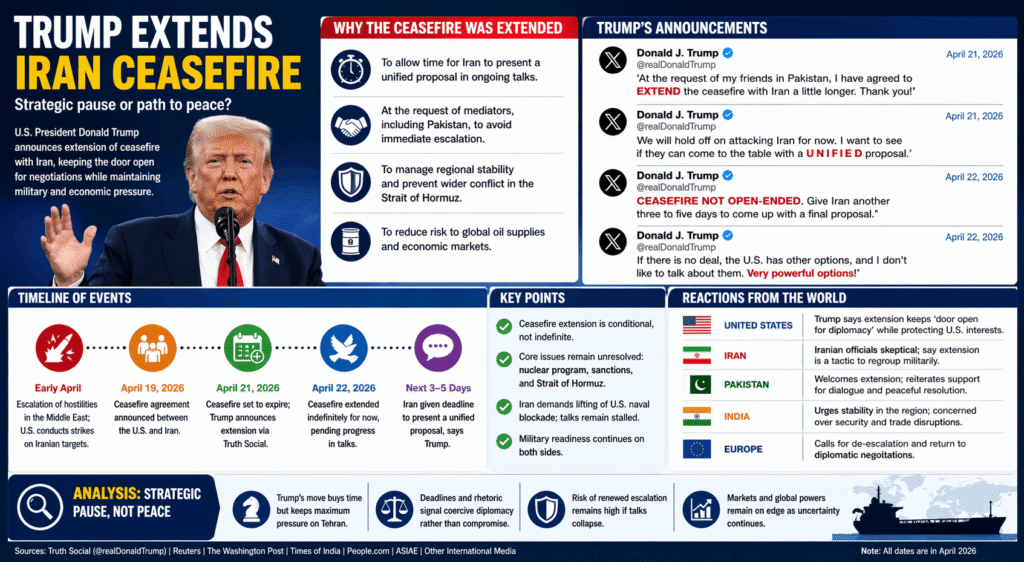
Even as he extended the ceasefire, Trump imposed new urgency. Reports indicate he gave Iran a narrow window—“three to five days”—to present a unified negotiating position. This approach underscores a broader negotiating tactic: compress timelines to force decision-making in Tehran, where internal divisions have slowed diplomacy.
However, such pressure may also backfire. Iran’s leadership has historically resisted negotiations under perceived coercion, framing them as infringements on sovereignty. The more Washington tightens deadlines, the more Tehran may delay or harden its stance.
The extension also reflects the growing role of Pakistan as a mediator. Trump explicitly acknowledged requests from Islamabad to delay military action, indicating that external diplomatic pressure influenced the decision.
Yet, Pakistan’s mediation has limitations. While it can facilitate dialogue, it cannot resolve the core disputes—namely Iran’s nuclear program and the U.S. blockade. As a result, the ceasefire extension buys time for talks but does not guarantee progress.
Despite the ceasefire, tensions have not eased. Iran has taken assertive actions in the Strait of Hormuz, including seizing vessels, signaling that military and economic pressure continues even during the truce.
At the same time, the United States has maintained its naval presence and blockade, reinforcing its leverage. This creates a paradox: a ceasefire in name, but continued confrontation in practice.
From a broader perspective, the ceasefire extension reflects a recognition of the high stakes involved. The Strait of Hormuz remains a critical chokepoint for global energy supplies, and any escalation could trigger severe economic consequences.
By extending the truce, Trump appears to be managing risk—preventing immediate escalation while keeping strategic options open. However, the lack of a clear roadmap raises concerns about sustainability.
Trump’s announcement of a ceasefire extension is best understood as a strategic pause rather than a diplomatic breakthrough. It postpones conflict without resolving its underlying causes, maintaining a delicate balance between deterrence and negotiation.
The reliance on deadlines, public messaging, and pressure tactics suggests that Washington is seeking to control the tempo of the crisis. Yet, as long as mutual trust remains absent and core demands remain unmet, the ceasefire risks collapsing into renewed confrontation.
In this sense, the extension is not the end of escalation—but merely its temporary suspension.