


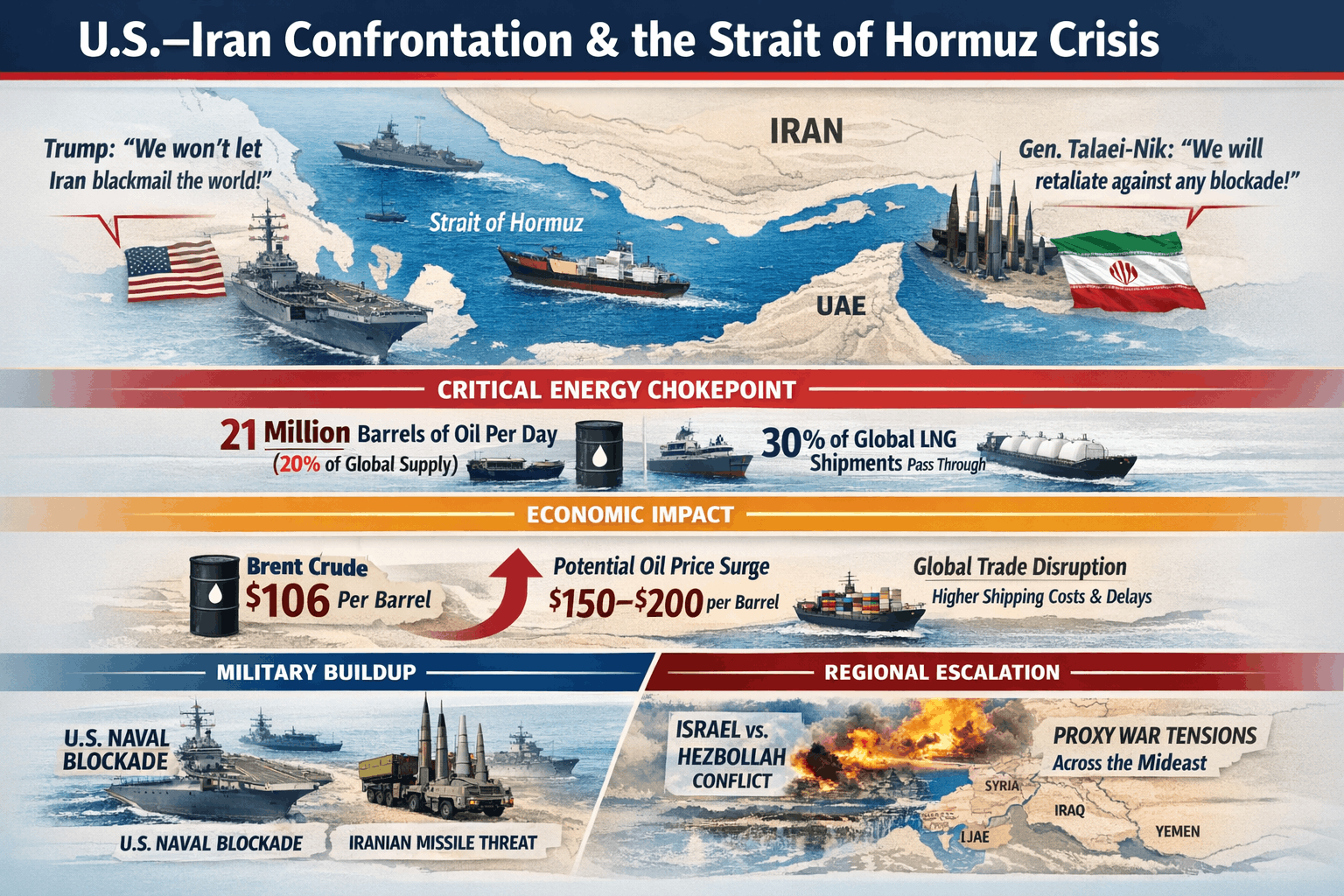
Brooklyn, NY: The current US–Iran confrontation has evolved from stalled diplomacy into a phase of direct strategic coercion centered on maritime control and energy security.
Following the collapse of negotiations held in Islamabad, the United States has intensified pressure on Iran through measures widely described as a maritime blockade framework targeting Iranian-linked shipping routes and increasing enforcement presence around the Strait of Hormuz.
US Vice President JD Vance acknowledged during the diplomatic process that while certain areas of dialogue showed limited progress, no final agreement could be reached. Shortly after, President Donald Trump framed the breakdown as a security failure of global consequence, arguing that Iran’s leverage over critical maritime chokepoints could not be allowed to continue unchecked.
His administration’s position has been interpreted as a shift from negotiation-based containment toward coercive maritime enforcement aimed at restricting Iran’s export capacity.
Iranian leadership, including senior defense and naval authorities, has rejected these measures as unlawful economic warfare. Tehran has warned that any attempt to restrict its maritime access or disrupt its export routes would trigger proportional countermeasures, including potential disruption of shipping stability across the wider Persian Gulf region.
The Strait of Hormuz and Its Global Energy Significance
The Strait of Hormuz is one of the most strategically important maritime chokepoints in the world, connecting the oil and gas fields of the Persian Gulf to global markets.
Under normal conditions, approximately 20 to 21 million barrels of oil per day pass through this narrow waterway, which represents roughly 20 percent of global petroleum liquids consumption. In addition, nearly one-fifth of global liquefied natural gas trade, particularly exports from Qatar, also transits through this corridor.
This concentration of global energy flows means that even limited disruption produces immediate macroeconomic effects. Global oil production averages around 100 million barrels per day, meaning that Hormuz alone handles roughly one-fifth of all traded crude oil worldwide.
Analysts estimate that even a partial reduction of 30 to 40 percent in traffic through the Strait could remove 6 to 8 million barrels per day from effective global supply, a scale of disruption comparable to major historical oil shocks.
Iran itself exports approximately 1.5 to 2 million barrels of crude oil per day under current sanctioned conditions, primarily directed toward Asian markets.
Any targeted blockade or shipping restriction affecting Iranian exports therefore represents not only a bilateral economic measure but also a tightening of already constrained global supply conditions.
Oil Markets and Immediate Price Transmission Effects
Energy markets have historically shown extreme sensitivity to risk in the Strait of Hormuz due to the absence of viable alternative export routes for Gulf producers.
In the current escalation cycle, Brent crude prices have already reflected heightened geopolitical risk premiums, moving above the 100 US dollar per barrel threshold in response to supply disruption fears.
Market modeling suggests that sustained disruption of even 3 to 5 million barrels per day from Gulf exports could push global oil prices into the 120 to 150 dollar range, depending on strategic reserves release and OPEC spare capacity utilization.
In more severe disruption scenarios involving military escalation or partial closure of the Strait, some estimates place potential price spikes significantly higher, reflecting the limited elasticity of short-term global oil supply.
Global strategic petroleum reserves, which collectively hold over 1.5 billion barrels across OECD countries, provide only temporary buffering capacity.
At current global consumption rates, these reserves would cover roughly 15 days of full global demand or a longer period of partial disruption, but they are not designed to offset prolonged geopolitical supply shocks.
Global Trade Exposure beyond Oil
While oil markets remain the most visible channel of impact, the Strait of Hormuz also plays a crucial role in broader global trade flows. Approximately 30 percent of global seaborne crude oil trade passes through this corridor, along with a significant share of petrochemical feed stocks and refined energy products.
The broader maritime trade system is also experiencing secondary effects. Global shipping insurance premiums for vessels transiting high-risk zones in the Persian Gulf have historically increased by 300 to 500 percent during periods of heightened tension.
Freight forwarders estimate that even a moderate risk escalation can increase per-container shipping costs by 10 to 20 percent on Asia–Europe routes due to rerouting and security surcharges.
Global container trade, which exceeds 850 million twenty-foot equivalent units (TEUs) annually, is indirectly affected through rising fuel costs and longer transit times. Energy price increases feed directly into global inflation, particularly in economies heavily dependent on imported fuel such as South Asia, East Asia, and parts of Europe.
Military Posture and Strategic Risk in a Narrow Waterway
The United States has expanded its naval presence in the region, deploying additional maritime assets to enforce navigation security and monitor Iranian naval activity.
Official statements from Washington emphasize the principle of freedom of navigation, though the operational reality of enforcement in a contested maritime environment introduces significant escalation risks.
The Strait of Hormuz itself is geographically constrained, measuring only about 21 nautical miles at its narrowest point, with shipping lanes even narrower.
This creates a unique military vulnerability in which asymmetric tactics such as mine deployment, drone strikes, or fast-boat harassment could significantly disrupt global traffic without requiring full-scale naval engagement.
From a strategic standpoint, this makes the Strait one of the most sensitive maritime zones in the world, where even minor incidents can escalate rapidly into broader conflict due to proximity, congestion, and overlapping military patrol zones.
Iran’s Strategic Doctrine and Regional Leverage
Iran’s response strategy is grounded in asymmetric deterrence, designed to offset conventional military disadvantages through targeted disruption of adversary vulnerabilities. Historically, this has included the implicit threat of closing or destabilizing the Strait of Hormuz during periods of heightened conflict.
Iranian officials have reiterated that any attempt to block its exports would lead to reciprocal disruption measures affecting regional maritime stability. Given Iran’s geographic positioning along the northern shore of the Strait, it retains significant tactical influence over shipping traffic patterns, even without achieving full closure.
This deterrence strategy is further reinforced by Iran’s regional network of allied groups, which extends potential escalation beyond maritime domains into land-based theaters across the Middle East.
Israel–Lebanon Front and the Expanding Proxy Dimension
Simultaneously, the Israel–Lebanon conflict continues to intensify, particularly along Israel’s northern border with Hezbollah. Israel’s ongoing military operations in Lebanon are officially framed as defensive measures aimed at neutralizing cross-border threats, while Hezbollah presents its actions as resistance to Israeli military presence.
Hezbollah’s strategic alignment with Iran introduces a critical proxy dimension into the broader US–Iran confrontation. Although the Lebanon front is geographically separate from the Strait of Hormuz, it is politically and strategically interconnected through Iran’s regional deterrence architecture.
This creates a multi-theater escalation environment in which pressure in the Gulf and conflict in the Levant can reinforce each other. In such systems, escalation is rarely linear; instead, it often spreads laterally across regions through allied networks and retaliatory cycles.
Conclusion: A High-Risk Global Energy Flashpoint
The US–Iran confrontation over the Strait of Hormuz represents one of the most consequential geopolitical risks to global economic stability. With approximately one-fifth of global oil trade passing through a single narrow waterway, even limited disruption carries disproportionate economic consequences.
At a macro level, the Strait functions not only as a shipping route but as a critical pillar of global energy pricing, inflation stability, and industrial supply chains. The current escalation demonstrates how geopolitical conflict in a geographically constrained region can rapidly translate into global economic shock.
Unless de-escalation mechanisms are restored, the risk is not limited to regional military confrontation but extends to a sustained global energy disruption affecting trade flows, inflation trajectories, and financial stability across multiple continents.


