


Co-Author: Salman-Bin-Kareem
Rochester, NY/ Doha, QR: The latest push by U.S. President Donald Trump to expand the Abraham Accords has once again placed Pakistan at the center of a complex geopolitical debate.
Trump’s recent statements linking a broader Middle East settlement to the normalization of relations between Israel and additional Muslim-majority states have revived speculation about whether Islamabad may eventually be compelled to reconsider its decades-old position on Israel.
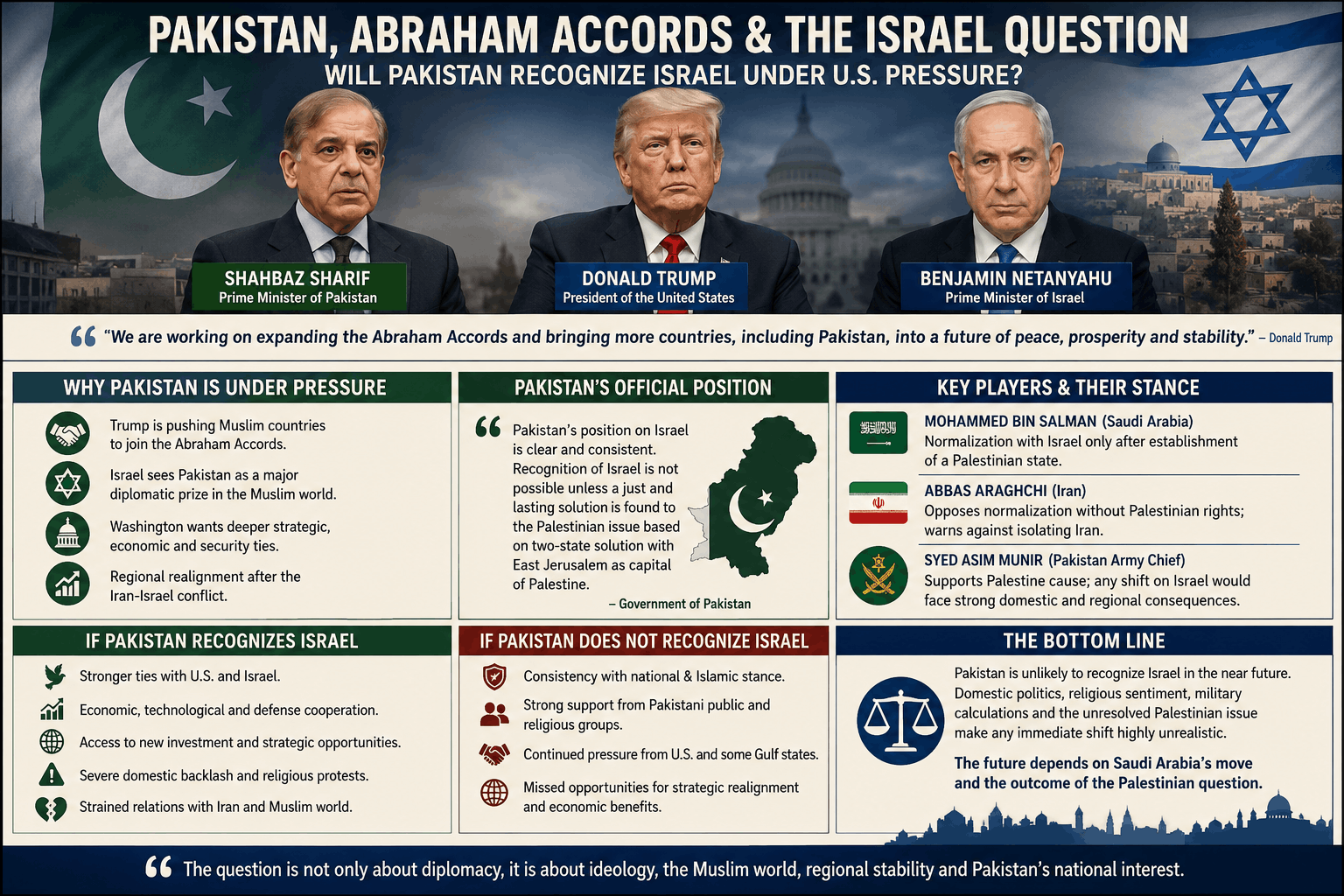
According to reports, Trump urged several Muslim countries, including Pakistan, to join the Abraham Accords as part of a wider regional realignment following efforts to stabilize the Iran-Israel crisis.
The question is not merely diplomatic. For Pakistan, recognition of Israel touches upon ideology, domestic politics, military calculations, relations with Saudi Arabia, ties with Iran, and its standing within the Muslim world. The debate therefore extends far beyond foreign policy and enters the realm of national identity.
Trump’s Vision and the Expansion of the Abraham Accords
Trump views the Abraham Accords as one of the signature achievements of his foreign policy legacy. His current effort seeks to broaden the framework beyond the countries that normalized relations with Israel during his first administration.
Reports indicate that Trump has argued that additional Muslim-majority countries should join the process if a wider regional settlement is achieved.
For Washington, Pakistani recognition of Israel would represent a major symbolic breakthrough.
Pakistan is the world’s second-largest Muslim-majority country and possesses nuclear weapons. Its entry into the Abraham Accords would provide legitimacy to the normalization process that many Arab governments have struggled to sell domestically.
However, what appears strategically attractive in Washington is politically explosive in Islamabad.
Pakistan’s Official Position Remains Unchanged
The government of Shehbaz Sharif has not announced any shift in policy regarding Israel. Pakistan’s traditional position remains tied to the establishment of an independent Palestinian state with East Jerusalem as its capital.
Recent statements from senior Pakistani officials have reaffirmed that recognition of Israel is not currently under consideration. Pakistan’s leadership has consistently maintained that any change in policy would require a just settlement of the Palestinian issue.
The political reality is straightforward. Any government in Pakistan that openly moves toward recognition without a Palestinian state would face fierce opposition from religious parties, Islamist organizations, sections of civil society, and significant segments of the public.
The Religious Pressure Factor
Pakistan’s religious parties may not command overwhelming electoral strength, but they possess substantial street power.
Organizations across the religious spectrum have historically treated the Palestinian issue as a matter of Islamic solidarity rather than merely foreign policy.
Any attempt by Islamabad to recognize Israel under current circumstances would likely trigger nationwide protests. Religious leaders would portray such a move as abandoning the Palestinian cause at a time when Israeli military operations in Gaza and Lebanon remain highly controversial across the Muslim world.
Recent military escalations involving Israel and both Hamas and Hezbollah have only strengthened anti-Israel sentiment in Pakistan.
For Prime Minister Shehbaz Sharif, already navigating economic and political challenges, opening a new domestic front over Israel would carry substantial risks.
What about the Military Establishment in Pakistan?
The role of Pakistan’s military cannot be ignored. Pakistan’s army remains the country’s most influential institution on national security and strategic foreign policy.
There is no credible public statement from Field Marshal Syed Asim Munir indicating support for recognizing Israel. In fact, military leadership has repeatedly emphasized support for Palestinian rights in public speeches and official messaging.
Within military circles, strategic thinking is often more pragmatic than ideological. Some security analysts argue that parts of the establishment recognize the potential benefits of limited engagement with Israel, particularly in technology, agriculture, cyber security, and relations with Washington.
However, pragmatism does not automatically translate into recognition. The military is acutely aware that a sudden policy shift could generate domestic instability and damage Pakistan’s relationships with key regional partners.
Is Saudi Arabia using Pakistan as Political Cover?
One of the most intriguing questions is whether Mohammed bin Salman might prefer Pakistan to move first.
Some analysts speculate that if Pakistan recognized Israel before Saudi Arabia, it could help reduce political pressure on Riyadh by demonstrating that normalization is not limited to Arab states.
Others argue the opposite: Saudi Arabia would prefer to lead such a transformation itself rather than follow another country.
The available evidence suggests that Riyadh has not abandoned its longstanding condition that Israeli recognition must be linked to Palestinian statehood.
Mohammed bin Salman has repeatedly stated that Saudi Arabia will not establish diplomatic relations with Israel without a Palestinian state.
This position significantly reduces the likelihood that Saudi Arabia is secretly pressuring Pakistan to move ahead independently.
If anything, Pakistan currently benefits from Saudi Arabia’s insistence on maintaining the Palestinian-state condition.
Iran’s View: A Strategic Red Line
For Iran, expansion of the Abraham Accords is viewed as a strategic effort to isolate Tehran and strengthen Israel’s regional position.
Iranian leaders, including Foreign Minister Abbas Araghchi, have consistently opposed normalization initiatives that bypass Palestinian statehood. Tehran regards the Palestinian issue as a core component of its regional narrative.
If Pakistan were to recognize Israel, relations between Islamabad and Tehran could deteriorate sharply.
Although Pakistan and Iran have experienced periodic tensions, both countries share a long border and significant security interests.
A Pakistani move toward Israel would likely be interpreted in Tehran as alignment with a U.S.-Israeli regional framework, potentially complicating border security cooperation and regional diplomacy.
Netanyahu’s Calculation
Israeli Prime Minister Benjamin Netanyahu has long viewed the expansion of normalization agreements as a strategic priority. From Israel’s perspective, securing recognition from Pakistan would represent one of the most significant diplomatic achievements since the original Abraham Accords.
Yet Netanyahu faces his own challenges.
Ongoing military operations and the unresolved Palestinian question continue to make normalization politically difficult for many Muslim-majority states.
As long as Gaza remains a flashpoint and regional tensions persist, governments considering recognition face substantial domestic opposition.
If Pakistan Recognizes Israel
Should Pakistan eventually recognize Israel, several consequences could follow.
Relations with Washington would likely improve, and Pakistan might gain greater access to diplomatic support in Western capitals.
Economic cooperation opportunities could emerge in technology, agriculture, water management, and defense-related sectors.
However, the domestic political backlash could be severe. Religious parties would likely mobilize mass protests. Relations with Iran could become significantly more complicated.
Pakistan could also face criticism from segments of the Muslim world that continue to oppose normalization without Palestinian statehood.
Most importantly, recognition would challenge one of the foundational principles of Pakistan’s foreign policy since independence.
If Pakistan Refuses
If Pakistan continues to reject recognition, it will maintain consistency with its longstanding position on Palestine and avoid major domestic upheaval.
The downside is that Islamabad may face periodic pressure from Washington and some regional actors seeking broader normalization. Pakistan could also miss opportunities for closer strategic alignment with emerging regional blocs.
Yet refusal would likely strengthen Pakistan’s standing among populations across the Muslim world that remains deeply sympathetic to the Palestinian cause.
The Most Likely Scenario
At present, the most realistic outcome is neither immediate recognition nor permanent rejection.
Pakistan is likely to maintain its current position: support for Palestinian statehood first, recognition later. This formula allows Islamabad to resist external pressure while keeping future diplomatic options open.
The decisive factor may not be Pakistan itself but Saudi Arabia. If Riyadh eventually reaches a historic agreement with Israel tied to meaningful Palestinian statehood, Pakistan would find it considerably easier to reconsider its own position. Conversely, if Saudi Arabia maintains its current stance, Islamabad has little incentive to move first.
For now, despite Trump’s renewed enthusiasm for expanding the Abraham Accords, Pakistan appears far more constrained by domestic politics, religious sentiment, military calculations, and regional realities than by American diplomatic pressure.
The debate will continue, but recognition of Israel remains a distant possibility rather than an imminent policy shift.
For more news, expert commentary, and strategic analysis, explore the latest reports and features published by The Variant.


