


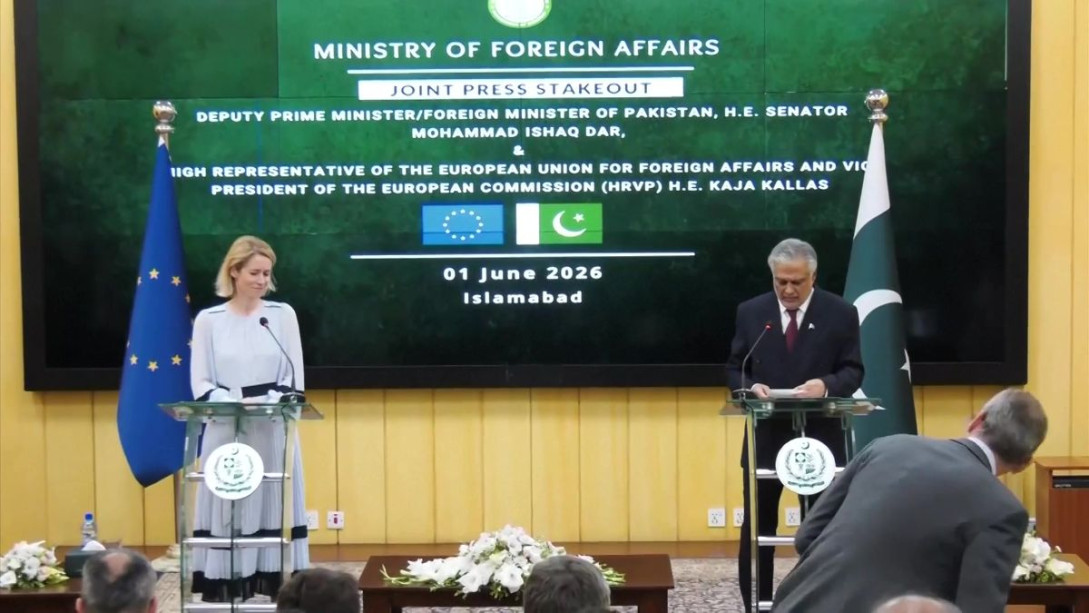
Rochester, NY/Islamabad, PK: The eighth round of the EU-Pakistan Strategic Dialogue, held in Islamabad and co-chaired by Kaja Kallas and Ishaq Dar, has attracted considerable diplomatic attention at a time when global geopolitical alignments are rapidly shifting.
The dialogue took place against the backdrop of the ongoing Middle East crisis, tensions surrounding Iran’s nuclear program, growing concerns over maritime security, and renewed efforts by major powers to reshape regional partnerships.
While both sides described the discussions as constructive and forward-looking, the real significance of the meeting lies in what Pakistan seeks to gain from Europe and how the European Union currently views Islamabad’s regional role.
For Pakistan, the dialogue represents an important opportunity to strengthen relations with one of its largest economic partners.
The European Union remains Pakistan’s biggest export destination, and access to European markets through preferential trade arrangements continues to be vital for Pakistan’s struggling economy.
With Pakistan facing persistent fiscal challenges, high external debt obligations, and pressure from international financial institutions, maintaining strong economic ties with Brussels has become a strategic necessity rather than a diplomatic luxury.
Beyond trade, Islamabad appears keen to project itself as a responsible regional stakeholder capable of contributing to conflict resolution and regional stability.
Pakistan’s leadership has repeatedly highlighted its diplomatic contacts with both Washington and Tehran during the recent escalation between the United States and Iran. Pakistani officials have sought to portray the country as a bridge between competing regional actors rather than a participant in any emerging bloc politics.
However, European policymakers are likely to view Pakistan’s claims of mediation with a degree of caution. While the European Union appreciates any effort aimed at reducing tensions in the Gulf region, Brussels traditionally places greater emphasis on tangible diplomatic outcomes rather than diplomatic messaging.
European capitals understand that Pakistan maintains important historical, religious, and security ties with Iran, while simultaneously preserving strategic relations with the United States and Gulf Arab states.
This unique position gives Islamabad channels of communication that many countries lack. Yet European diplomats are also aware that Pakistan’s actual influence over Iranian strategic decision-making remains limited.
From the EU perspective, Pakistan’s value lies less in its ability to directly shape American or Iranian policy and more in its potential role as a stabilizing actor in a volatile region.
The European Union remains deeply concerned about any escalation that could threaten global energy supplies, disrupt trade routes, or trigger broader regional conflict. In that context, Pakistan’s calls for dialogue and de-escalation align closely with European diplomatic objectives.
Nevertheless, the dialogue also exposed certain realities. The European Union continues to prioritize issues such as governance reforms, human rights, democratic institutions, climate resilience, and counter-terrorism cooperation.
While Pakistan seeks recognition for its geopolitical importance, European policymakers often evaluate relationships through a broader lens that includes domestic governance standards. This difference in priorities occasionally creates friction in bilateral relations.
A critical reading of the dialogue suggests that Pakistan may have gained more economically and diplomatically than strategically. The meeting provided Islamabad with an opportunity to demonstrate that it remains diplomatically relevant despite recent questions regarding its foreign policy effectiveness.
Following criticism from some international observers over Pakistan’s limited influence in major global crises, hosting the EU’s top foreign policy representative allowed the government to showcase continued engagement with major international actors.
At the same time, the European Union appears interested in preventing Pakistan from drifting entirely into the orbit of other major powers, particularly as global competition intensifies.
Brussels recognizes Pakistan’s geographic significance, its role in regional connectivity, and its position at the crossroads of South Asia, Central Asia, and the Middle East.
Strengthening engagement with Islamabad serves Europe’s broader objective of maintaining influence in a strategically important region.
Regarding the US-Iran conflict specifically, European officials seem to acknowledge Pakistan’s diplomatic outreach efforts but have stopped short of portraying Islamabad as a decisive mediator.
The EU’s assessment is likely pragmatic: Pakistan can facilitate communication, encourage restraint, and contribute to regional stability, but ultimate decisions regarding nuclear negotiations and regional security remain primarily in the hands of Washington and Tehran.
The broader outcome of the eighth EU-Pakistan Strategic Dialogue therefore reflects mutual interests rather than a dramatic diplomatic breakthrough.
Pakistan secured an opportunity to reinforce its international standing, strengthen economic cooperation, and present itself as a constructive regional actor.
The European Union, meanwhile, reinforced engagement with an important regional partner while encouraging Islamabad to continue supporting diplomatic solutions to regional conflicts.
The challenge for Pakistan now is converting diplomatic symbolism into measurable gains. Economic cooperation, trade expansion, investment flows, and enhanced political credibility will ultimately determine whether the dialogue becomes a meaningful milestone or simply another routine diplomatic engagement.
For Europe, the test will be whether Pakistan can evolve from being viewed as a strategically located partner to becoming a consistently influential actor capable of contributing to regional peace and stability in an increasingly uncertain international environment.
Discover more perspectives, breaking news, and in-depth reports from around the world by visiting The Variant.


