Courtesy: Reporting Contribution by Hira Ahmed [A Correspondent I Islamabad, Pakistan]
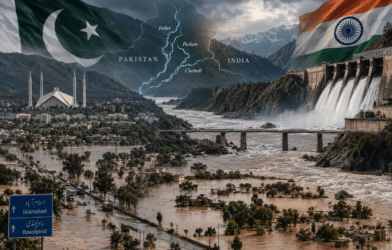
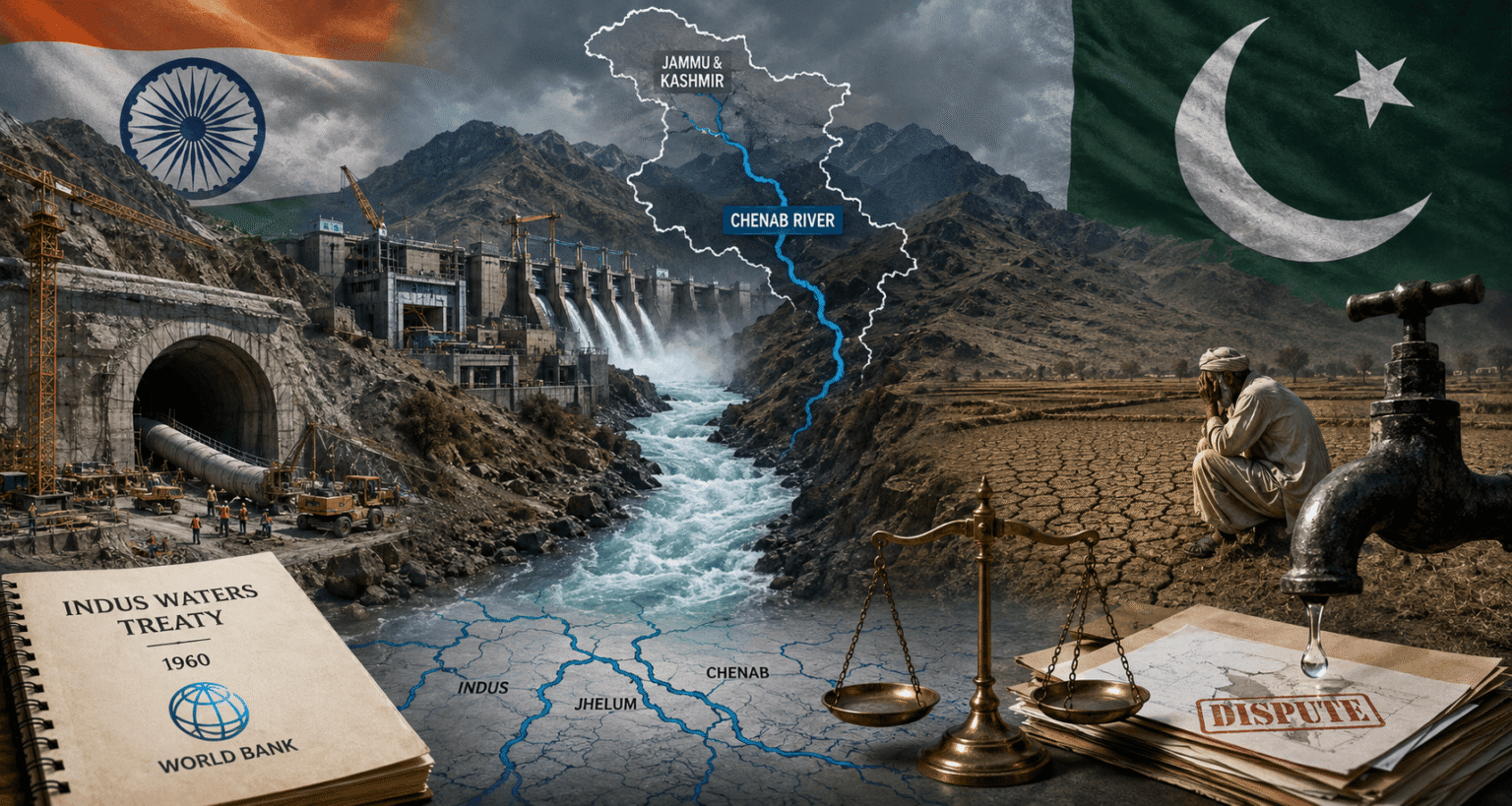
Rochester, NY/Islamabad, PK: The growing controversy surrounding India’s reported plans to expand infrastructure on the Chenab River, including tunnel-based diversion studies and the rapid construction of a chain of hydroelectric projects in Indian held Jammu and Kashmir, has intensified fears in Pakistan that New Delhi is gradually acquiring the capability to manipulate flows on one of the country’s most critical water arteries.
For Pakistan, the issue is no longer merely about hydroelectric dams or engineering projects; it is increasingly viewed as a question of national security, food security and strategic survival.
The Chenab River is one of the three western rivers allocated primarily to Pakistan under the Indus Waters Treaty (IWT) of 1960. The treaty, brokered and guaranteed by the World Bank, has historically been regarded as one of the world’s most durable water-sharing agreements.
Under the treaty, Pakistan received rights over the waters of the Indus, Jhelum and Chenab rivers, while India retained control of the eastern rivers — Ravi, Beas and Sutlej.
Even during wars and major political crises, the treaty survived because both countries recognized that water security was too important to become a casualty of conflict. However, recent developments have raised serious concerns in Islamabad regarding the future of the agreement and the balance of water control in the basin.
India has accelerated the construction of several major hydroelectric projects on the Chenab basin. Among the most significant are the 1,000 MW Pakal Dul project, the 850 MW Ratle project, the 624 MW Kiru project and the 540 MW Kwar project.
Together, these four projects alone represent more than 3,000 MW of installed generation capacity under construction on the Chenab system. Indian authorities have also approved or revived additional projects, including the 260 MW Dulhasti Stage-II project and the massive 1,856 MW Sawalkot hydropower project.
Existing facilities such as Salar (690 MW), Baglihar (900 MW) and Dulhasti (390 MW) already provide India substantial operational influence over river flows. Collectively, the Chenab basin is estimated to possess more than 11,000 MW of hydroelectric potential.
From Pakistan’s perspective, the concern is not simply the generation of electricity but the cumulative effect of a cascade of reservoirs, barrages, tunnels and run-of-the-river projects operating in coordination. Even where projects technically comply with treaty provisions, their combined operational flexibility can significantly affect downstream flows.
Pakistan’s irrigation system, the largest contiguous canal network in the world, depends heavily on predictable releases from western rivers. Sudden reductions or increases in water discharge can disrupt irrigation schedules, damage standing crops and create uncertainty for millions of farmers across Punjab and Sindh.
Sources in Pakistan’s foreign office informed The Variant that authorities have already expressed concern regarding unusual fluctuations in Chenab flows linked to Indian hydroelectric operations and maintenance activities.
The latest controversy involves reports and discussions regarding tunnel and canal schemes designed to transfer Chenab waters toward India’s eastern river systems.
While some of these proposals remain at the study or pre-feasibility stage, Indian political leaders and media discussions have increasingly explored the possibility of diverting Chenab water to Punjab, Haryana and Rajasthan.
Such proposals have generated alarm in Pakistan because they suggest a long-term strategic objective extending beyond hydropower generation toward inter-basin water transfer.
Although not all reported diversion plans have reached implementation, the very consideration of such projects has reinforced Pakistani fears that India seeks to maximize utilization of waters historically flowing into Pakistan.
The approaching monsoon season further complicates the situation. During periods of heavy rainfall, upstream reservoirs can theoretically regulate the timing of releases.
Pakistan’s water experts have long argued that the danger is not necessarily permanent deprivation of water but rather manipulation of timing. Large and sudden releases during peak monsoon periods could exacerbate flooding downstream, while temporary withholding during crucial agricultural periods could affect sowing and irrigation cycles.
The risk perception is amplified because Pakistan remains highly dependent on river flows for agriculture, which contributes significantly to national employment, exports and food production. Any uncertainty in water availability directly translates into economic vulnerability.
Equally significant is the role of the World Bank. The World Bank was not merely a facilitator but a guarantor and signatory witness to the Indus Waters Treaty.
For decades, it played a critical role in dispute resolution mechanisms and institutional continuity between the two countries. However, many Pakistani analysts argue that the World Bank’s response to recent tensions has appeared cautious and insufficient.
Islamabad maintains that unilateral actions affecting treaty implementation should trigger stronger international engagement. Critics within Pakistan contend that the guarantor of the treaty has not demonstrated the level of urgency required to preserve one of the world’s most important transboundary water-sharing arrangements.
Yet the sharpest criticism in Pakistan is increasingly directed inward rather than outward. Successive civilian governments and military establishments have repeatedly described water as a national security issue, but practical preparation has often lagged behind rhetoric.
For decades, policymakers possessed ample warning that upstream infrastructure development would continue on rivers shared with India.
Nevertheless, Pakistan failed to build sufficient large-scale reservoirs, modernize irrigation infrastructure, reduce transmission losses, reform water pricing mechanisms or encourage widespread adoption of water-efficient agricultural technologies.
The result is a country that loses enormous volumes of water annually through outdated canals, inefficient farming practices and inadequate storage capacity.
The criticism extends to the military establishment as well. Pakistan’s security doctrine has historically focused on conventional and strategic military threats, while water security received comparatively less institutional attention despite repeated warnings from hydrologists and economists.
If water is genuinely regarded as an existential challenge, critics argue that the response should have included sustained diplomatic campaigns, aggressive legal engagement, reservoir construction, scientific planning and comprehensive water management reforms years ago rather than reactive statements after each new Indian project announcement.
The current debate therefore reveals a deeper national dilemma. India is steadily expanding its physical infrastructure on the Chenab basin and increasing its operational capabilities.
Whether every project violates the treaty remains legally contested, but their cumulative strategic impact is undeniable. Pakistan’s challenge is not only to contest questionable projects through diplomatic and legal channels but also to address its own structural weaknesses in water governance.
Without major investments in reservoirs, canal modernization, groundwater management and climate resilience, Pakistan’s vulnerability will persist regardless of international rulings or diplomatic protests.
The Chenab dispute is thus evolving into a broader test of state capacity. For Pakistan, the fundamental question is no longer whether India is building dams, tunnels or hydropower projects.
The more pressing question is whether Pakistan can develop the institutional, diplomatic and engineering capabilities necessary to protect its long-term water security in an increasingly contested Indus basin. The answer to that question may shape the country’s economic and strategic future far more than any single dam or tunnel ever could.
For more news, expert commentary, and strategic analysis, explore the latest reports and features published by The Variant.