


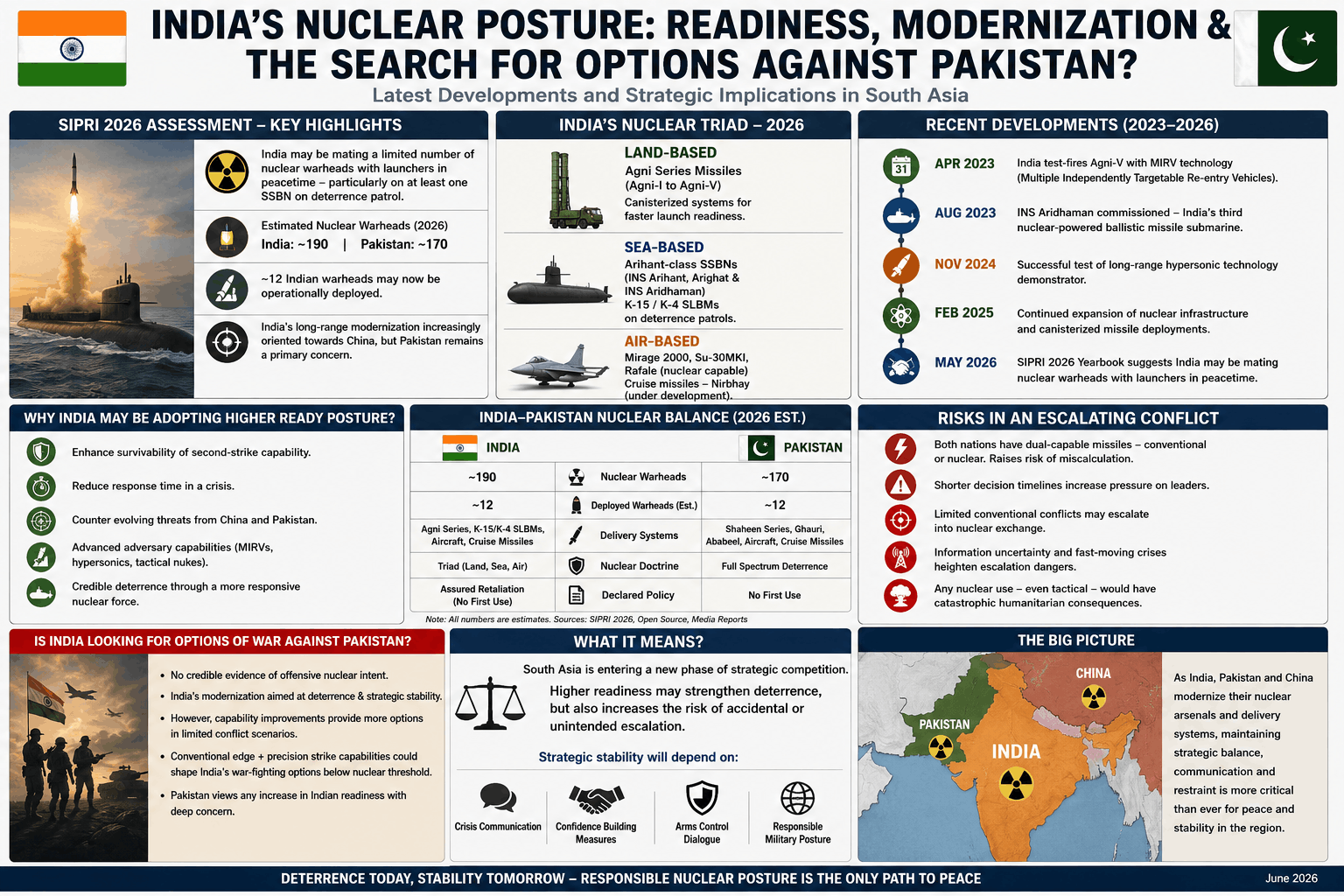
New Delhi, IN/Lahore, PK: The latest assessment by the Stockholm International Peace Research Institute (SIPRI) has intensified debate over the changing nature of India’s nuclear doctrine.
For decades, it was widely believed that India stored its nuclear warheads separately from their delivery systems during peacetime, reinforcing its declared policy of restrained nuclear readiness and “No First Use” (NFU).
However, SIPRI’s 2026 Yearbook now suggests that India may have begun mating a limited number of nuclear warheads with launchers during peacetime, particularly aboard at least one ballistic missile submarine (SSBN) conducting deterrence patrols.
The institute stresses that this assessment carries “considerable uncertainty,” but, if accurate, it would represent a notable shift in India’s operational nuclear posture.
The report estimates that India possesses approximately 190 nuclear warheads, compared with Pakistan’s estimated 170, and assesses that around 12 Indian warheads may now be operationally deployed.
SIPRI links this assessment to India’s expanding sea-based deterrent, the induction of additional Arihant-class ballistic missile submarines, and increasing reliance on canisterized missile systems that can remain in a higher state of readiness.
At the same time, SIPRI notes that India’s long-range modernization is increasingly oriented toward China, even though New Delhi’s nuclear planning continues to be heavily influenced by its enduring rivalry with Pakistan.
This evolution should not automatically be interpreted as evidence that India is preparing for war. Military analysts generally distinguish between modernization for deterrence and preparation for offensive military action.
Nuclear-armed states often improve the survivability, responsiveness, and credibility of their deterrent forces without intending to initiate conflict. Nevertheless, increased readiness can shorten decision-making timelines during crises and heighten the risks of miscalculation if tensions escalate unexpectedly.
The strategic environment in South Asia has become increasingly complex following recent India-Pakistan military confrontations.
SIPRI warns that conventional clashes involving strategic military assets could increase the danger of rapid escalation because both countries possess dual-capable missile systems capable of carrying either conventional or nuclear payloads.
In a fast-moving conflict, uncertainty about the nature of an incoming missile could complicate crisis management and increase the possibility of unintended escalation.
India continues to invest heavily in advanced capabilities, including MIRV (Multiple Independently Targetable Re-entry Vehicle) technology for the Agni-V missile, hypersonic systems under development, and an expanded fleet of nuclear-powered ballistic missile submarines.
These programs aim to strengthen India’s second-strike capability and ensure survivable deterrence against both regional and extra-regional adversaries.
Simultaneously, Pakistan continues developing new delivery systems and expanding its strategic capabilities, indicating that the regional strategic competition remains active.
From Pakistan’s perspective, any indication that India is reducing the separation between warheads and launchers is likely to be viewed as a development requiring close monitoring.
Pakistani officials have previously expressed concern that greater operational readiness on either side could reduce crisis stability.
India, however, has not announced any formal change to its declared nuclear doctrine, and the reported deployment assessment comes from SIPRI rather than an official confirmation by the Indian government.
Whether India is “looking for options of war” cannot be established from publicly available evidence alone. India’s ongoing military modernization, enhanced missile capabilities, and expansion of sea-based nuclear forces can be interpreted as efforts to strengthen deterrence and strategic preparedness.
However, military modernization by itself does not demonstrate an intention to initiate armed conflict. Assessments of intent require direct evidence from official policy decisions, military mobilization, or credible intelligence rather than capability improvements alone.
The broader implication of SIPRI’s assessment is that South Asia may be entering a new phase in its strategic competition.
As India, Pakistan, and China continue modernizing their nuclear forces and delivery systems, maintaining reliable communication channels, robust crisis-management mechanisms, and confidence-building measures will become increasingly important to reducing the risk of accidental or unintended escalation.
In a region where conventional confrontations can unfold rapidly, preserving strategic stability remains as important as maintaining credible deterrence.


