Rochester, NY: The announcement by U.S. President Donald Trump that a peace agreement with Iran would be signed on Sunday, June 14, marks what could become one of the most consequential diplomatic developments in the Middle East since the 2015 nuclear accord negotiated during the administration of Barack Obama.
Yet despite Trump’s confidence on Truth Social, Iranian officials have continued to signal caution, insisting that while negotiations are advancing, the timing and final details remain unresolved.
Any analysis of the current negotiations must begin with the 2015 Joint Comprehensive Plan of Action (JCPOA), commonly known as the Iran nuclear deal. Under President Obama, Iran accepted restrictions on its nuclear program, international inspections, and limits on uranium enrichment in exchange for sanctions relief.
The agreement was backed by major world powers and was presented as a mechanism to prevent Iran from obtaining a nuclear weapon. However, Trump consistently criticized the accord, calling it too weak and arguing that it provided Tehran with economic benefits without permanently ending its nuclear ambitions.
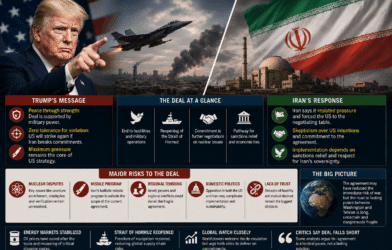
The emerging 2026 framework appears designed to contrast sharply with Obama’s approach. Trump has publicly emphasized that no direct financial payment would accompany the agreement and that Iran would be prevented from acquiring nuclear weapons through development, purchase, or any other means.
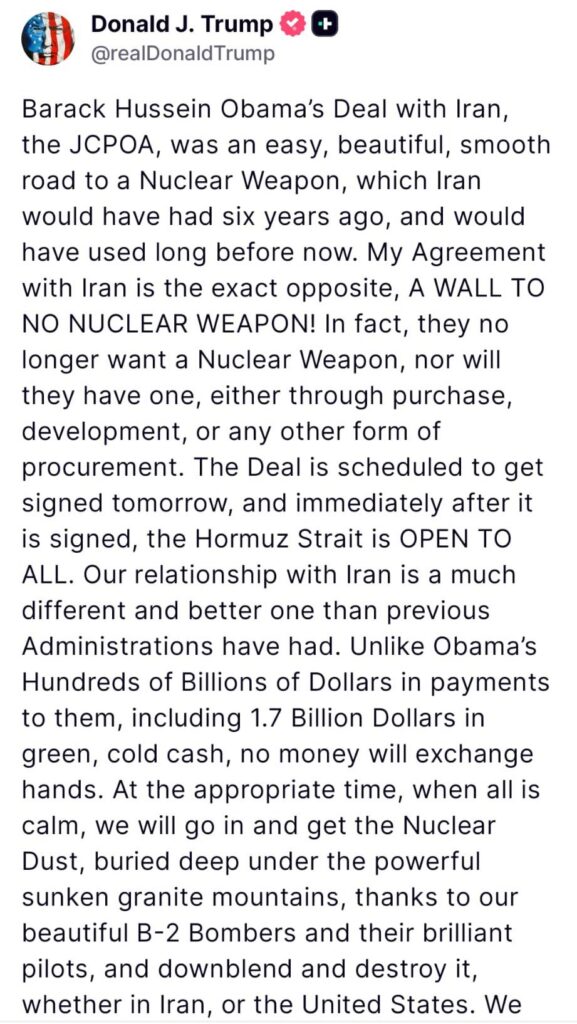
He has also stated that remaining nuclear materials would eventually be removed and destroyed under international supervision.
Politically, Trump wants this agreement to be viewed not as a revised version of Obama’s diplomacy but as a fundamentally different arrangement achieved through military pressure, sanctions, and negotiations conducted after months of conflict and regional escalation.
Why June 14 Matters?
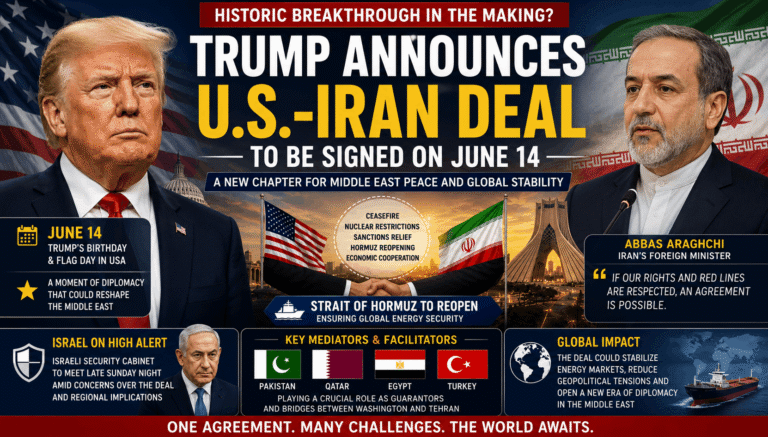
The choice of June 14 is difficult to ignore. The date coincides with Trump’s 80th birthday and also falls on Flag Day in the United States.
Several reports indicate that Trump planned major public events around the date, including celebrations associated with his birthday.
Whether the timing is coincidental or deliberately symbolic, the political advantages are obvious. A peace agreement announced on the president’s birthday would allow Trump to present himself as both a wartime leader and peacemaker.
Throughout his political career, Trump has attached great importance to symbolism, branding, and dramatic announcements. Securing a diplomatic breakthrough on June 14 would reinforce a narrative that military pressure forced Iran to negotiate while avoiding a wider regional war.
From a domestic political perspective, the date offers maximum visibility. For supporters, it would be evidence that Trump’s strategy succeeded where previous administrations failed. For critics, it could be viewed as an attempt to align a major foreign policy achievement with a personal political milestone.
Where Will the Agreement Be Signed?
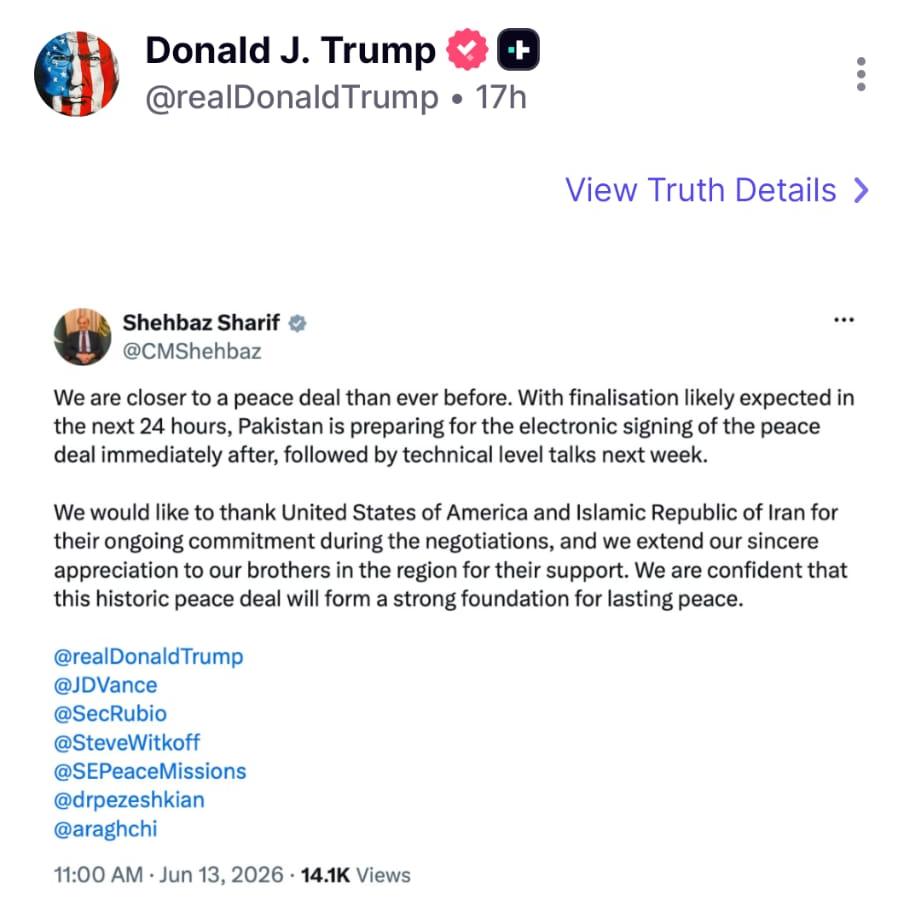
One of the most intriguing aspects of the negotiations concerns the signing venue. Multiple reports suggest the agreement may not involve a traditional face-to-face ceremony but rather an electronic or virtual signing of a memorandum of understanding.
Pakistan’s government has reportedly been involved in preparations for such a process.
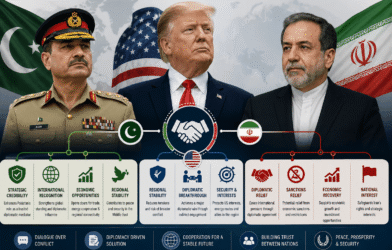
Current reporting indicates that Pakistan has played a central mediating role throughout the negotiations. Qatar, Egypt and Turkey have also been identified as key facilitators helping bridge communication between Washington and Tehran.
As a result, there is no confirmed physical venue for a signing ceremony. The most credible reports point toward an electronically executed agreement coordinated through mediating states rather than a public ceremony in Washington, Tehran or a Gulf capital.
The Guarantor States and Regional Mediators
According to reports surrounding the negotiations, Pakistan has emerged as the most visible intermediary.
Prime Minister Shehbaz Sharif has repeatedly expressed optimism regarding the talks and publicly suggested that the parties were close to finalizing an agreement.
Qatar, Egypt and Turkey have also been identified as diplomatic channels helping facilitate communication and confidence-building measures.
While none of these countries have formally been designated as “guarantors” in a treaty sense, they appear to be serving as political guarantors and mediators whose involvement lends credibility and regional support to the process. Their participation is particularly important because both Washington and Tehran continue to lack direct trust in each other’s intentions.
The Strategic Importance of the Strait of Hormuz
A central element of the proposed agreement is the reopening of the Strait of Hormuz, one of the world’s most important energy chokepoints.
Trump has repeatedly stated that the waterway would reopen immediately after the agreement takes effect.
The significance extends far beyond the Gulf. Roughly one-fifth of global oil trade moves through Hormuz.
Any sustained closure threatens energy supplies, increases shipping costs and fuels inflation worldwide. This explains why financial markets have reacted positively to reports of an impending agreement.
For Iran, reopening Hormuz could help secure sanctions relief and economic breathing room. For the United States, it would demonstrate that military pressure produced tangible strategic gains without requiring a prolonged war.
Why Israel’s Security Cabinet Is Meeting?
Perhaps the most revealing development is the decision by Israeli Prime Minister Benjamin Netanyahu to convene Israel’s security cabinet on Sunday evening following Trump’s announcement.
Reports indicate that Israeli officials are deeply concerned about elements of the proposed agreement and fear that Washington may be easing pressure on Tehran before Israel believes its security objectives have been achieved.
The cabinet meeting is therefore not merely routine. It is likely intended to assess the implications of any U.S.-Iran understanding and determine Israel’s response.
Israeli security officials reportedly worry that a ceasefire and diplomatic framework could reduce American leverage over Iran while leaving key Iranian capabilities intact.
The timing is significant. If Trump secures an agreement while Israel continues to view Iran as an existential threat, a strategic gap could emerge between Washington and Jerusalem.
Such differences would not necessarily rupture the alliance, but they could produce tensions over future policy toward Iran’s nuclear infrastructure and regional proxy networks.
Will the Deal Actually Be Signed Today?
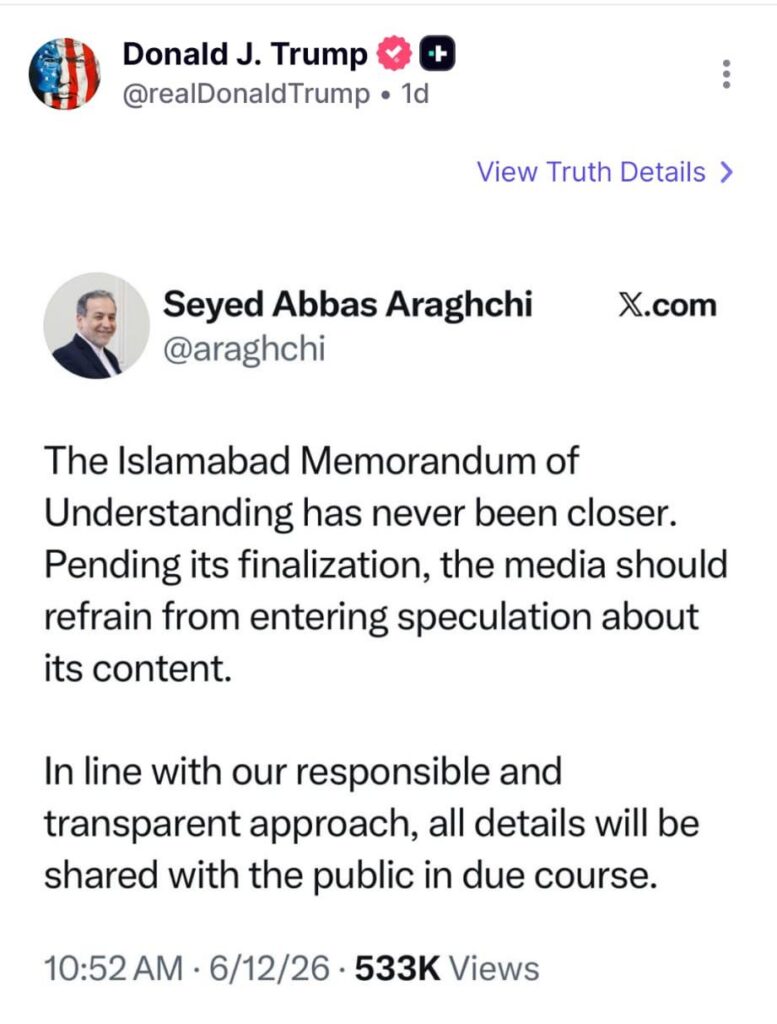
Despite Trump’s certainty, the reality remains uncertain. Iranian officials have avoided confirming a Sunday signing and continue to describe negotiations as ongoing.
Several reports indicate that Tehran believes a framework agreement may be close but not necessarily finalized.
This discrepancy highlights a familiar pattern in U.S.-Iran diplomacy. Washington often emphasizes momentum and imminent breakthroughs, while Tehran prefers strategic ambiguity until every detail has been negotiated.
Conclusion
The proposed June 14 agreement represents far more than a ceasefire. It is an attempt to reshape the regional balance after months of conflict, reopen the Strait of Hormuz, and establish a framework for future negotiations on Iran’s nuclear activities.
Trump clearly intends the agreement to stand in contrast to Obama’s 2015 nuclear deal, portraying it as a product of pressure rather than concession.
Yet the final outcome remains uncertain. Iran has not fully endorsed Trump’s timeline, Israel is signaling concern through an emergency security cabinet meeting, and many of the most difficult nuclear questions appear to have been postponed to later negotiations.
The coming hours will therefore determine whether June 14 becomes a historic diplomatic breakthrough or simply another chapter in the long and often unpredictable story of U.S.-Iran relations.
Follow The Variant for timely updates and comprehensive coverage of global affairs, politics, business and international relations.