


Brussels, BE: The Middle East crisis has entered a dangerous phase where the consequences are no longer limited to military confrontation, diplomatic tensions or regional instability.
The conflict has transformed into a global economic challenge, with Europe emerging as one of the biggest financial victims.
The escalation of tensions around the Persian Gulf, disruption risks in major energy corridors and uncertainty over future oil supplies have created a new energy shock that is costing European economies tens of billions of Euros.
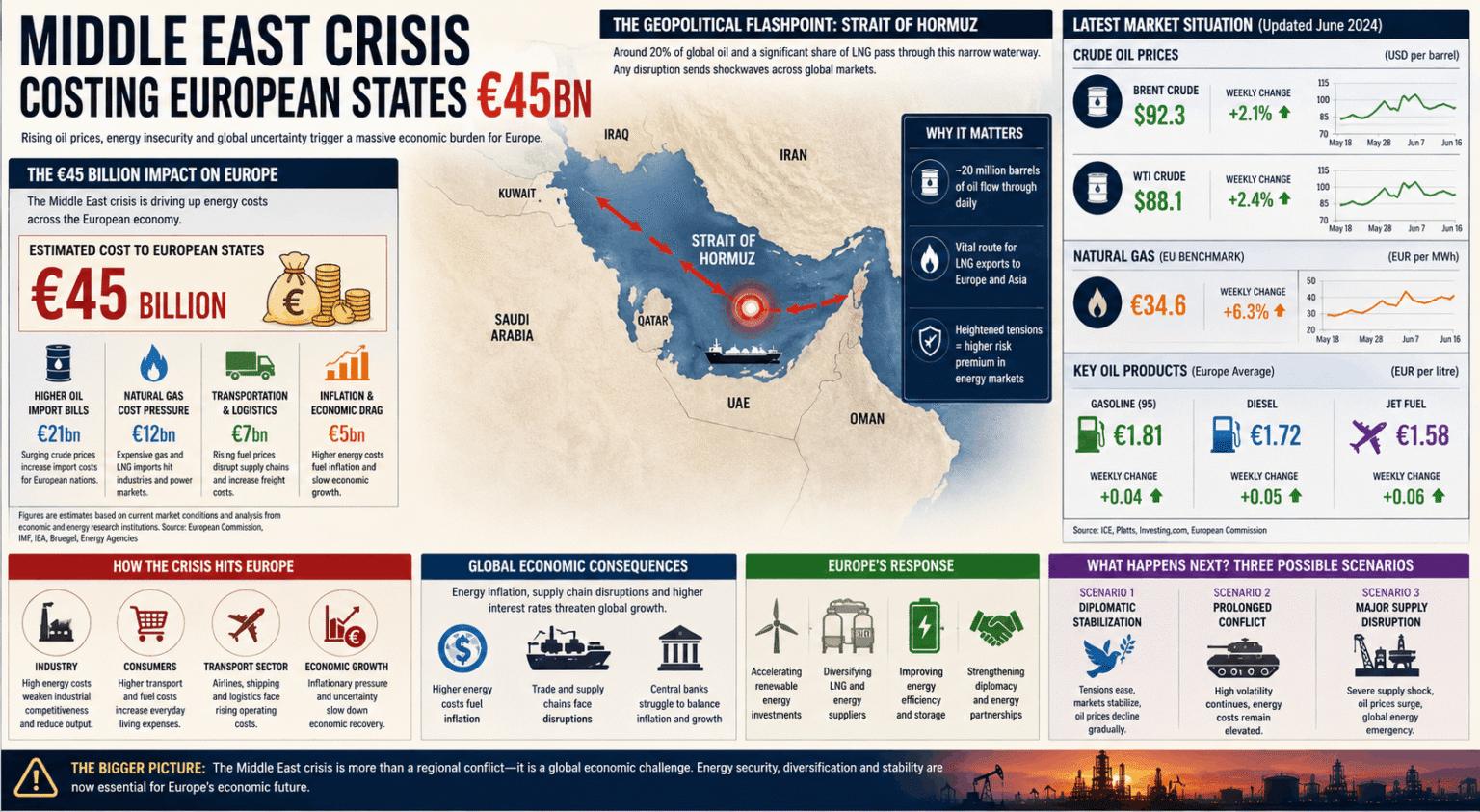
European states are facing an estimated economic burden approaching €45 billion as higher oil prices, expensive gas imports, increased transportation costs and inflationary pressures continue to affect businesses and consumers.
The crisis has reminded Europe of a harsh reality: despite years of investment in renewable energy and diversification strategies, the continent remains deeply connected to global fossil fuel markets and vulnerable to instability in the Middle East.
The latest crisis has created a situation where a conflict thousands of kilometers away is influencing electricity bills in European homes, production costs in European factories and fuel prices at European petrol stations.
The Middle East Energy Route That Controls the Global Economy
At the heart of the crisis is the strategic importance of the Persian Gulf and the Strait of Hormuz, one of the most critical energy routes on the planet.
Any threat to the security of this narrow waterway immediately creates panic in global markets because millions of barrels of crude oil and large quantities of liquefied natural gas pass through the region every day.
Energy markets do not only respond to actual supply shortages; they react strongly to the possibility of future disruption. Even the possibility of attacks on energy infrastructure, restrictions on shipping routes or a wider regional war forces traders to add a risk premium to oil prices.
For Europe, the timing of this crisis is particularly challenging. The continent is still recovering from the energy shock caused by the Russia-Ukraine war, which forced European countries to replace traditional Russian energy supplies with more expensive alternatives.
The Middle East crisis has created another test of Europe’s energy resilience.
Europe’s €45 Billion Energy Bill: The Hidden Cost of Conflict
The financial impact of the Middle East crisis is spreading throughout the European economy. Rising crude oil prices have increased import costs for European countries that rely heavily on international energy markets. Every increase in the price of oil affects transportation, manufacturing, agriculture and consumer goods.
The additional energy burden has become a major concern for European governments because expensive fuel directly affects inflation.
When transportation companies pay more for diesel, the increased costs eventually reach supermarkets, industries and ordinary households.
The industrial sector is among the biggest victims. Energy-intensive industries such as chemicals, steel, fertilizers and manufacturing require stable and affordable energy supplies.
Higher gas and electricity prices reduce competitiveness and force some companies to slow production or reconsider investment decisions.
Germany, Europe’s largest industrial economy, has been particularly concerned about energy costs because its manufacturing model depends heavily on reliable and affordable power.
Oil Markets Enter a New Era of Geopolitical Volatility
Global oil markets have entered a period of extreme uncertainty as traders attempt to calculate the possible consequences of prolonged instability in the Middle East.
Brent crude oil, the international benchmark, has recently remained highly volatile, moving around the $90–100 per barrel range during periods of heightened geopolitical tension.
West Texas Intermediate (WTI), the U.S. benchmark, has also experienced significant movement as investors evaluate possible supply disruptions.
The current market environment reflects a combination of three major factors: geopolitical risk, concerns about supply security and uncertainty about future demand.
Oil prices are not only influenced by actual production losses. The fear that millions of barrels could disappear from the market is enough to push prices higher.
This is why even limited disruptions or threats against energy infrastructure can create major financial consequences.
Fuel Prices, Transportation Costs and Consumer Pressure
The impact of rising oil prices is quickly visible in gasoline and diesel markets. European consumers are particularly sensitive because fuel prices already include significant taxation, meaning any increase in global crude prices creates additional pressure at fuel stations.
Diesel has become a major concern because it powers the backbone of the European economy. Heavy trucks, shipping networks, agricultural machinery and industrial transportation all depend heavily on diesel fuel.
When diesel prices rise, the consequences spread across the entire supply chain. Food transportation becomes more expensive, manufacturing costs increase and consumers eventually face higher prices for everyday goods.
The aviation sector is also experiencing pressure. Airlines depend heavily on jet fuel, which is closely linked to crude oil prices. A prolonged energy crisis could increase ticket prices and affect international travel demand.
Natural Gas: Europe’s Second Major Vulnerability
While oil receives most attention, natural gas remains another critical concern for Europe.
The continent’s energy strategy changed dramatically after the reduction of Russian gas supplies, forcing countries to rely more heavily on liquefied natural gas imports.
The Middle East crisis has increased competition for global LNG supplies because Asian and European buyers are competing for limited cargoes.
Any disruption in Middle Eastern gas exports could create another price shock similar to the energy crisis experienced after 2022.
Higher gas prices also threaten Europe’s industrial recovery because many factories depend on gas for production processes. Expensive energy weakens European competitiveness compared with regions where energy costs are lower.
Inflation Threat Returns as Central Banks Face Pressure
The energy crisis has created a difficult situation for European policymakers. Higher oil and gas prices can increase inflation at a time when governments and central banks are trying to maintain economic stability.
Energy inflation affects almost every sector of the economy. Transportation becomes more expensive, businesses increase prices to protect profits, and consumers reduce spending because household budgets become tighter.
The European Central Bank faces a complicated challenge: controlling inflation without damaging economic growth. Higher interest rates may slow inflation, but they can also weaken investment and employment.
The Middle East crisis has therefore become not only an energy issue but also a monetary and economic policy challenge.
A New Strategic Reality for Europe
The crisis has forced Europe to reconsider its long-term energy strategy. The continent has accelerated efforts to expand renewable energy, improve energy efficiency and diversify energy suppliers.
However, the transition away from fossil fuels cannot happen immediately. Oil remains essential for transportation, aviation and industrial activity, while gas continues to play a major role in electricity generation and heating.
The crisis has demonstrated that energy security is now directly linked with national security. European governments increasingly recognize that dependence on unstable regions creates economic vulnerability.
Three Possible Futures for Global Energy Markets
The future direction of oil markets depends largely on how the Middle East crisis develops.
If diplomatic efforts succeed and tensions decrease, energy markets could stabilize and oil prices may gradually decline as geopolitical risk disappears.
However, if the conflict continues for a prolonged period, Europe and the global economy could face sustained energy inflation, slower economic growth and higher living costs.
The most dangerous scenario would be a major disruption to Gulf energy exports. Such an event could send oil prices sharply higher, trigger a global energy emergency and create another wave of inflation similar to previous energy shocks.
Conclusion: The Middle East Crisis Has Become Europe’s Economic Security Test
The estimated €45 billion cost facing European states represent more than a financial loss; it reflects the deeper economic consequences of geopolitical instability.
The crisis has exposed Europe’s continued dependence on global energy markets and highlighted the connection between security, diplomacy and economic stability.
The Middle East has once again demonstrated that regional conflicts can create worldwide consequences.
A missile strike, a shipping disruption or political escalation in the Gulf can influence energy prices, inflation rates and economic decisions across Europe and beyond.
For Europe, the lesson is clear: energy independence, diversified supplies and diplomatic engagement are no longer simply policy choices.
They have become essential elements of economic security in an increasingly unstable world
Stay engaged with the issues shaping our future through comprehensive reporting and informed commentary from The Variant.







