


Courtesy: Reporting Contribution by Ghulam Murtaza [A Senior Journalist I Islamabad, Pakistan]
Rochester, NY/Islamabad, PK: Prime Minister Shehbaz Sharif’s visit to Türkiye was not a routine brotherhood photo-op. It was a carefully staged attempt to convert Pakistan’s emotional diplomacy with Ankara into economic, industrial and strategic advantage.
In Istanbul, Shehbaz Sharif and Turkish President Recep Tayyip Erdoğan spoke the familiar language of friendship, sacrifice and shared history. But behind the poetry was a hard reality:
Pakistan needs investment, trade corridors, defence-industrial cooperation and regional relevance. Türkiye needs reliable partners, markets and strategic depth. Both sides know that warm words alone cannot pay bills or build factories.
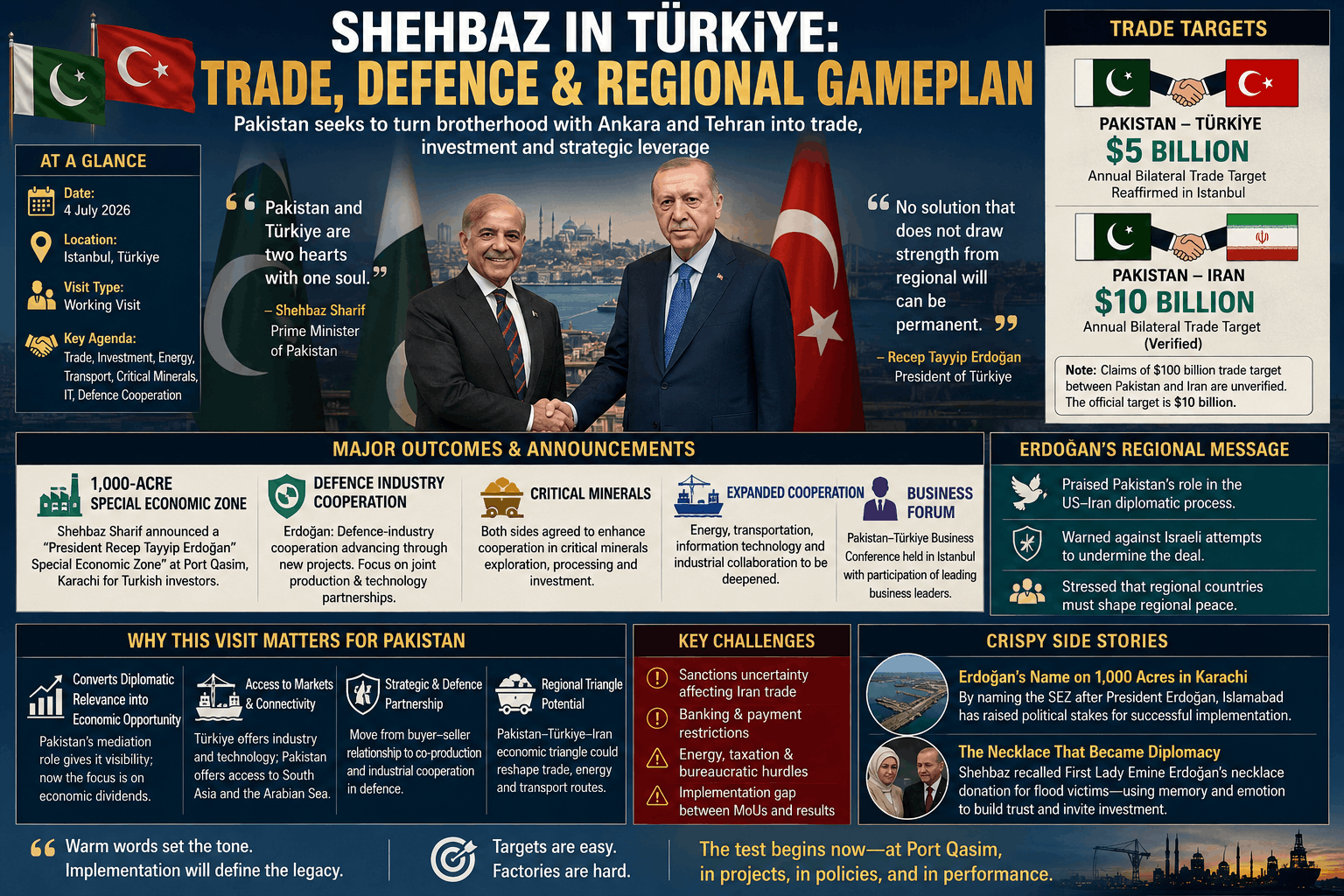
The centerpiece of the visit was the renewed commitment to take Pakistan-Türkiye bilateral trade to $5 billion annually.
Erdoğan confirmed this target during the joint press briefing and said both sides were exploring cooperation in energy, transport, critical minerals, information technology and defence industry.
That list shows the real character of the visit. It was economic in presentation, strategic in design and partly military in substance.
The most interesting announcement was Shehbaz Sharif’s offer of a 1,000-acre special economic zone at Port Qasim for Turkish investors.
The proposed “President Recep Tayyip Erdoğan Special Economic Zone” is more than ceremonial branding. By attaching Erdoğan’s name to the project, Islamabad has raised its political value and created pressure for delivery.
If implemented seriously, the zone could become a Turkish industrial gateway into Pakistan’s largest commercial region. If it fails, it will become another decorated file in Pakistan’s long archive of unrealized economic promises.
The defence side was equally important, though it requires careful wording. Erdoğan publicly said defence-industry cooperation with Pakistan is advancing through new projects.
Pakistan and Türkiye already have a deep defence relationship, including naval and military-industrial cooperation. But there is no verified public confirmation from this visit of a specific new defence contract worth hundreds of millions of dollars.
Claims about exact figures should therefore be treated cautiously unless officially documented.
The more credible interpretation is that both countries are moving toward broader strategic-industrial cooperation. Türkiye’s defence industry has matured rapidly.
Pakistan wants technology partnerships, co-production and strategic diversification. In that context, defence was not the only agenda, but it was clearly one of the strongest pillars.
Shehbaz’s press briefing was emotional but purposeful. He recalled the historic support Muslims of the subcontinent gave to Türkiye during its independence struggle and praised Türkiye’s help during Pakistan’s floods and natural disasters.
He described Pakistan and Türkiye as “two hearts with one soul.”
But the real message was aimed at Turkish investors: friendship must now become investment.
Erdoğan’s remarks were wider and sharper. Alongside trade and defence, he praised Pakistan’s role in the US-Iran diplomatic process and warned that regional peace cannot be imposed from outside.
He also cautioned against Israeli attempts to undermine diplomacy with Iran, saying the region must not again be pushed into bloodshed and gunpowder.
That statement gave Pakistan diplomatic value. Ankara was effectively endorsing Islamabad’s claim that regional countries must shape the future of Middle Eastern stability.
For Shehbaz, this matters because Pakistan is trying to turn its recent mediation profile into economic benefit.
The Iran angle is where facts must be separated from exaggeration. The verified Pakistan-Iran trade target is $10 billion, not $100 billion.
Iranian President Masoud Pezeshkian and official Iranian statements have repeatedly referred to increasing bilateral trade with Pakistan to $10 billion.
The $100 billion figure circulating in some commentary appears connected to broader discussions about Iranian frozen funds and sanctions-related assets, not a confirmed Iran-Pakistan trade pledge.
This correction is important. Inflated numbers damage credibility. A $10 billion Pakistan-Iran target is already ambitious, considering banking restrictions, sanctions risks, border management problems and limited formal trade infrastructure.
Still, the broader picture is fascinating. Pakistan is speaking of $5 billion trade with Türkiye and $10 billion trade with Iran.
Together, these targets suggest Islamabad wants to build a regional economic triangle: Turkish industry, Iranian energy and markets, and Pakistani ports, population and geography.
On paper, it is attractive. In reality, it is difficult.
Iran remains trapped under sanctions uncertainty. Pakistan struggles with policy inconsistency, energy costs, taxation disputes and bureaucratic delays.
Türkiye has its own economic pressures and geopolitical balancing acts. None of these obstacles can be removed by press conferences.
The crispest side story of the visit was Shehbaz’s use of memory as diplomacy. He recalled Turkish First Lady Emine Erdoğan’s donation of a necklace for Pakistan’s flood victims and Erdoğan’s past visits to flood-hit areas.
This was not casual nostalgia. It was emotional statecraft. Shehbaz first reminded Türkiye of shared sacrifice, and then invited Turkish businesses to invest in Pakistan’s future.
Another sharp side story is the timing. Pakistan has recently gained attention through its role in the US-Iran diplomatic track.
Shehbaz is now trying to convert that visibility into commercial momentum. The message is clear: Pakistan does not want applause only; it wants investment, trade and regional connectivity.
But the danger is equally clear. Pakistan has often confused announcements with achievements. Special economic zones, trade targets and memorandums of understanding are easy to declare. Factories, export orders, bankable projects and jobs are much harder to deliver.
The Istanbul visit should therefore be judged neither as a breakthrough nor as empty theatre. It was a serious diplomatic effort with real strategic potential, but its success depends on implementation.
If Port Qasim becomes a functioning Turkish industrial zone, if defence cooperation moves toward technology transfer, if Turkish investors receive predictable treatment, and if Pakistan-Iran trade grows through legal, secure and sanctions-compliant channels, then Shehbaz’s visit may be remembered as more than ceremonial diplomacy.
But if the visit produces only speeches, slogans and another trade target, it will join the long list of impressive Pakistani diplomatic moments that failed to become economic transformation.
The real verdict is simple: Shehbaz went to Türkiye with trade on the table, defence in the background and Iran in the regional frame.
Now Pakistan must prove that friendship can produce factories, not just photographs.
Understanding global events requires context. The Variant brings together facts, analysis, and perspectives that matter.


