


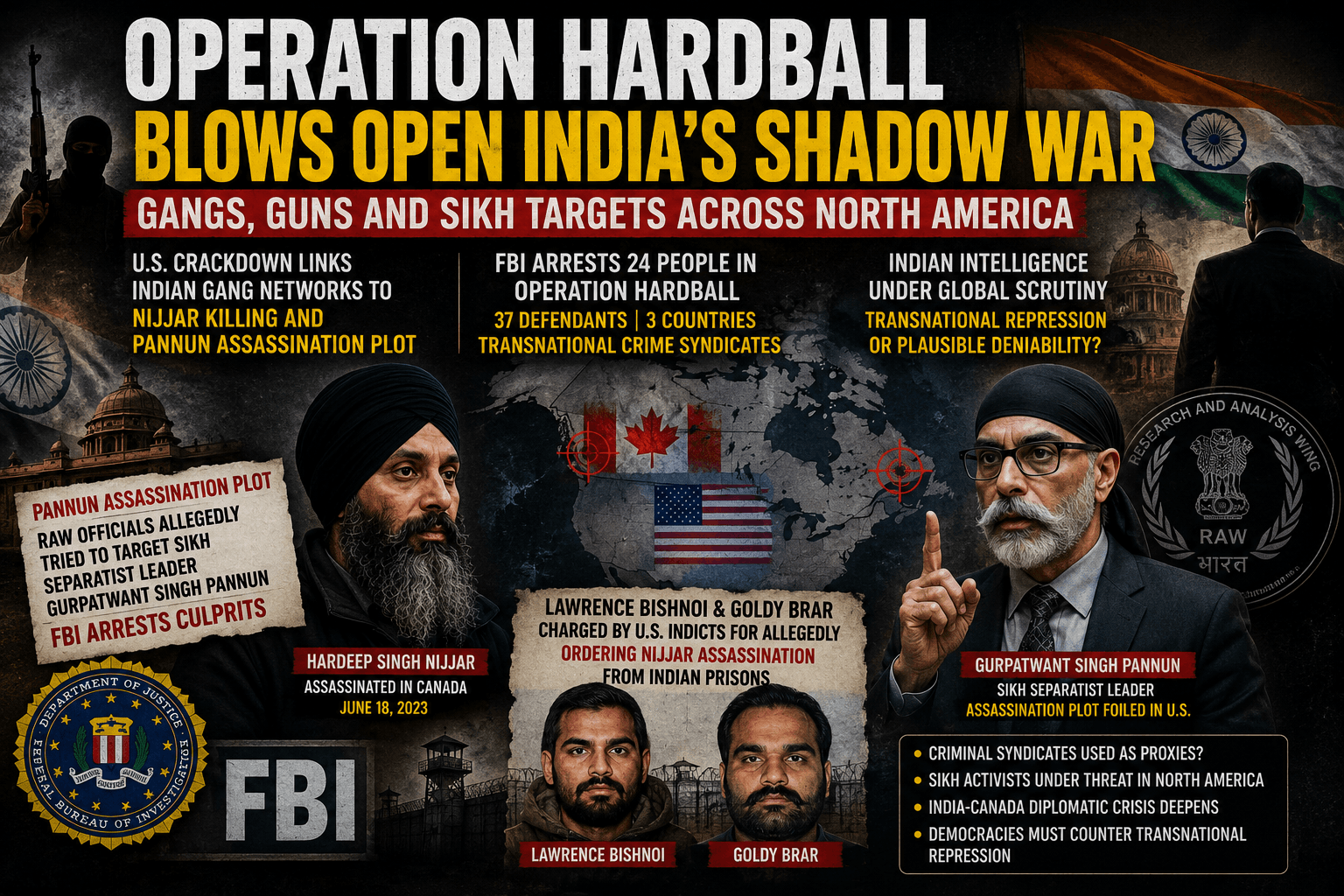
Rochester, NY: The U.S. Justice Department announced Operation Hardball on July 7, 2026, saying 24 people were arrested in the U.S., Canada and Europe in a wider case involving 37 defendants linked to three India-based transnational organized crime groups.
The alleged crimes include racketeering, extortion, narcotics trafficking, shootings and targeted killings, including the 2023 assassination of Sikh leader Hardeep Singh Nijjar in Canada.
The Nijjar case became a diplomatic earthquake after Canada alleged a possible link between Indian government agents and his killing. Nijjar, a Canadian citizen and Sikh separatist activist, was shot dead outside the Guru Nanak Sikh Gurdwara in Surrey, British Columbia, on June 18, 2023.
India had accused him of terrorism; his supporters called him a political activist. The dispute turned into a sovereignty crisis because the killing happened on Canadian soil.
Operation Hardball now adds a criminal-network dimension to that story. U.S. prosecutors have charged jailed Indian gangster Lawrence Bishnoi and Goldy Brar with allegedly directing Nijjar’s assassination.
It is reported that the indictment says Bishnoi allegedly operated from prison using smuggled phones and passed Nijjar’s photograph and addresses for the hit.
This does not automatically prove the Indian state ordered Nijjar’s killing. In fact, the new U.S. indictment against the gang figures does not itself charge the Indian government.
But Canada’s own public position has been stronger: Global Affairs Canada said in October 2024 that six Indian diplomats and consular officials were expelled after the RCMP gathered evidence linking agents of the Government of India to a targeted campaign against Canadian citizens.
The most damaging parallel case is the attempted assassination of Gurpatwant Singh Pannun, a U.S.-based Sikh separatist leader and American citizen.
The U.S. Justice Department charged Indian government employee Vikash Yadav and Indian national Nikhil Gupta in a murder-for-hire plot.
DOJ said Yadav directed the plot from India and Gupta tried to hire a hitman, who turned out to be connected to U.S. law enforcement. Gupta later pleaded guilty in February 2026 to murder-for-hire, conspiracy and money laundering charges.
Together, Nijjar’s killing in Canada and the failed Pannun plot in New York suggest a disturbing pattern: diaspora activists, especially Sikh separatist voices, were allegedly treated not as political opponents protected by democratic law, but as targets to be silenced through clandestine networks.
The critical question is how Indian criminal syndicates became so powerful abroad. Groups like the Bishnoi network appear to combine prison-based command, encrypted communications, diaspora extortion, narcotics routes, weapons access and local shooters.
Such gangs can serve criminal profit, but they can also be useful to intelligence actors because they offer plausible deniability. If a target is attacked, the state can deny involvement and blame gang rivalry.
Canadian intelligence has openly described this as transnational repression. CSIS said evidence pointed to links between Indian government agents and criminal networks used to create violent activity in South Asian communities in Canada.
India has strongly denied these allegations and has accused Canada of sheltering extremists. That denial must be included, but denial alone cannot erase the seriousness of U.S. indictments, Canadian expulsions and ongoing criminal trials.
The broader failure is institutional. If Indian law enforcement and intelligence agencies are allowing gang leaders to operate internationally from Indian prisons, it raises questions about corruption, political protection or operational misuse.
If the networks are acting independently, then India has failed to control violent transnational crime. If they are acting with state-linked encouragement, then the issue becomes far more serious: extrajudicial targeting on allied soil.
For the United States and Canada, Operation Hardball is therefore not only a crime crackdown. It is a warning about foreign interference, diaspora intimidation and the weaponization of organized crime.
Western governments will now face pressure to protect Sikh, Kashmiri, Baloch, Pakistani and other diaspora activists from surveillance, coercion and violence.
For India, the reputational cost is severe. A democratic state cannot fight separatism abroad through gangsters, covert killings or intimidation. Legitimate counterterrorism must pass through evidence, courts, extradition requests and lawful cooperation.
Once a state appears to outsource punishment to criminal syndicates, it damages its own global credibility.
Operation Hardball has pulled back the curtain on a dark ecosystem where organized crime, diaspora politics and alleged intelligence-linked targeting overlap.
The final legal truth will come through courts, but politically the message is already clear: North America is no longer willing to treat these networks as distant Indian gang problems.
They are now seen as direct threats to sovereignty, public safety and democratic freedom.


