Courtesy: Reporting Contribution by Hira Ahmed [A freelance Journalist I Rawalpindi, Pakistan] & Anjali Sharma [A Veteran Journalist I New Delhi, India]
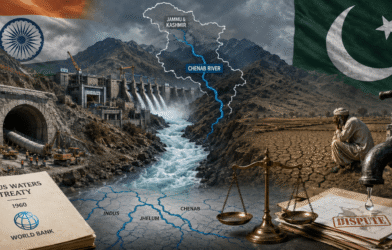
Rochester, NY/Islamabad, PK/New Delhi, IN: The India-Pakistan water dispute is no longer simply an argument over dams, river flows or technical clauses of the 1960 Indus Waters Treaty.
By September 2026, water has moved closer to the center of the two nuclear-armed neighbors’ broader strategic confrontation.
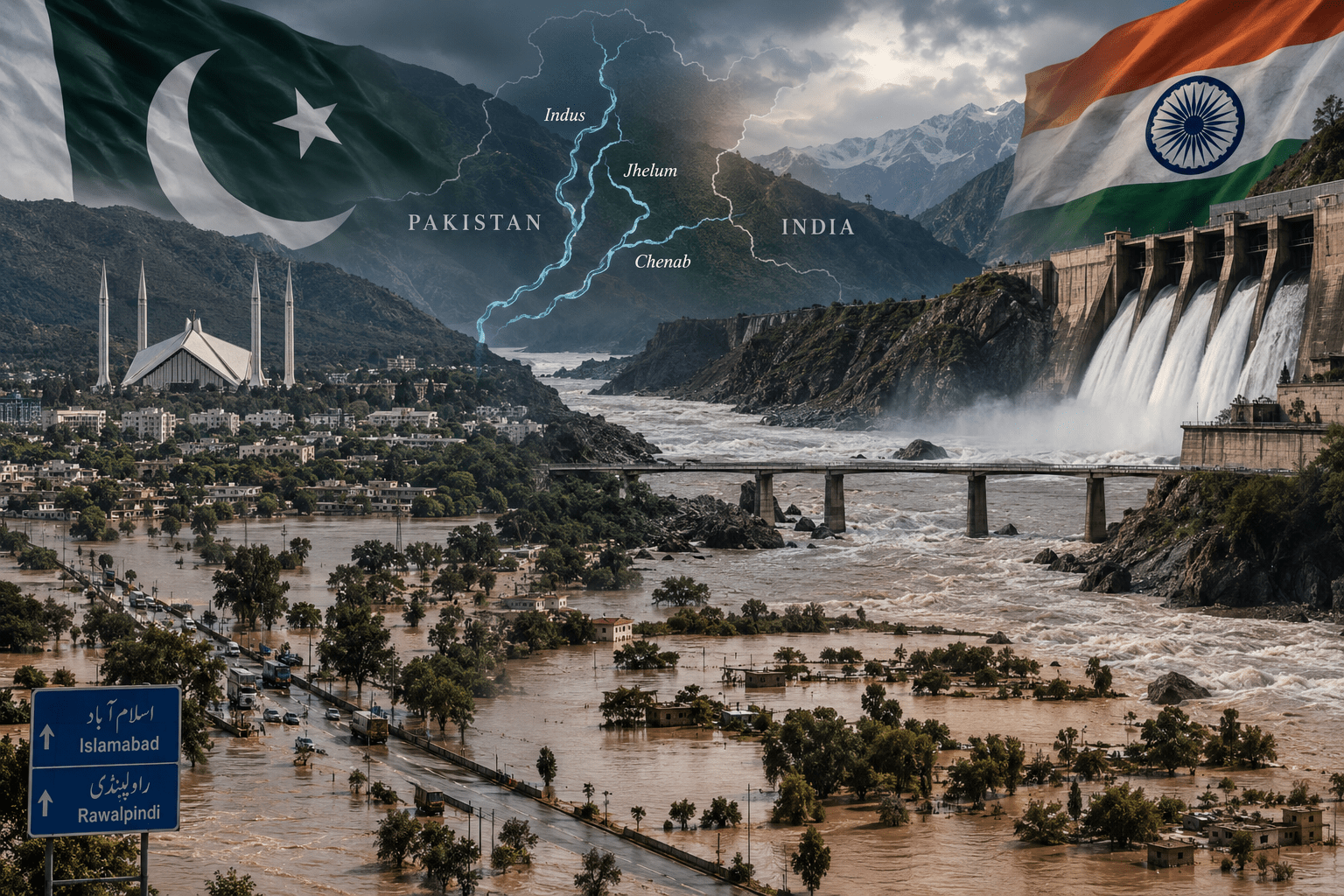
The latest monsoon flooding across Pakistan, renewed accusations over Indian management of the western rivers and a fresh international arbitration ruling have combined to turn an old disagreement into one of South Asia’s most dangerous emerging security challenges.
Pakistan has increasingly accused India of attempting to “weaponized” water by placing the Indus Waters Treaty in abeyance and expanding its ability to regulate flows on the Indus basin’s western rivers.
India rejects that description, arguing that Pakistan cannot expect normal treaty cooperation while, in New Delhi’s view, supporting cross-border terrorism.
The danger lies between those two positions. India does not currently possess the reservoir capacity to simply shut off Pakistan’s western rivers, but even limited control over timing, hydropower operations, data-sharing and reservoir releases becomes politically explosive during droughts or extreme monsoon flooding.
Floods Deepen Pakistan’s Fear of Upstream Control
The latest flooding has strengthened the perception inside Pakistan that upstream water management by India could magnify the country’s vulnerability.
Pakistan has experienced severe monsoon conditions across Khyber Pakhtunkhwa, Azad Jammu and Kashmir, Gilgit-Baltistan, the Potohar region and Punjab in recent days.
Pakistan’s National Disaster Management Authority issued severe flash- and urban-flood warnings on September 4 for Khyber Pakhtunkhwa, GB and AJK, along with a separate warning covering the Potohar region and Punjab.
Rawalpindi and Islamabad are particularly vulnerable because intense rainfall can rapidly overwhelm local waterways and drainage systems.
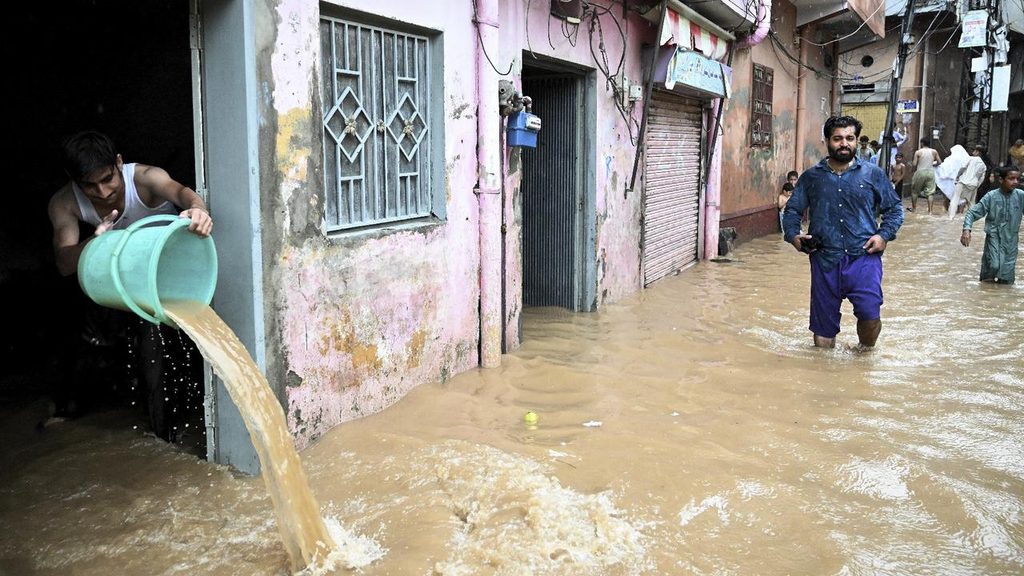
Rawalpindi’s Nullah Lai and other local streams can rise dramatically following cloudbursts and concentrated rainfall across the Potohar plateau.
That distinction is crucial.
It would be technically inaccurate to attribute flooding in Rawalpindi and Islamabad directly to Indian releases into the Indus, Jhelum or Chenab.
The twin cities do not sit downstream of those three rivers in a way that would make Indian reservoir releases a direct cause of their urban flooding.
Similarly, much of the destructive flash flooding in Khyber Pakhtunkhwa originates from heavy rainfall, mountain catchments, tributaries and local torrents rather than releases from Indian dams.
Pakistan’s own disaster authorities have tied the current threat primarily to heavy monsoon rainfall and flash-flood conditions.
Indian releases or rapidly changing upstream flows can, however, be highly relevant farther downstream on rivers such as the Chenab and Jhelum, particularly when Pakistan’s own reservoirs and river systems are already swollen by monsoon rainfall.
The strategic concern therefore is not that India created every flood affecting Pakistan, but that deteriorating cooperation could make natural flooding more difficult to anticipate and manage.
India Rejects the Flood-Warfare Allegation
New Delhi has explicitly rejected Pakistani allegations that India deliberately caused flooding.
Indian External Affairs Ministry spokesperson Randhir Jaiswal said in July that reports accusing India of intentionally increasing Chenab flows were “baseless and contrary to the facts.” India attributed increased flows to intense monsoon rainfall over Jammu and adjoining catchment areas between July 20 and July 23.
New Delhi also pointed out that Pakistan’s own Flood Forecasting Division had linked the elevated Chenab levels to heavy rainfall in the upper catchment.
This is important because river politics can easily turn a hydrological event into a security narrative.
During extreme rainfall, dams frequently have to release water once reservoirs approach safety limits.
Such releases can worsen downstream flooding, but that does not necessarily mean the flooding was deliberately engineered.
The larger problem is trust. When treaty mechanisms, hydrological exchanges and bilateral contacts weaken, even technically necessary reservoir operations can be interpreted as hostile actions.
The Indus Waters Treaty Has Entered Uncharted Territory
The dispute revolves around one of the most durable agreements ever reached between India and Pakistan.
Under the World Bank-brokered Indus Waters Treaty signed in 1960, India obtained principal rights over the eastern rivers — Ravi, Beas and Sutlej — while Pakistan received unrestricted use, subject to defined Indian exceptions, of the western rivers — Indus, Jhelum and Chenab.
India may undertake certain uses on the western rivers, including run-of-river hydroelectric generation, irrigation and limited storage, provided projects comply with treaty specifications.
For decades, those technical limitations were the center of disputes involving projects such as Kishanganga and Ratle.
The conflict fundamentally changed after India placed the treaty in abeyance following the April 2025 Pahalgam attack. New Delhi accused Pakistan of links to cross-border terrorism, an allegation Islamabad rejected.
India subsequently declared that normal water relations could not be separated from security.
Indian Prime Minister Narendra Modi summarized India’s position forcefully:
“Bharat has now decided — blood and water will not flow together.”
He also described the treaty as “unjust and one-sided” and argued that water originating in India should benefit Indian farmers.
India’s Ministry of External Affairs reiterated in July 2026 that the treaty would remain in abeyance until Pakistan “irrevocably and credibly” renounces support for cross-border terrorism.
That position effectively links water cooperation to India’s national-security doctrine.
Pakistan: Water Has Become a Red Line
Islamabad views the issue from almost the opposite perspective.
For Pakistan, the western rivers are not simply diplomatic assets. They underpin agriculture, food security, electricity generation and the livelihoods of millions of people.
Pakistan’s Prime Minister Shehbaz Sharif delivered one of country’s strongest warnings in August 2026:
“Every single drop of Pakistan’s water is our red line.”
He simultaneously stressed that Pakistan sought peace rather than war but warned against interpreting that preference as weakness.
At the Shanghai Cooperation Organisation summit on September 1, Sharif adopted a more diplomatic formulation:
“Water is the lifeblood of our region.”
He said water “must never be weaponized” or used as political leverage and argued that treaties governing shared waters are binding international commitments rather than agreements governments can discard for political convenience.
Pakistan’s Foreign Ministry has gone further, accusing India of attempting to use water coercively and warning that any action threatening Pakistan’s water, food or economic security would be unacceptable.
Islamabad maintains that there is no unilateral exit provision in the treaty and argues that India’s declaration of “abeyance” therefore has no legal foundation.
The Hague Ruling Strengthens Pakistan’s Legal Position
The legal dimension changed significantly at the end of August.
A Hague-based Court of Arbitration ruled that India remained bound by the Indus Waters Treaty despite New Delhi’s attempt to suspend its operation.
The court held that unilateral action could not remove treaty obligations and imposed restrictions concerning aspects of the Ratle hydroelectric project while the dispute continues through treaty mechanisms.
Pakistan welcomed the ruling as confirmation of its long-standing interpretation.
Its Foreign Ministry said on September 2 that the decision reaffirmed that the treaty “remains fully in force and binding.” Islamabad also stated that it retained diplomatic and other options concerning what it calls India’s “weaponization of water.”
India rejected the judgment.
New Delhi argues that the arbitration court lacks legitimate jurisdiction and has called the body improperly constituted. India therefore maintains that the award cannot constrain sovereign decisions relating to its water policy or hydroelectric infrastructure.
This creates an unusually serious legal impasse: Pakistan considers the arbitration mechanism legally binding, while India contests the legitimacy of the very institution issuing the rulings.
Can India Actually Stop Pakistan’s Water?
Political rhetoric sometimes gives the impression that India can simply close a gate and stop the Indus system from entering Pakistan.
The physical reality is considerably more complicated.
Most Indian hydroelectric installations on the western rivers are run-of-river projects with comparatively limited storage.
They can influence flows for certain periods, particularly through pondage and reservoir operations, but they cannot currently capture the enormous seasonal volumes carried by the Indus basin indefinitely.
A hydrology expert quoted by Al Jazeera estimated India’s existing storage capacity on the Chenab at roughly one million acre-feet and argued that India would itself face flooding problems if it attempted to store huge monsoon flows indefinitely.
That means the most realistic short-term leverage is not the permanent stopping of Pakistan’s rivers.
It is the ability to alter timing.
Even relatively short-term variations matter enormously during sensitive agricultural periods.
A reduction during sowing season, unexpected fluctuations during irrigation cycles, or rapid releases during already high monsoon flows could create economic and political disruption.
And if India expands storage and hydropower infrastructure over the coming decades, its operational flexibility could increase.
India’s Water Resources Minister C.R. Patil illustrated New Delhi’s longer-term ambition in June when he said:
“It is certain, not a single drop of water will go [to Pakistan] in the coming years.”
The statement represented political intent rather than India’s present hydrological capability, but it inevitably intensified Pakistan’s fears.
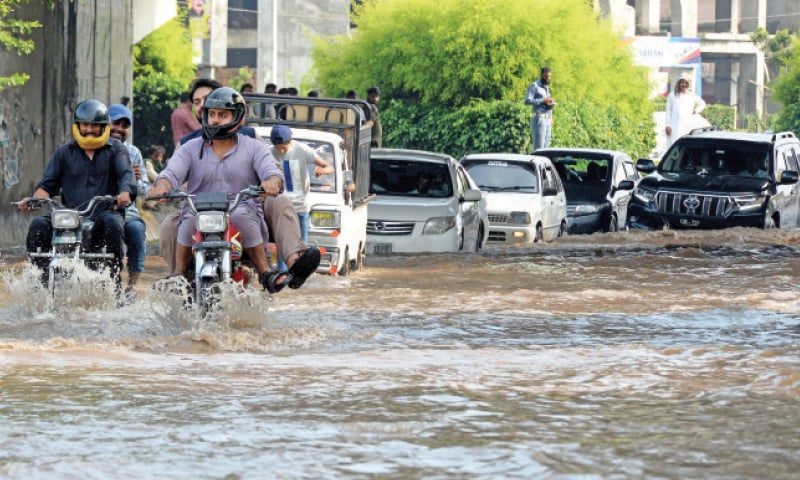
Flooding Exposes Pakistan’s Own Structural Weakness
Pakistan’s legitimate concerns over upstream predictability should not obscure its domestic water-management failures.
Climate change is increasing the frequency of extreme precipitation events across South Asia.
Rapid urbanization, construction on natural waterways, inadequate drainage, deforestation and weak enforcement of flood-zone regulations amplify their consequences.
Rawalpindi provides a classic example.
Flooding around Nullah Lai predates the current India-Pakistan treaty crisis by decades. Encroachment, drainage limitations and increasingly intense rainfall make the metropolitan area vulnerable regardless of what happens on the Chenab or Jhelum.
Khyber Pakhtunkhwa similarly faces glacier-fed streams, steep catchments, landslide risks and flash floods capable of developing within hours.
Therefore, blaming every Pakistani flood on India would weaken Pakistan’s otherwise stronger legal argument concerning treaty compliance.
Pakistan’s case is more credible when it distinguishes between three separate issues: extreme climate-driven flooding, inadequate domestic water infrastructure, and the strategic risks arising from unpredictable upstream river management.
From Water Sharing to Water Deterrence
The most consequential transformation is psychological.
For almost seven decades, the Indus Waters Treaty insulated water from the broader India-Pakistan confrontation. The countries fought wars, endured terrorist attacks and experienced long diplomatic breakdowns while the treaty largely survived.
That firewall is disappearing.
India now explicitly links terrorism and river cooperation through the slogan that “blood and water cannot flow together.”
Pakistan increasingly describes interference with the western rivers as a national-security red line.
Once both sides begin discussing water using the language traditionally associated with military deterrence, the risk of miscalculation increases.
Imagine a future monsoon in which intense rainfall forces an Indian hydroelectric project to make large releases into an already swollen Chenab.
Pakistan experiences devastating flooding. Social media immediately portrays the release as deliberate “water aggression.” Political pressure builds in Islamabad before engineers have determined the hydrological causes.
Or consider the opposite season: flows unexpectedly decline during a crucial Pakistani agricultural cycle. Islamabad suspects deliberate withholding while India attributes the reduction to hydrological conditions.
Without trusted data exchange and functioning treaty institutions, technical ambiguity can become strategic escalation.
Pakistan’s Legal Victory Is Important — But Not Enough
The Hague ruling gives Islamabad valuable diplomatic leverage because it reinforces the principle that treaty obligations cannot simply disappear through unilateral political declarations.
But international arbitration has limitations when one party rejects jurisdiction.
Pakistan therefore faces a strategic choice.
Its strongest long-term position lies not simply in threatening retaliation but in internationalizing the principle of transboundary water stability while simultaneously improving domestic storage, forecasting and irrigation efficiency.
Pakistan also has one of the world’s most extensive irrigation systems but loses enormous volumes through inefficient canals, outdated agricultural practices, inadequate reservoirs and groundwater mismanagement.
Water security must consequently become an infrastructure strategy as much as a foreign-policy strategy.
India faces a different dilemma.
New Delhi may gain domestic political support from framing the treaty as excessively generous to Pakistan, but treating transboundary water flows as instruments of counterterrorism risks creating a dangerous precedent.
India itself is a downstream state on several rivers originating outside its territory, particularly regarding China.
A regional doctrine legitimizing upstream geopolitical pressure could therefore eventually work against Indian interests.
A Water Crisis Could Become More Dangerous Than a Border Crisis
The India-Pakistan rivalry has historically been dominated by Kashmir, terrorism and military confrontation.
Water may now be joining that list.
Unlike territorial disputes, however, rivers cannot be frozen along a ceasefire line. They flow every day, cross political borders continuously and react unpredictably to climate conditions.
The present floods illustrate the dilemma perfectly.
Pakistan is genuinely experiencing destructive flooding. Heavy monsoon rainfall and local hydrological conditions are central causes, particularly in Rawalpindi, Islamabad and Khyber Pakhtunkhwa.
Indian releases on western rivers should not automatically be presented as the cause of those disasters without hydrological evidence.
At the same time, Islamabad has legitimate reasons to worry about a future in which India expands upstream infrastructure while treaty transparency collapses.
The most dangerous outcome would therefore not necessarily be India completely stopping the Indus.
It would be something subtler: the disappearance of trust over when water will arrive, how much will arrive and why river levels suddenly change.
For an agricultural country downstream, unpredictability itself becomes a strategic vulnerability.
The Indus Waters Treaty survived wars precisely because both governments once accepted that rivers should remain outside warfare.
India and Pakistan are now moving toward the opposite doctrine — where terrorism, retaliation, sovereignty and water increasingly belong to the same strategic conversation.
If that transformation continues, the Indus basin could cease to be one of South Asia’s greatest examples of successful conflict management and become another potential trigger for confrontation between two nuclear powers.
For more news, expert commentary, and strategic analysis, explore the latest reports and features published by The Variant.