


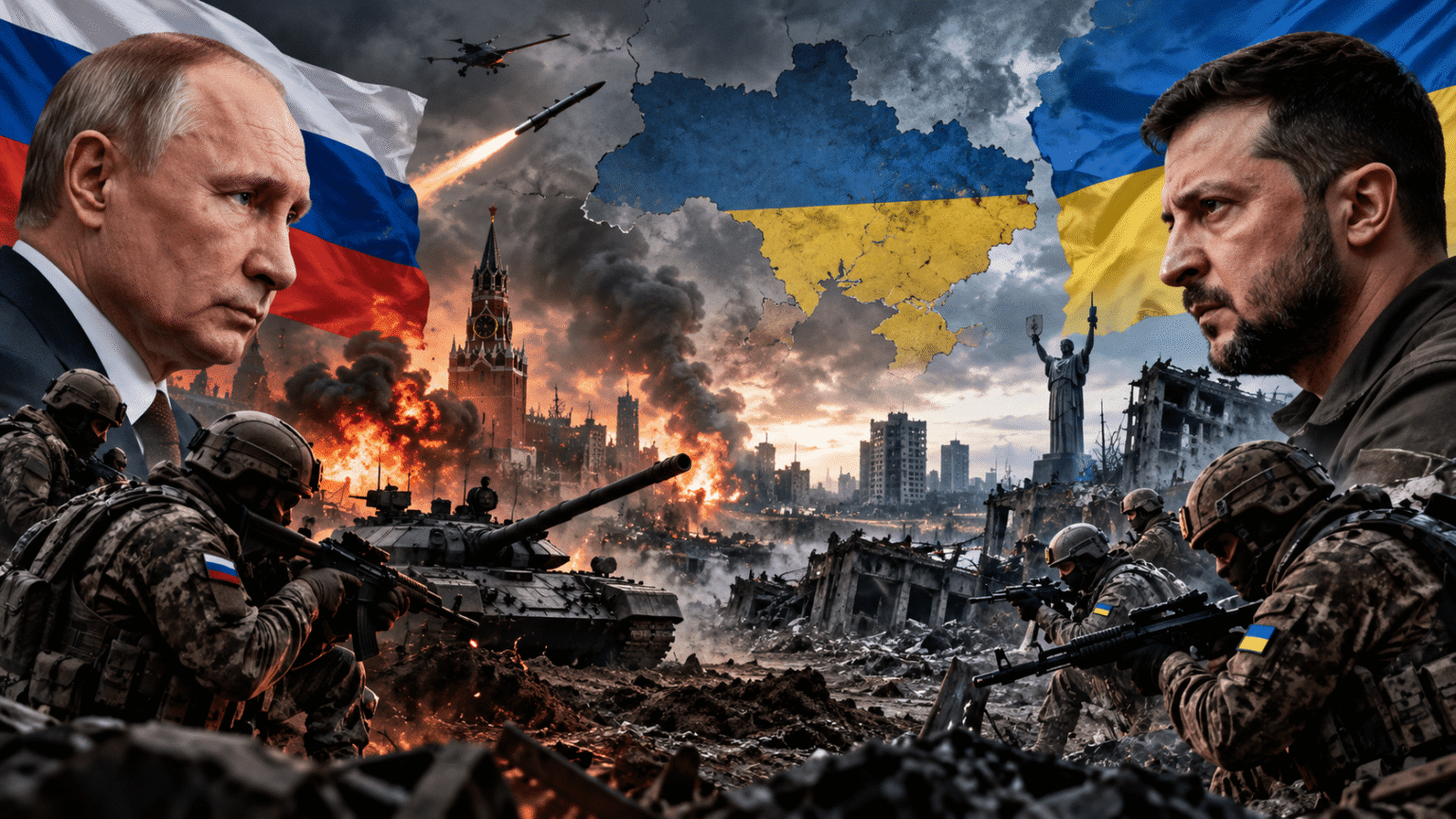
Rochester, NY: The Institute for the Study of War’s Russian Offensive Campaign Assessment of September 1, 2026 presents a battlefield that is violent, increasingly technologically sophisticated, but strategically far less decisive than Moscow’s rhetoric might suggest.
The central conclusion is striking: Russia marginally accelerated its territorial advance during August, yet its Spring-Summer 2026 offensive failed to produce the operational breakthrough necessary to collapse Ukrainian defensive lines.
Instead, the conflict continues to resemble an increasingly expensive war of attrition in which Russia is trading large numbers of personnel, drones, missiles and equipment for comparatively modest territorial gains, while Ukraine attempts to offset its manpower disadvantages through counterattacks, deep strikes and changes to its battlefield command structure.
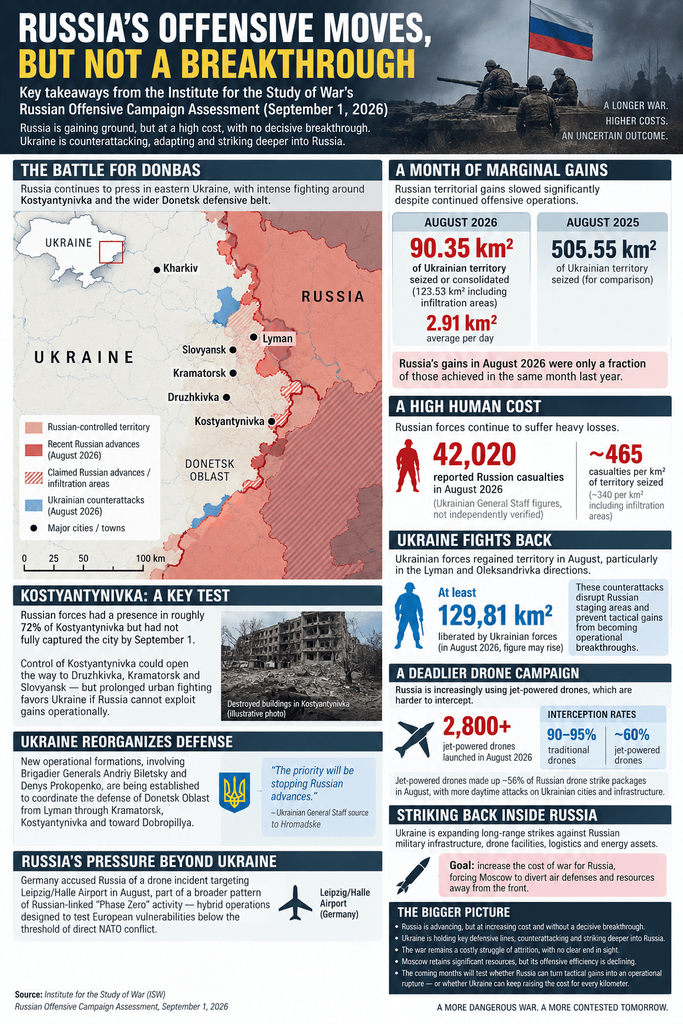
ISW assesses that Russian forces seized or consolidated approximately 90.35 square kilometers of Ukrainian territory during August 2026, averaging about 2.91 square kilometers per day. When areas entered through Russian infiltration operations are included, the figure rises to 123.53 square kilometers.
Those statistics alone could support Moscow’s narrative that its forces continue moving westward. But the historical comparison fundamentally changes the picture.
According to ISW, Russian forces seized approximately 505.55 square kilometers during August 2025. Russia’s August 2026 gains were therefore only a fraction of those achieved during the corresponding month one year earlier.
That distinction matters strategically. Wars are not determined merely by whether an army advances, but by whether that advance can create operational effects: breaking defensive formations, disrupting logistics, surrounding major concentrations of troops or forcing the enemy to abandon strategically important territory.
ISW’s assessment suggests Russia has not achieved such maneuver.
The Russian campaign increasingly appears characterized by localized infantry assaults, infiltration teams and incremental pressure rather than mechanized breakthroughs capable of destabilizing Ukraine’s broader defensive architecture.
Kostyantynivka Becomes the Test of Russia’s Donbas Strategy
The most important battlefield remains Ukraine’s fortified Donetsk defensive belt.
Russia has spent months attempting to penetrate the Ukrainian defensive network around Kostyantynivka, Druzhkivka, Kramatorsk and Slovyansk — cities that collectively represent some of Kyiv are most important remaining defensive positions in Donetsk Oblast.
ISW assesses that Russian forces had a presence, through either confirmed advances or infiltration, in roughly 72 percent of Kostyantynivka, but had still failed to completely capture the city by September 1.
This makes Kostyantynivka more than another urban battle.
If Russia can fully secure the city and subsequently place additional pressure on Druzhkivka, Kramatorsk and Slovyansk, Moscow could threaten the integrity of Ukraine’s wider Donbas defense.
But prolonged fighting also benefits the defender if Russia is required to continuously commit infantry into contested urban areas without generating a breakthrough beyond them.
For Moscow, therefore, occupying portions of Kostyantynivka is tactically significant; taking the city only after months of high-cost combat without exploiting the victory operationally would be far less decisive.
The Casualty-to-Territory Equation Is Russia’s Growing Problem
Perhaps the most consequential part of the September 1 assessment concerns manpower.
Citing the Ukrainian General Staff — whose battlefield casualty figures cannot be treated as independently verified totals — ISW reported approximately 42,020 Russian casualties during August, the second consecutive month in which reported Russian casualties exceeded 40,000.
ISW calculates this as approximately 465 Russian casualties for every square kilometer actually seized, or roughly 340 casualties per square kilometer when infiltration areas are included.
Even allowing for uncertainty surrounding wartime casualty estimates, the larger strategic question remains valid: Can Russia continue replacing manpower at the rate at which its forces are being consumed?
Moscow has largely relied upon volunteer recruitment, financial incentives and other manpower-generation mechanisms rather than another politically disruptive nationwide mobilization.
ISW argues that Russia’s existing recruitment structure is struggling to replace battlefield losses and raises the possibility that Moscow may eventually require some additional form of mobilization.
Russia still possesses a substantially larger population and military-industrial base than Ukraine. But demographic superiority does not automatically produce operationally effective combat formations. Newly recruited soldiers require training, leadership, equipment and integration with experienced units.
A military can therefore continue advancing geographically while simultaneously deteriorating institutionally.
Ukraine’s Counteroffensive Complicates the Russian Narrative
Another important feature of the report receives comparatively less attention: Ukraine itself regained territory during August.
ISW assesses that Ukrainian forces liberated at least 129.81 square kilometers, particularly around the Lyman and Oleksandrivka directions, and believes the final figure could rise as additional information becomes available.
These operations should not automatically be interpreted as the beginning of another large Ukrainian strategic counteroffensive. Kyiv continues to face serious manpower and resource pressures.
Their significance is instead defensive.
Localized Ukrainian counterattacks can disrupt Russian staging areas, force Moscow to redeploy reserves and prevent tactical penetrations from becoming operational breakthroughs.
Ukraine is consequently attempting to make Russian advances temporary, fragmented and expensive.
This creates a battlefield in which territorial control can become fluid even while neither side possesses sufficient superiority to produce a decisive collapse.
Kyiv Is Reorganizing Command around the Fortress Belt
Ukraine also appears to recognize that command structure may determine whether Russia can eventually turn incremental gains into something larger.
The ISW report highlights Ukraine’s creation of new operational formations responsible for defending Donetsk Oblast. Command structures involving Brigadier Generals Andriy Biletsky and Denys Prokopenko are intended to coordinate sectors extending from Lyman through the Kramatorsk-Kostyantynivka area and toward Dobropillya.
A Ukrainian General Staff source cited by Hromadske said the formations’ priority would be stopping Russian advances.
The restructuring suggests Kyiv is attempting to solve one of the recurring problems of prolonged warfare: coordinating multiple brigades and corps across an increasingly complex defensive environment in which drones, artillery, infantry infiltration and long-range fires operate simultaneously.
Russia’s objective is effectively to overwhelm that system somewhere along the line. Ukraine’s task is to prevent tactical crises from cascading into operational collapse.
Russia’s Drone War Is Entering a More Dangerous Phase
The battlefield is simultaneously expanding far beyond the trenches.
One of the report’s most significant technological developments is Russia’s increasing reliance on jet-powered attack drones.
Ukrainian Air Force spokesperson Colonel Yuriy Ihnat said Russia launched more than 2,800 jet-powered drones during August. According to the figures cited by ISW, Ukraine intercepts approximately 90–95 percent of traditional piston-powered drones but only around 60 percent of jet-powered variants.
Russia appears to be responding directly to improvements in Ukrainian air defense.
Instead of simply maximizing the total number of drones launched, Moscow is changing their composition. ISW says jet-powered systems constituted roughly 56 percent of Russian drone strike packages during August.
This adaptation illustrates the constant technological competition defining the war: once one side improves interception, the other changes speed, routing, altitude, electronic protection or attack timing.
Russia has also expanded attacks into daytime hours rather than concentrating large waves primarily overnight. ISW assesses that this creates greater disruption to civilian life and economic activity while placing continuous pressure on Ukrainian air defenses.
On August 31 and September 1 alone, Russia combined ballistic missiles, cruise missiles, loitering munitions and hundreds of drones in attacks across Ukraine. Ukrainian authorities reported strikes against residential, commercial, energy, railway and other infrastructure.
The strategic contest is therefore increasingly two wars simultaneously: one along the ground front and another hundreds of kilometers behind it.
Ukraine Is Trying to Move the Cost of War Back Into Russia
Kyiv’s answer has been an expanding long-range strike campaign against Russian military infrastructure, drone facilities, logistics and energy assets.
This represents an effort to change the economic mathematics of the conflict.
Ukraine cannot necessarily match Russia missile-for-missile or soldier-for-soldier. It can, however, attempt to damage the infrastructure supporting Moscow’s war machine — forcing Russia to spend additional resources protecting refineries, military depots, airfields and logistics networks.
The objective is not simply destruction. It is cost multiplication.
Every additional Russian air-defense battery redeployed to protect infrastructure deep inside Russia is a system potentially unavailable elsewhere.
The War Is Also Testing NATO below the Threshold of Direct Conflict
ISW’s September 1 assessment extends beyond Ukraine by highlighting German accusations that Russia was responsible for an August drone incident targeting Leipzig/Halle Airport.
German officials described the incident as part of a Russian-linked hybrid operation. ISW places it within what it calls Moscow’s broader “Phase Zero” activity — operations designed to test European vulnerabilities and Western responses below the threshold of conventional Russia-NATO war.
This is an ISW analytical framework rather than proof that every unexplained European sabotage incident is Russian-directed. Attribution requires careful intelligence and law-enforcement investigation.
Nevertheless, the wider strategic implication is serious: the Ukraine war increasingly interacts with European infrastructure security, defense production and NATO deterrence.
A Russian Victory Is neither Inevitable nor Impossible
The September 1 ISW assessment does not show a Russian army on the verge of defeat. Moscow retains significant manpower resources, industrial capacity, long-range strike capabilities and the ability to sustain pressure across multiple sectors.
But neither does it show the unstoppable Russian advance sometimes portrayed in Kremlin narratives.
Instead, it reveals a contradiction at the heart of Russia’s 2026 campaign: Russia can continue taking territory while simultaneously becoming less efficient at taking it.
Ukraine’s challenge is equally severe. Successful localized counterattacks and high Russian casualty rates do not guarantee that Kyiv can indefinitely defend every city. If Ukrainian manpower, ammunition or Western military assistance deteriorates substantially, today’s slow Russian advance could accelerate.
For this reason, the decisive indicator during the coming months will not simply be how many villages change hands.
The real question is whether Russia can transform tactical pressure into an operational rupture of Ukraine’s Fortress Belt — or whether Ukraine can keep forcing Moscow to pay increasingly unsustainable military and economic costs for every kilometer gained.
ISW’s September 1 report strongly suggests that, at least by the end of August 2026, Moscow was still winning ground but had not yet found the breakthrough capable of winning the war.
Stay ahead of emerging trends and international developments with trusted reporting and analysis from The Variant.


