New York City, NY: The 81st session of the United Nations General Assembly in New York became less a celebration of multilateral diplomacy than a vivid demonstration of how severely the international system is being tested by the Middle East conflict.
The speeches of U.S. President Donald Trump, Iranian President Masoud Pezeshkian, Israeli Prime Minister Benjamin Netanyahu, Pakistani Prime Minister Shehbaz Sharif and Saudi Foreign Minister Prince Faisal bin Farhan exposed fundamentally different visions of how the crisis should end.
At one end stood coercive diplomacy backed by military power. At the other stood Iranian defiance coupled with an offer of negotiation. Between them, Pakistan, Saudi Arabia, Qatar and others attempted to preserve a diplomatic channel before military escalation becomes even harder to reverse.
US President, Donald Trump delivered perhaps the most consequential warning of the gathering when he framed Iran’s future as a choice between agreement and overwhelming American force.
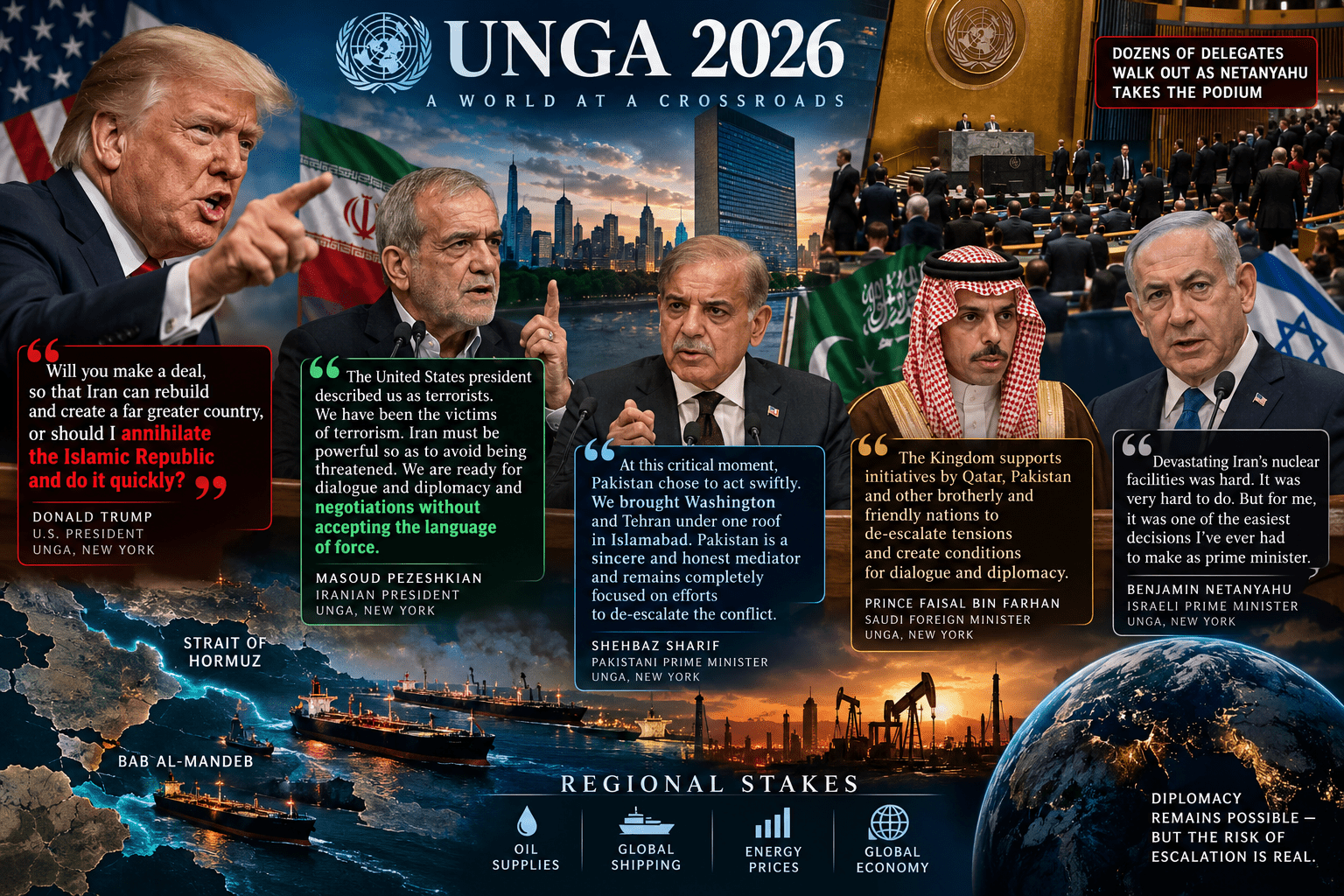
After describing previous U.S. military action against Iran and accusing Tehran of rejecting opportunities for an agreement, Trump asked whether a deal would allow Iran to “rebuild and create a far greater country” — or whether he should “annihilate the Islamic Republic and do it quickly.”
The language matters.
This was not simply another declaration that Washington would prevent Iran from obtaining a nuclear weapon. Trump publicly presented diplomacy and potentially devastating military escalation as two alternative outcomes.
That approach appears designed to strengthen U.S. bargaining leverage: convince Tehran that refusing Washington’s conditions carries an intolerably high cost. But coercive diplomacy contains its own contradiction.
The more explicitly military destruction is placed on the negotiating table, the harder it can become for Iranian leaders to compromise without appearing to have surrendered under threat.
Trump nevertheless left an important diplomatic opening. His speech did not declare negotiations dead. Instead, he portrayed an agreement as the alternative to escalation.
The central question emerging from his address therefore was not whether Washington prefers an agreement to prolonged war, but what conditions Washington will require and whether Tehran believes those conditions permit negotiation rather than capitulation.
Pezeshkian: defiance without closing the door
Iranian President Masoud Pezeshkian answered Trump from the same UN platform a day later.
He said he had prepared a different speech before hearing the American president and directly challenged Trump’s characterization of Iran.
“The United States president described us as terrorists. We have been the victims of terrorism,” Pezeshkian told the Assembly.
Holding up photographs of children he said had been killed in an attack, Pezeshkian attempted to reverse Washington’s narrative: Iran, in his presentation, was not the source of aggression but a state compelled to strengthen itself because military pressure had demonstrated the cost of weakness.
“Iran must be powerful so as to avoid being threatened,” he declared.
Yet the most strategically significant part of his speech came later.
Pezeshkian did not reject diplomacy. Instead, he drew a distinction between negotiations and negotiations conducted under coercion:
“We are ready for dialogue and diplomacy and negotiations without accepting the language of force.”
That sentence arguably captured Tehran’s UNGA strategy. Iran sought simultaneously to demonstrate resistance and preserve an exit ramp.
The problem is that Washington and Tehran remain divided not merely over technical issues but over the very structure of negotiations.
Washington wants pressure to generate concessions; Tehran argues that pressure undermines the legitimacy and credibility of negotiations.
That creates a dangerous cycle: American officials may interpret Iranian resistance as evidence that greater pressure is required, while Tehran may interpret greater pressure as proof that compromise invites further demands.
Netanyahu and the diplomatic walkout
The atmosphere became even more confrontational when Israeli Prime Minister Benjamin Netanyahu entered the General Assembly hall.
Dozens of delegates walked out as Netanyahu began his address. Reuters documented delegations leaving during his appearance, while Netanyahu responded by calling those departing “moral cowards.”
The walkout was politically significant because it demonstrated the depth of international opposition to aspects of Israel’s conduct and policies, even as Israel continues to receive strong U.S. backing.
Netanyahu remained unapologetic about Israel’s military strategy toward Iran.
“Devastating Iran’s nuclear facilities was hard. It was very hard to do. But for me, it was one of the easiest decisions I’ve ever had to make as prime minister,” he said.
His message complemented Trump’s pressure strategy but went further in defending military action already undertaken. Netanyahu presented force not as a failure of diplomacy but as an instrument necessary for Israeli security.
The competing speeches therefore revealed a deeper strategic disagreement at the UN.
Many governments continue to emphasize international institutions, negotiated settlements and restraint; Israel argues that those mechanisms cannot substitute for military action when it perceives an existential security threat.
The walkout did not settle that argument. It demonstrated how deeply divided the international community has become over it.
Pakistan attempts to occupy the diplomatic middle
Against this confrontational backdrop, Prime Minister Shehbaz Sharif attempted to position Pakistan as a bridge rather than another participant in the escalation.
“At this critical moment, Pakistan chose to act swiftly,” Sharif told the General Assembly, saying that through diplomatic efforts Pakistan had brought Washington and Tehran “under one roof in Islamabad.”
Outside the chamber, Sharif described Pakistan as a “sincere and honest mediator” and said Islamabad remained “completely focused” on efforts to de-escalate the conflict.
Pakistan’s diplomatic argument rests partly on geography and relationships. Iran is Pakistan’s neighbor, while Islamabad simultaneously maintains important political, economic and security relationships with the United States, Saudi Arabia and other Gulf states.
That combination creates opportunities, but also significant constraints.
A mediator becomes valuable only if opposing parties believe it can communicate with both sides without becoming an extension of either.
Pakistan therefore has to maintain credibility in Tehran while preserving strategic relationships with Washington and Riyadh.
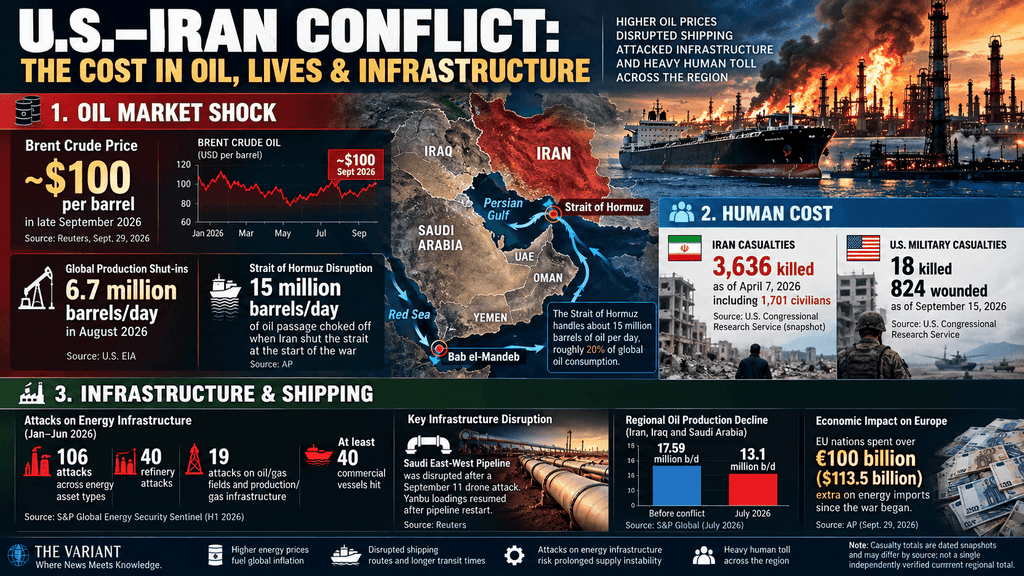
Sharif also shifted the discussion beyond Iran itself, calling the Strait of Hormuz and Bab al-Mandeb “arteries of the global economy” that must remain open.
That was an important reframing. The conflict is no longer solely about American-Iranian or Israeli-Iranian security.
Disruption of these waterways can transmit the consequences of regional confrontation into energy prices, shipping costs, supply chains and inflation far beyond the Middle East.
Saudi Arabia gives Pakistan diplomatic recognition
Pakistan’s mediation narrative received notable support from Saudi Foreign Minister Prince Faisal bin Farhan.
Speaking for the Kingdom, Prince Faisal said Saudi Arabia supported initiatives contributing to de-escalation, specifically identifying the efforts of “Qatar, Pakistan, and other brotherly and friendly nations” aimed at restoring regional stability and creating conditions for dialogue and diplomacy.
The wording is significant, though it should not be overstated.
Saudi recognition does not mean Pakistan alone controls the diplomatic process.
Qatar is also actively engaged in mediation, and the negotiations remain dependent ultimately on decisions in Washington and Tehran. Recent reporting indicates Qatar and Pakistan have both served as channels for communications between the parties.
But Riyadh publicly acknowledging Pakistan’s role gives Islamabad greater diplomatic legitimacy to continue facilitating talks.
Saudi Arabia also connected Gulf stability directly with global energy security, international commerce and supply chains.
That creates an interesting convergence: Pakistan and Saudi Arabia may differ in their security perceptions of Iran, but both have an immediate interest in preventing uncontrolled escalation that threatens Gulf economies and maritime trade.
The contradiction at the heart of UNGA 2026
The most revealing feature of these speeches was that virtually every major actor spoke about peace while simultaneously defending the instruments of coercion it believes necessary to achieve it.
Trump offered negotiation while threatening annihilation.
Pezeshkian offered dialogue while insisting Iran would strengthen its military deterrence.
Netanyahu defended military action as essential to Israeli survival.
Pakistan promoted mediation while emphasizing regional security and defence cooperation.
Saudi Arabia backed diplomatic de-escalation while asserting its right to defend itself against threats.
This is the central contradiction confronting diplomacy: all sides say they prefer peace, but none wants peace on terms that could be interpreted domestically or strategically as surrender.
The United Nations cannot itself resolve that contradiction. What it can provide is political space in which intermediaries can prevent communication from collapsing altogether.
Pakistan’s role should therefore be assessed realistically rather than symbolically. Islamabad cannot impose an agreement on Washington or Tehran. What it can potentially do — alongside Qatar, Saudi Arabia and other interlocutors — is maintain channels, clarify proposals, reduce miscalculation and provide politically acceptable pathways back to negotiations.
Indeed, the UN Secretary-General’s spokesperson publicly described Pakistan’s role as “critical” and called the earlier Islamabad understanding a significant achievement.
A UNGA of warnings — but also an unfinished negotiation
UNGA 2026 ultimately produced no decisive diplomatic settlement. Instead, New York exposed the architecture of the crisis.
Washington believes superior military and economic pressure can compel Tehran toward an acceptable agreement.
Tehran believe accepting negotiations under explicit threats would weaken its deterrence and invite further pressure.
Israel remains prepared to use force against threats it identifies as existential. Saudi Arabia wants stronger regional security without allowing prolonged conflict to destabilize energy markets.
Pakistan is attempting to transform its relationships across these competing camps into diplomatic leverage.
The most important fact, however, is that the diplomatic door remains open.
Pezeshkian declared that Iran was ready for negotiations without coercion. Trump himself contrasted destruction with the possibility of a deal.
Pakistan continues mediation, while Saudi Arabia has publicly supported de-escalation efforts by Pakistan and Qatar.
That leaves the international community with two competing trajectories after New York.
One is escalation in which every military action generates retaliation, every retaliation justifies greater force and diplomacy becomes progressively more difficult.
The other is an imperfect negotiated process in which neither Washington nor Tehran receives everything it demands but both conclude that compromise is less costly than continued confrontation.
The speeches at the United Nations demonstrated how narrow the distance between those two paths has become.
For an institution founded to replace the logic of war with collective diplomacy, that may be the most consequential message to emerge from New York: the UNGA did not resolve the Iran crisis, but it revealed with unusual clarity both how close the region remains to further escalation and where the remaining diplomatic exits may still lie.
The global landscape is constantly evolving. Stay connected with The Variant for reliable news and thoughtful analysis.