Rochester, NY: The newly signed U.S.–Iran peace agreement was presented by President Donald Trump as a diplomatic breakthrough capable of ending months of conflict, reopening the Strait of Hormuz, and preventing what he described as a potential global economic crisis.
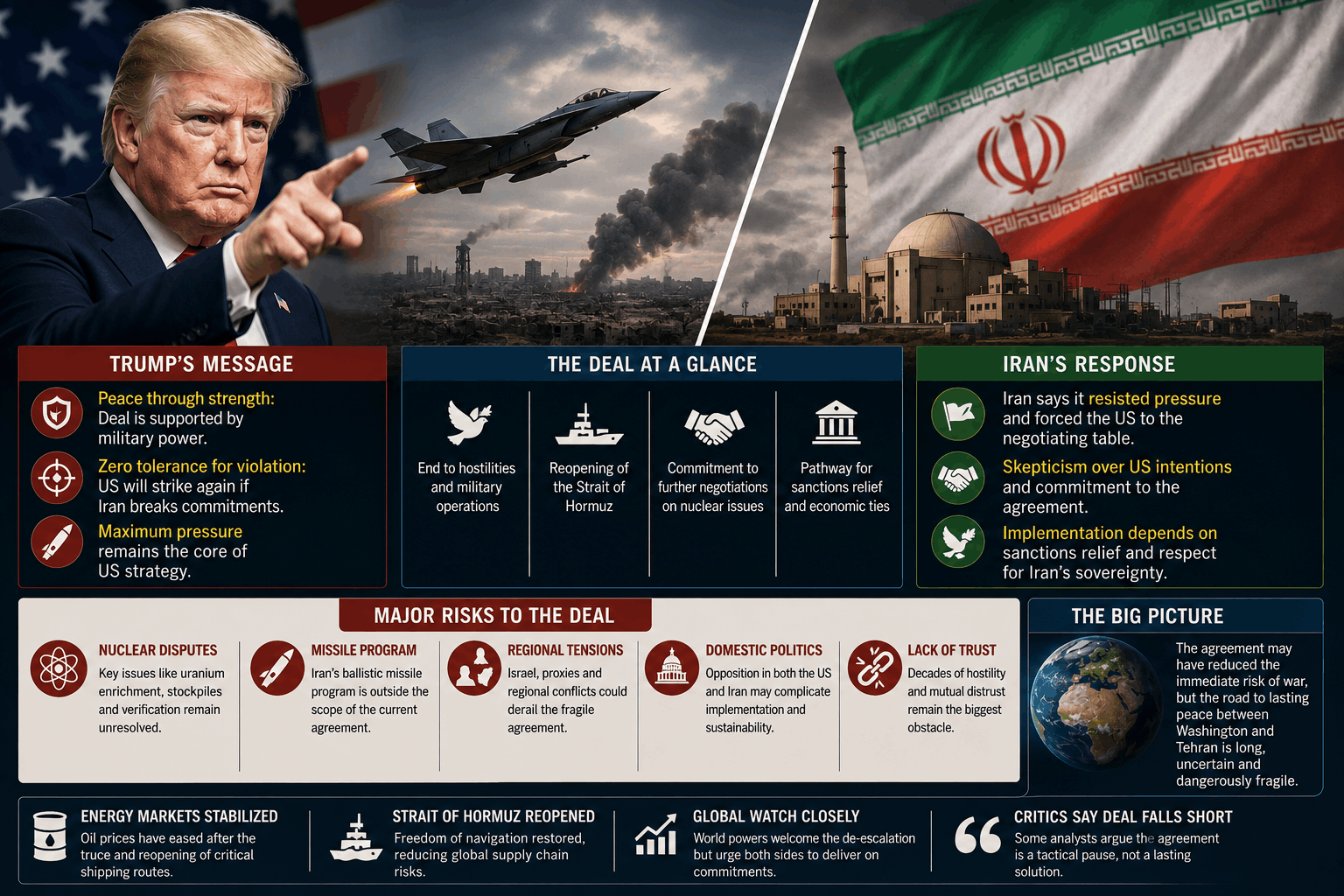
Yet within hours of endorsing the deal, Trump also issued a stark warning: if Iran violates its commitments, the United States could resume military strikes.
That statement has immediately become one of the most controversial aspects of the agreement because it raises questions about whether the deal represents a genuine strategic settlement or merely a temporary pause in hostilities.
According to reports from the G7 summit and subsequent diplomatic discussions, Trump defended the agreement while simultaneously making clear that military force remains an option.
He warned that attacks could resume if Iran “acts up” or fails to comply with the terms of the accord. Such language reflects the administration’s attempt to maintain pressure on Tehran while reassuring domestic critics that Washington has not abandoned its deterrence posture.
Why Trump’s Statement Matters
The significance of Trump’s warning lies in the contradiction it creates. Peace agreements are generally designed to build confidence and reduce the risk of renewed conflict.
However, when one side publicly threatens the possibility of future military action immediately after signing the accord, it introduces uncertainty into the implementation process.
For Iran, Trump’s remarks reinforce a long-standing belief among many Iranian policymakers that Washington’s commitments can be reversed depending on political circumstances.
Iranian negotiators have repeatedly emphasized that trust, rather than technical details, remains the biggest obstacle in relations with the United States.
During negotiations, Iranian officials questioned the timing and certainty of the agreement and demanded assurances that commitments would be honored.
The result is a paradox: Washington views the threat of force as leverage to ensure compliance, while Tehran views the same threat as evidence that the agreement may not be durable.
The Nuclear Issue Remains Unresolved
Perhaps the most serious weakness of the deal is that it does not fully resolve the Iranian nuclear question. While Iran has reportedly reaffirmed that it will not develop nuclear weapons, major issues concerning uranium enrichment, existing stockpiles, verification mechanisms, and future inspections remain subject to further negotiations.
The agreement effectively postpones the hardest questions rather than settling them.
This is important because the nuclear dispute has been the central source of confrontation between Washington and Tehran for more than two decades.
Reuters reported that U.S. intelligence assessments still believe Iran retains the technical capability to build a nuclear weapon within a relatively short period if it chooses to do so, while Iran continues to insist that its program is peaceful.
As long as these competing narratives persist, the possibility of future confrontation remains significant.
Iran’s Leadership and the Narrative of Resistance
Iranian leaders have presented the agreement differently from Washington. Rather than portraying it as a concession, Tehran has emphasized that the country resisted military pressure and secured the reopening of economic channels without surrendering its strategic independence.
Iranian officials have also expressed skepticism regarding American commitments and have linked the success of the agreement to broader regional developments, including Israeli military activity and sanctions relief.
This divergence in narratives creates another implementation challenge. Trump portrays the agreement as proof that military pressure forced Iran to negotiate.
Iran portrays it as proof that resistance compelled Washington to compromise. Both sides claim victory, but incompatible interpretations often become a source of future disputes.
Why the Deal Could Still Fail
Several factors could undermine implementation over the coming months.
First, the agreement appears to be transitional rather than permanent. It reportedly provides a limited negotiation window during which both sides must reach broader understandings on nuclear issues, sanctions, regional security, and maritime arrangements.
Failure to achieve progress could quickly reignite tensions.
Second, Iran’s ballistic missile program remains largely outside the current framework. G7 leaders have already called for follow-on negotiations addressing missile capabilities, an issue Tehran has historically rejected as non-negotiable.
Third, regional actors could complicate implementation.
Israel has repeatedly argued that any agreement must prevent Iran from retaining capabilities that could eventually support nuclear weapons development or regional military influence.
Continued tensions involving Lebanon, Hezbollah, or other regional theaters could place the agreement under immediate pressure.
Fourth, domestic politics in both countries remain uncertain. Congressional Republicans have already demanded greater transparency regarding the agreement, while hardline factions within Iran remain deeply suspicious of U.S. intentions.
The New York Times Criticism
One of the strongest criticisms of the agreement has come from major Western media outlets, including reporting and commentary highlighted by critics who argue that the deal reflects the limits rather than the success of U.S. strategy.
The central argument is that after months of military operations, Washington ultimately accepted many realities it originally sought to change, including Iran’s continued enrichment capabilities and the absence of a complete dismantlement of its nuclear infrastructure.
Critics therefore contend that the agreement demonstrates the failure of military pressure to achieve maximal objectives and instead represents a pragmatic compromise.
Supporters of the administration reject that characterization.
They argue that reopening the Strait of Hormuz, ending direct hostilities, restoring energy stability, and creating a framework for future negotiations represent substantial achievements that would have been impossible without military and economic pressure.
Conclusion
Trump’s post-deal warning that the United States could resume attacks on Iran has transformed what was supposed to be a celebration of diplomacy into a debate about credibility and durability.
The statement may strengthen deterrence from Washington’s perspective, but it simultaneously reinforces Iranian concerns that the agreement could unravel at any moment.
The future of the U.S.–Iran peace deal will therefore depend less on the signing ceremony itself and more on whether both sides can bridge the unresolved disputes surrounding Iran’s nuclear program, sanctions relief, regional security, and mutual trust.
The agreement has reduced the immediate risk of war and stabilized global energy markets, but the fundamental causes of confrontation remain unresolved.
For that reason, the deal should be viewed not as the end of the crisis, but as the beginning of a highly uncertain and politically fragile new phase in U.S.–Iran relations.
Follow our latest coverage for deeper insights into the policies, trends, and developments influencing today’s world.