Rochester, NY: The Russia–Ukraine war has entered another consequential phase in which military operations, diplomatic maneuvering and competing visions of European security are increasingly inseparable.
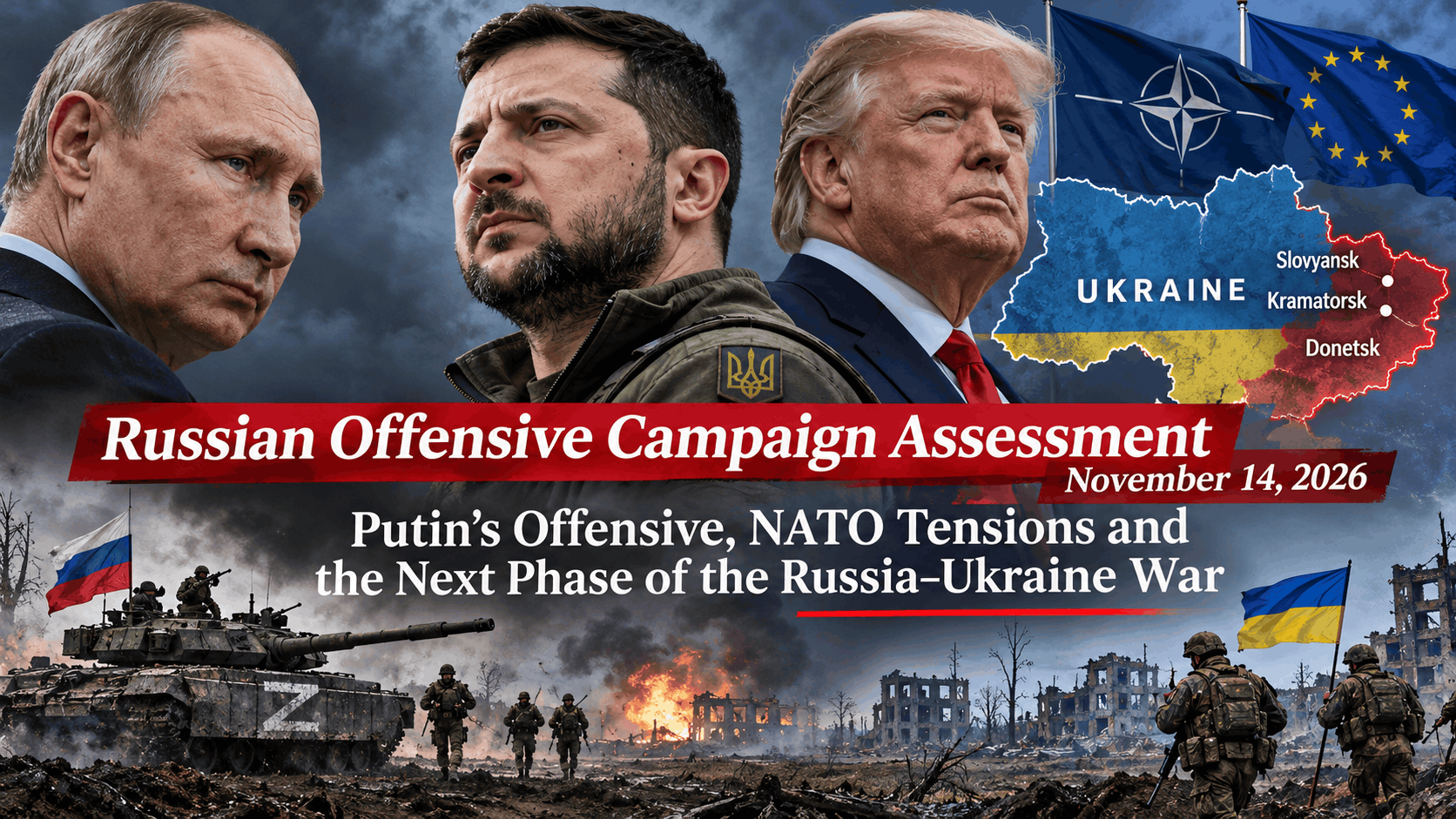
The Russian Offensive Campaign Assessment released by the Institute for the Study of War (ISW) on November 14, 2026, presents a strategic picture extending far beyond the trenches of eastern Ukraine.
It suggests that Moscow’s ambitions remain rooted not simply in territorial acquisition but in a broader effort to reshape the European security order established after the Cold War.
The assessment arrives at a particularly sensitive moment for Washington, Kyiv and European capitals.
Diplomatic discussions about Ukraine’s possible NATO membership, future security guarantees and Europe’s participation in peace negotiations are exposing fundamental differences between Russia’s demands and the security priorities of Ukraine and its Western partners.
The central question is no longer exclusively whether Russia can achieve additional territorial gains. It is whether Moscow can convert sustained military pressure into diplomatic concessions that fundamentally alter the balance of power across Europe.
Moscow’s Strategic Ambitions Extend beyond Ukraine
One of the most significant conclusions in the November 14 assessment concerns Russia’s continued commitment to its security demands originally presented to the United States and NATO in December 2021.
Those demands included restrictions on NATO enlargement and significant changes to the alliance’s military posture in Europe.
Moscow portrayed these measures as necessary protections against Western encroachment, while NATO governments regarded them as attempts to undermine the sovereignty of countries entitled to determine their own security arrangements.
According to ISW, Russian objectives have not substantially moderated despite years of warfare, economic sanctions and enormous military expenditures. Instead, the Kremlin reportedly seeks concessions that would weaken the post-Cold War European security architecture.
ISW interprets President Vladimir Putin’s ambitions as extending to the fundamental weakening of NATO and the restoration of Russian influence over countries Moscow considers part of its strategic sphere.
This is an analytical assessment of Russian intentions rather than proof that Moscow possesses the military or diplomatic capacity to achieve those objectives.
The distinction is important. Russia may continue demanding a transformation of European security, but its ability to compel such a transformation depends on battlefield outcomes, Western political cohesion, economic endurance and the willingness of other states to accept Russian terms.
The Battlefield: Sustained Pressure without Guaranteed Breakthrough
While diplomacy attracts international attention, the military contest remains concentrated along strategically important sections of eastern and southern Ukraine.
Russia’s broader operational objective continues to include the seizure of remaining Ukrainian-held territory in Donetsk Oblast, particularly the fortified defensive network linking Slovyansk, Kramatorsk, Druzhkivka and Kostyantynivka.
These urban centers represent more than geographical objectives. They are crucial components of Ukraine’s defensive infrastructure, logistics network and military resistance in the Donbas.
Russian operations around Lyman, Kostyantynivka and the Dobropillya sector illustrate a continuing reliance on localized assaults, infiltration tactics and attempts to weaken Ukrainian defensive positions.
The preceding November 13 ISW assessment described Russian infiltration operations near Dobropillya, the concentration of armored equipment and sustained offensive activity. However, it also reported several sectors where Russian attacks had failed to produce confirmed territorial advances.
This pattern demonstrates a defining feature of the conflict: tactical activity does not automatically translate into operational success.
Russia can maintain pressure through manpower, artillery, drones and repeated assaults, but achieving a decisive breakthrough requires the ability to exploit gains, maintain supply lines and overcome prepared Ukrainian defenses.
For Kyiv, the challenge is equally demanding. Successfully preventing Russian advances does not eliminate the economic, personnel and logistical costs of defending an extended frontline.
The war therefore remains a contest of endurance in which both sides must continually balance battlefield objectives against their available resources.
NATO Membership and the Struggle over European Security
The debate surrounding Ukraine’s potential NATO membership has become one of the most consequential diplomatic dimensions of the conflict.
ISW’s November 14 assessment argues that American proposals concerning Ukraine’s possible future membership implicitly reject Russia’s demands to halt NATO expansion.
For Moscow, NATO enlargement represents a strategic challenge to its regional influence. For Ukraine, however, membership is viewed as a potential long-term guarantee against renewed Russian military aggression.
European governments face a difficult strategic calculation. Excluding Ukraine from future security arrangements could leave the country vulnerable to renewed attacks, while advancing membership discussions without a negotiated settlement could intensify confrontation with Moscow.
Yet NATO membership is not an automatic consequence of diplomatic proposals. It requires agreement among alliance members and involves political and security considerations that remain unresolved.
The fundamental disagreement concerns the sovereignty of European states. Russia seeks a security order in which its interests impose limits on neighboring countries’ strategic choices. NATO maintains that sovereign nations should be free to determine their alliances.
Any sustainable settlement must confront this contradiction rather than merely postpone it.
Washington’s Diplomatic Challenge and Europe’s Role
The November 14 assessment also highlights Washington’s continuing support for European participation in future multilateral negotiations.
This represents an important diplomatic consideration because European countries would bear many of the long-term security, economic and reconstruction consequences of any agreement.
The November 13 ISW assessment indicated that American and Ukrainian representatives considered European involvement necessary, while Moscow sought to distinguish discussions about Ukraine from negotiations concerning the wider European security architecture.
For President Donald Trump’s administration, the challenge is to pursue a negotiated settlement without producing an agreement that encourages future military coercion.
A ceasefire might reduce immediate casualties and economic disruption, but its durability would depend on monitoring arrangements, security guarantees and mechanisms for responding to violations.
European participation could strengthen the legitimacy and implementation of a settlement.
Conversely, excluding major European stakeholders from negotiations could create disagreements over sanctions, military assistance and reconstruction responsibilities.
The diplomatic challenge is therefore not simply to stop the fighting but to establish conditions under which renewed conflict becomes less likely.
Drone Warfare and the Changing Military Balance
Technological adaptation continues to influence the war’s military trajectory.
Unmanned aerial systems, electronic warfare, precision strikes and battlefield surveillance have transformed the operational environment.
Both militaries increasingly depend on drones for reconnaissance, targeting and attacks against equipment, infrastructure and personnel.
The November 13 assessment reported disruptions affecting Ukrainian Star-shield satellite communications, which Ukrainian officials said were hindering drone interception and certain strike operations, despite denials from SpaceX.
These developments underline the vulnerability of modern military operations to disruptions in communications and technological infrastructure.
Russia’s ability to sustain aerial attacks places continuing pressure on Ukrainian air defenses, while Ukraine’s capacity to strike Russian logistics, industrial facilities and energy infrastructure creates costs beyond the immediate battlefield.
The resulting confrontation is increasingly shaped by industrial production, technological resilience and the ability to replace damaged equipment.
Neither side can rely exclusively on territorial maneuver. Military effectiveness also depends on communications reliability, ammunition supplies, maintenance capacity and the resilience of civilian infrastructure.
Economic Warfare and the Cost of Prolonged Conflict
The economic consequences of the war extend across Russia, Ukraine and the wider international system.
Russia continues to direct substantial resources toward military operations, defense manufacturing and personnel requirements.
Although its economy has demonstrated an ability to adapt to sanctions and wartime conditions, sustained military expenditure creates long-term pressures on public finances, labor availability and investment.
Ukraine faces even more immediate challenges arising from infrastructure destruction, population displacement, military expenditures and dependence on external financial assistance.
For European economies, the conflict reinforces concerns about defense spending, energy security and the costs of supporting Ukraine.
The United States must also balance continued military and diplomatic engagement with domestic budgetary priorities and competing international security commitments.
These pressures do not necessarily produce an imminent collapse on either side. They do, however, make economic endurance an increasingly important component of military strategy.
The longer the conflict continues, the more difficult it becomes to separate battlefield developments from domestic political and economic considerations.
Putin’s Strategic Calculations and the Risks of Escalation
President Putin’s strategy appears to rest partly on the expectation that Russia can sustain military pressure longer than Ukraine and its international partners can maintain a unified response.
This calculation depends on several uncertain assumptions, including Western political cohesion, Ukrainian military resilience and Russia’s capacity to absorb continuing losses.
A prolonged war may provide Moscow with opportunities to exploit disagreements among Western governments. However, it also risks reinforcing European perceptions of Russia as a long-term security threat.
The consequence could be the opposite of Moscow’s stated objective: greater European defense cooperation, expanded military production and a stronger commitment to collective deterrence.
The possibility of escalation remains another concern. Strikes on infrastructure, increasingly sophisticated weapons and disputes over security guarantees could create conditions in which miscalculation becomes more dangerous.
Nevertheless, escalation is not inevitable. Diplomatic communication, military restraint and credible negotiating frameworks can reduce risks even when fundamental political disagreements persist.
Can Russia Transform Military Pressure Into Diplomatic Victory?
The November 14 assessment ultimately raises a question that extends beyond immediate battlefield outcomes: can Russia achieve through diplomacy the strategic concessions it has struggled to secure through military force?
Territorial control may provide negotiating leverage, but it does not automatically translate into international recognition, political legitimacy or lasting security.
Ukraine’s government continues to regard sovereignty and territorial integrity as essential principles, while European governments remain concerned that concessions obtained through military coercion could establish dangerous precedents.
Russia, meanwhile, appears unwilling to abandon its wider demands concerning NATO and Europe’s security arrangements.
These conflicting positions create a substantial obstacle to negotiations.
A settlement that freezes territorial lines without resolving underlying security disputes could reduce immediate violence while leaving the causes of future confrontation intact.
Alternatively, a broader agreement incorporating credible guarantees, enforceable commitments and participation by relevant European governments might offer a more sustainable framework, although reaching such an agreement would require significant political compromise.
Conclusion: A War That Will Shape Europe Beyond the Battlefield
The Russian Offensive Campaign Assessment of November 14, 2026, illustrates how the war in Ukraine has evolved into a confrontation over the future structure of European security.
Russia continues pursuing territorial and geopolitical objectives, while Ukraine seeks to preserve its sovereignty and establish credible protection against future aggression.
Washington and European capitals face the difficult task of balancing diplomacy, deterrence and the costs of continued confrontation.
The battlefield remains important, but military gains alone cannot determine the long-term outcome.
The decisive issue is whether negotiations can produce a security arrangement that reduces the likelihood of another war without rewarding the use of force as a means of rewriting international boundaries.
For Moscow, the danger is that an extended conflict could weaken the very strategic influence it seeks to restore. For Kyiv, the danger is that exhaustion or inadequate security guarantees could undermine its long-term independence.
For the United States and Europe, the stakes extend beyond Ukraine to the credibility of collective security and the principles governing relations between powerful states and their smaller neighbors.
Ultimately, the November 14 assessment suggests that the conflict cannot be understood merely as a struggle over territory. It is also a struggle over who determines Europe’s security future, whose sovereignty is respected and whether military coercion can successfully redefine the international order.
Editorial sourcing note: This is an original analytical interpretation centered on ISW’s November 14, 2026 assessment, with operational context from its November 13 report. Statements about Russia’s strategic intentions are attributed to ISW’s assessments rather than presented as independently established facts. Battlefield claims remain subject to verification.