


Rochester, NY: The abrupt cancellation of the planned U.S. delegation visit to Islamabad has marked a sharp interruption in what was emerging as a tentative backchannel for indirect engagement with Iran.
The decision, linked to President Donald Trump’s directive, reflects growing dissatisfaction in Washington over the pace, structure, and perceived reliability of ongoing mediation efforts.
Islamabad had positioned itself as a neutral facilitator capable of bridging communication between Tehran and Washington at a time when direct diplomatic engagement remains politically constrained.
However, the sudden withdrawal of the U.S. delegation has effectively frozen this initiative before it could mature into a structured negotiation framework.
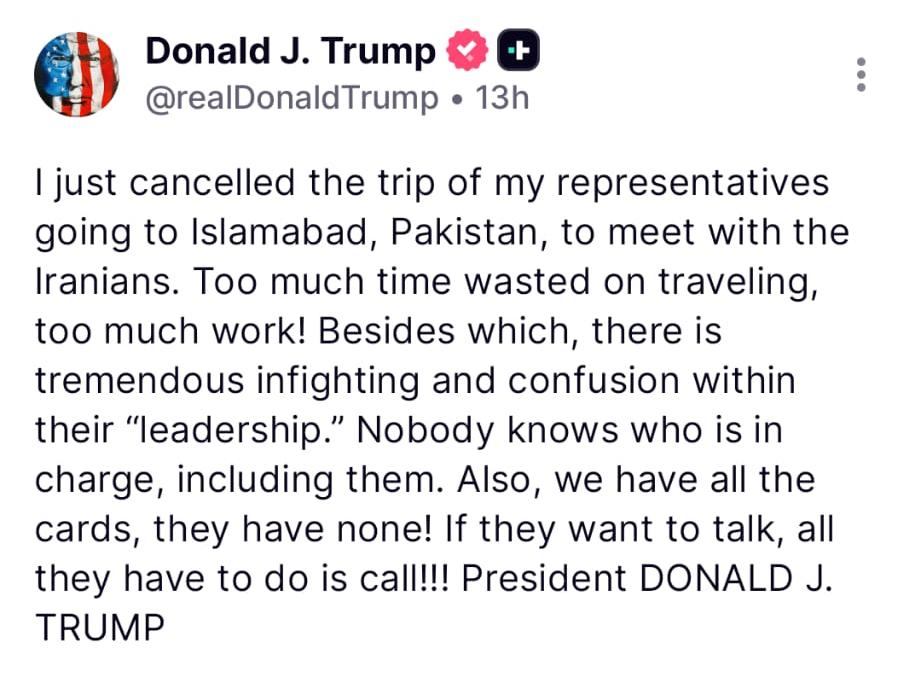
President Trump, communicating through his Truth Social platform, framed the decision as a response to what he described as Iran’s lack of seriousness in negotiations and repeated shifts in diplomatic posture.
His message underscored that the United States would not persist in engaging in indirect formats that do not yield quantifiable results.
The same position was reaffirmed by parallel statements circulating from administration-linked accounts on X, which portrayed the cancellation as a strategic recalibration rather than a diplomatic failure.
Iran Leaves Islamabad and Reorients toward Moscow
Almost in parallel with the breakdown of the Islamabad track, Iranian Foreign Minister Abbas Araghchi concluded his engagements in Pakistan and departed without confirming continuation of the mediated process.
Iranian officials had reportedly presented a structured diplomatic proposal aimed at reducing tensions and opening space for broader de-escalation talks.
Following the breakdown, Iranian messaging shifted noticeably. Statements shared through state-linked X accounts accused the United States of inconsistency and questioned the credibility of externally mediated negotiations that depend on shifting political conditions in Washington. Tehran’s tone suggested growing skepticism toward intermediary-driven diplomacy.
In a move carrying significant geopolitical implications, Araghchi is now expected to travel to Moscow for consultations with Russian Foreign Minister Sergey Lavrov.
This shift signals a clear strategic reorientation toward Russia, reflecting Tehran’s effort to strengthen alignment with a long-standing partner amid uncertainty in Western diplomatic channels.
Trump’s Truth Social Messaging and a Hardening U.S. Position
President Trump’s communication strategy has increasingly emphasized directness and conditional engagement. Through Truth Social, he has portrayed the breakdown of talks as evidence of Iran’s unwillingness to commit to substantive negotiations, arguing that the United States should not remain engaged in open-ended mediation processes.
This approach reflects a broader shift toward diplomacy defined by leverage rather than extended negotiation architecture. Administration-aligned accounts on X have echoed this framing, reinforcing the idea that future engagement must be direct, structured, and outcome-driven rather than mediated through third-party facilitation.
Iran’s Narrative and Strategic Diversification
Iran, in contrast, has framed the collapse of the Islamabad channel as part of a broader pattern of unpredictable U.S. diplomatic behavior.
Through official communication channels and affiliated social media accounts, Iranian officials have argued that repeated interruptions undermine the credibility of externally mediated negotiations.
From Tehran’s perspective, the shift toward Moscow is not merely reactive but strategic. By deepening engagement with Russia, Iran is signaling a willingness to operate within a broader multipolar diplomatic framework rather than relying on Western-mediated channels that it perceives as unstable.
Russia’s Expanding Diplomatic Role
Russia’s position in this evolving diplomatic landscape continues to strengthen. Moscow has consistently presented itself as a proponent of alternative diplomatic frameworks that operate outside Western-led pressure systems.
The anticipated meeting between Araghchi and Lavrov is expected to cover regional security dynamics, energy cooperation, and broader geopolitical alignment.
Russian messaging, particularly through affiliated channels, has emphasized dialogue based on sovereignty and non-interference, positioning Moscow as a stable interlocutor amid shifting diplomatic alliances.
Pakistan’s Role and a Possible Diplomatic Exit
One of the most significant but understated consequences of the collapse of the Islamabad track is its impact on Pakistan’s diplomatic positioning. Islamabad had invested political capital in presenting itself as a neutral facilitator capable of enabling indirect dialogue between Washington and Tehran.
However, with the cancellation of the U.S. delegation and Iran’s pivot toward Moscow, that mediation framework now appears effectively stalled.
This development raises the possibility that Pakistan may gradually step back from its mediation role altogether. Without active participation from both principal actors, Islamabad’s function as a diplomatic bridge becomes largely symbolic rather than operational.
While Pakistan is unlikely to formally announce a withdrawal from mediation efforts, the current trajectory suggests that its role may naturally diminish as the negotiations shift into other channels and geopolitical alignments.
In practical terms, Pakistan’s mediation effort now risks being defined as an aborted initiative rather than an ongoing diplomatic platform, unless future conditions revive mutual engagement between Washington and Tehran.
A Fragmenting Diplomatic Architecture
The breakdown of the Islamabad channel, combined with Iran’s shift toward Moscow, reflects a broader fragmentation of diplomatic engagement around the Iran crisis. Rather than converging into a unified negotiation process, multiple parallel tracks are now emerging.
The United States is increasingly favoring direct, conditional diplomacy, Iran is deepening alignment with non-Western partners, and Russia is consolidating its role as an alternative diplomatic hub. Within this shifting environment, intermediary platforms such as Pakistan face structural limitations that reduce their long-term effectiveness.
Conclusion: Diplomacy Moving Into Parallel Systems
The cancellation of the U.S. delegation to Islamabad and Iran’s immediate pivot toward Moscow represent more than procedural setbacks—they signal a structural transformation in how diplomacy around this conflict is being conducted.
Instead of a single, coordinated negotiation process, the situation is evolving into fragmented and competing diplomatic channels. Pakistan’s potential withdrawal from an active mediation role further underscores this shift, highlighting the diminishing space for traditional intermediaries in an increasingly polarized geopolitical environment.
Unless a unified framework re-emerges, the diplomatic landscape is likely to remain divided into parallel systems of engagement, each reinforcing its own strategic logic while reducing the chances of consolidated resolution.


