


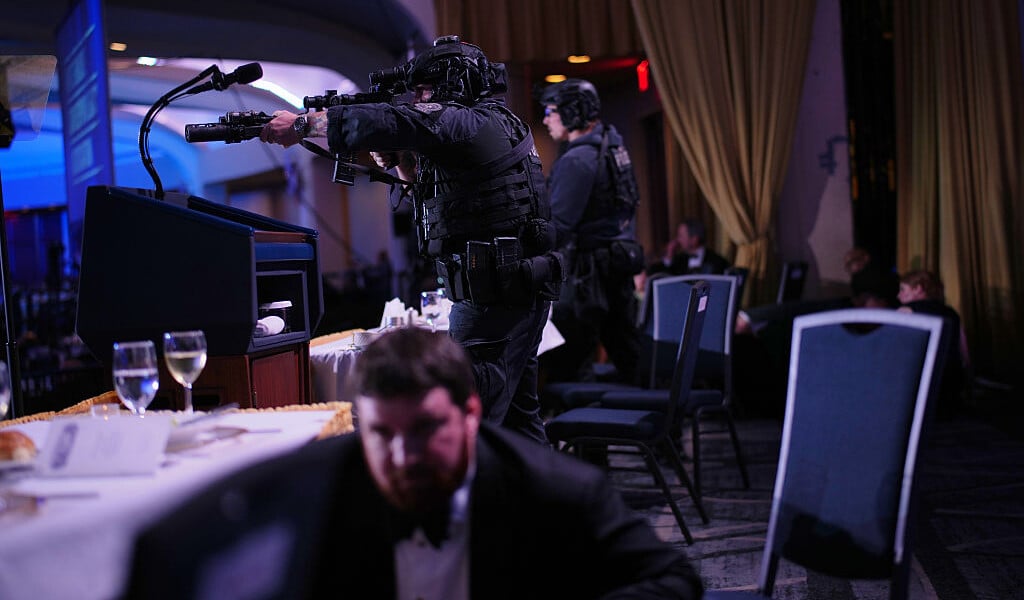
Washington, D.C: The shooting incident at the White House Correspondents’ Dinner inside the Washington Hilton Ballroom has sent shockwaves through the American political establishment, exposing the fragility of even the most tightly guarded spaces.
What was meant to be an evening celebrating journalism and political discourse turned into a moment of chaos, fear, and urgent crisis management?
The presence of the sitting U.S. President, cabinet officials, and influential media figures transformed the event into a high-value target, amplifying both the symbolic and strategic significance of the attack.
As the evening progressed in the packed ballroom, the sound of gunfire shattered the controlled environment of the event. Panic spread almost instantly as attendees, including senior officials and journalists, sought cover under tables and behind barricades.
Security personnel reacted within seconds, drawing weapons and initiating emergency evacuation protocols. The attacker, positioned near a secured entry point, attempted to breach the perimeter, indicating a clear intent to reach the central gathering of political leadership and media influence.
The rapid transition from ceremony to crisis demonstrated both the unpredictability of such threats and the importance of layered security systems that ultimately prevented the attacker from reaching the main hall.
Authorities identified the suspect as Cole Tomas Allen, a 31-year-old from California, who was apprehended at the scene after being subdued by security forces.
Investigators confirmed that he was heavily armed and had attempted to force his way through a security checkpoint while discharging a weapon. His immediate arrest prevented further escalation, and he now faces multiple federal charges tied to the attack.
Early findings suggest that Allen acted independently, with officials leaning toward a “lone wolf” classification, although the investigation remains active to determine motive, possible ideological influences, or any indirect networks.
The response from federal agencies was both immediate and decisive, reflecting years of preparation for precisely such high-risk scenarios.
The U.S. Secret Service, tasked with protecting the President and key officials, neutralized the threat before the attacker could enter the ballroom. In the process, an agent was struck but survived due to protective gear, underscoring the severity of the confrontation.
The Federal Bureau of Investigation quickly assumed a central role in the aftermath, securing the scene, collecting forensic evidence, and initiating a comprehensive background investigation into the suspect.
Coordination between agencies ensured that all high-profile attendees, including the President, were moved to secure locations without delay.
Shortly after the incident, Donald Trump delivered a live address, projecting calm authority while acknowledging the seriousness of the situation.
He confirmed that the attacker had been apprehended and praised the swift actions of the Secret Service and law enforcement agencies. Trump described the suspect as a lone actor and emphasized that all protected individuals were safe.
His remarks also carried a policy undertone, highlighting concerns about venue security and suggesting that future high-profile events may require more controlled and fortified environments. The address sought to reassure the nation while reinforcing a narrative of resilience in the face of targeted violence.
The gravity of the incident is underscored by the concentration of powerful figures present at the dinner. Among them were JD Vance, Marco Rubio, Robert F. Kennedy Jr., and Doug Burgum, alongside leading journalists and media executives.
Many of these individuals were forced to take cover or were swiftly escorted out by security teams, highlighting how narrowly a potential national catastrophe was avoided.
This incident is increasingly being framed as a second attempt to target Donald Trump, following earlier threats and security scares in recent political cycles. While investigators have not established a direct operational link between incidents, the recurrence of such threats raises serious concerns about the persistence and evolution of risks facing high-profile political figures in the United States.
The pattern suggests that lone actors, often difficult to detect in advance, continue to pose a significant challenge to even the most advanced security systems.
The global response was swift and unequivocal, with governments and international organizations condemning the attack and expressing solidarity with the United States.
The incident has been widely described as an alarming breach of security at one of the most symbolically important political gatherings in the country.
Beyond immediate condemnation, analysts warn that such events risk eroding international perceptions of stability and could embolden similar acts elsewhere, particularly in democracies where public political gatherings remain a cornerstone of governance.
The White House Correspondents’ Dinner shooting stands as a stark reminder that even the most secure and symbolic democratic spaces are not immune to disruption. While the swift response of the Secret Service and federal agencies prevented a tragedy of far greater magnitude, the incident exposes underlying vulnerabilities that demand reassessment.
As the investigation into Cole Tomas Allen continues, the broader implications are already clear. The balance between openness and security in democratic societies is becoming increasingly difficult to maintain, and this event may mark a turning point in how such high-profile gatherings are conducted in the future.
For further latest news click here


