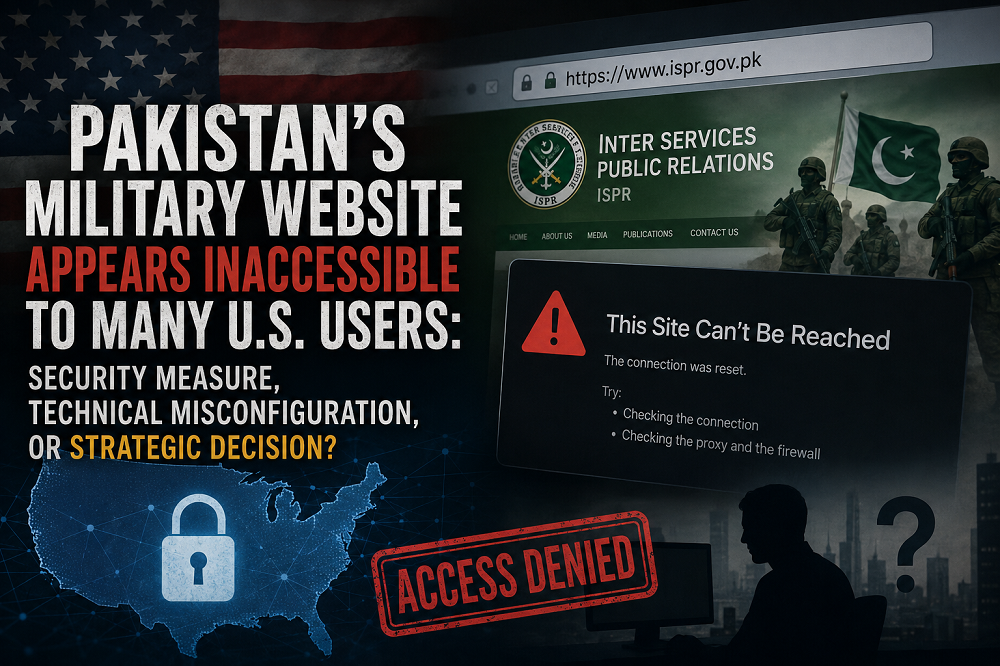
Rochester, NY: A growing number of internet users in the United States have reported being unable to access Pakistan military’s official media website, ISPR.gov.pk.
Instead of loading the website, users frequently receive connection failures, timeout errors, or access-denied messages, while the site reportedly remains accessible from Pakistan and several other countries.
As of now, Pakistan’s Inter-Services Public Relations (ISPR) has not issued any official statement confirming that it intentionally blocked U.S.-based IP addresses, nor has it announced any cyber security policy explaining the reported inaccessibility.
Likewise, there has been no public confirmation from Pakistan’s Ministry of Information Technology or other government agencies acknowledging such geo-blocking.
Because no official explanation exists, any assessment of the cause remains analytical rather than conclusive.
Three Plausible Explanations
The reported inability of U.S.-based users to access the website could stem from several different causes.
The first possibility is intentional geo-blocking. Government agencies around the world sometimes restrict access from particular countries or IP ranges to reduce exposure to cyber attacks, automated scanning, bot traffic, or distributed denial-of-service (DDoS) attacks.
Such restrictions are implemented through web application firewalls, content delivery networks, or IP filtering systems rather than by shutting down the website entirely. Internet filtering and IP-based blocking are well-established cyber security techniques.
A second possibility is a technical or configuration issue. Improper firewall rules, hosting-provider settings, CDN configuration errors, or DNS routing problems can unintentionally prevent users from certain geographic regions from reaching a website.
The third possibility is temporary defensive filtering following increased cyber threats. Governments experiencing elevated cyber risks sometimes tighten access controls without publicly announcing every technical measure.
Without official confirmation or independent network measurements showing deliberate filtering, it is not possible to conclude that the website has intentionally blocked all U.S. IP addresses.
Why Would a Military Website Restrict Foreign Traffic?
If geo-blocking is indeed intentional, several strategic considerations could explain such a decision.
Military websites are frequent targets of cyber espionage, automated vulnerability scanning, credential-stuffing attacks, and denial-of-service campaigns. Restricting traffic from selected regions can significantly reduce the attack surface while allowing domestic audiences to continue accessing official information.
Pakistan has also expanded its cyber security architecture in recent years, including broader efforts to strengthen control over national internet infrastructure and network security. Experts have noted increasing deployment of centralized filtering and monitoring capabilities.
However, restricting access from the United States would also carry important diplomatic and communication implications.
Public Diplomacy Could Be Affected
ISPR functions as Pakistan military’s principal public communications platform.
Its website publishes:
- Official press releases
- Military operation updates
- Statements from military leadership
- Speeches
- Defense cooperation announcements
- Counterterrorism information
- Humanitarian activities
International journalists, researchers, think tanks, diplomats, universities, and members of the Pakistani diaspora regularly consult these materials.
If U.S.-based users genuinely cannot access the site, the military’s official messaging becomes less accessible to one of the world’s largest audiences of policymakers, academics, defense analysts, and foreign correspondents.
In the absence of direct access, observers may increasingly rely on secondary reporting rather than Pakistan’s original official statements.
Pakistan-U.S. Security Relations Remain Important
The timing also attracts attention because Pakistan and the United States continue to maintain military-to-military engagement despite periodic political disagreements.
Both countries cooperate in areas including:
- Counterterrorism
- Regional security
- Military education
- Intelligence coordination
- Defense dialogue
Limiting access to official military communications for U.S.-based audiences—if intentional—would appear inconsistent with efforts to maintain transparency toward international partners.
Cybersecurity versus Transparency
Governments worldwide increasingly face the challenge of balancing cyber security with public accessibility.
Military organizations understandably seek to protect digital infrastructure from hostile cyber activity. Yet official websites also serve as instruments of strategic communication.
When official information becomes inaccessible internationally, information gaps can quickly be filled by unofficial sources, speculation, or misinformation.
Maintaining secure infrastructure while ensuring reliable global access has become an important aspect of modern digital diplomacy.
Technical Verification Would Be Needed
To determine whether U.S. access is deliberately restricted, independent technical researchers would normally examine:
- HTTP response codes (403, 404, timeout)
- DNS resolution from multiple regions
- Trace route comparisons
- BGP routing information
- CDN firewall policies
- Multiple U.S. network providers
- VPN versus non-VPN accessibility
Only such network measurements—or an official statement from ISPR—could establish whether the issue reflects deliberate geo-blocking or an unintended technical problem.
Conclusion
Reports that ISPR.gov.pk is inaccessible to many U.S.-based users raise legitimate questions, but the available public evidence does not establish that Pakistan military has intentionally blocked all U.S. IP addresses.
Several explanations remain plausible, ranging from intentional cyber security filtering to routine technical Misconfiguration or temporary network controls. Until ISPR or relevant Pakistani authorities provide clarification, any assertion that the military has deliberately denied access to U.S. internet users should be presented as an informed hypothesis rather than a confirmed fact.
Regardless of the underlying cause, the episode illustrates the growing intersection of cyber security, military communications, and digital diplomacy. In an era where official websites serve as primary channels of strategic messaging, accessibility itself has become an important component of national communication policy.
Continue exploring the latest developments in politics, business, diplomacy, and global affairs with The Variant.