


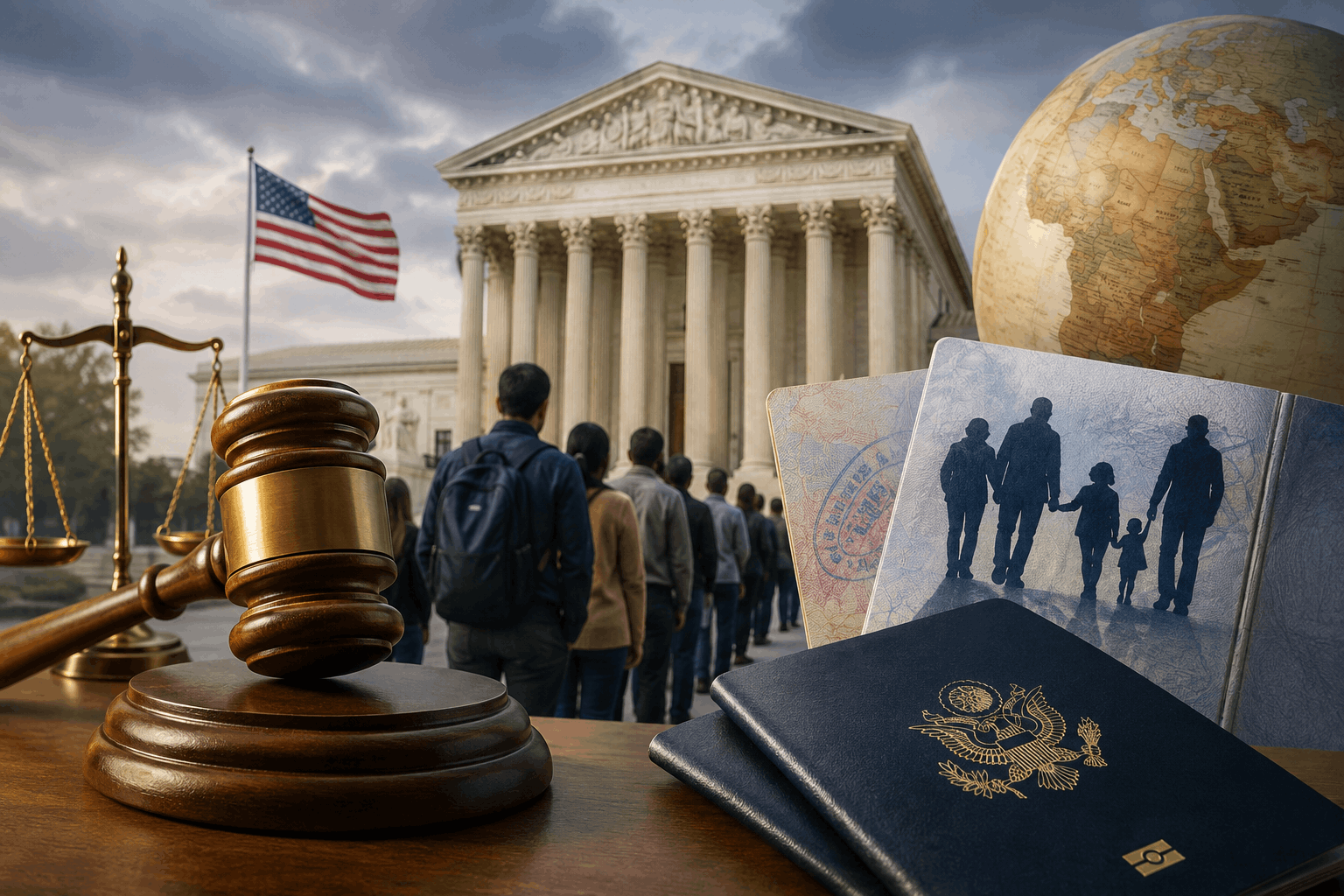
Rochester, NY/Washington, D.C: Federal judge’s ruling restores individualized immigrant-visa processing, but it does not dismantle the Trump administration’s broader immigration restrictions — and an appeal could open another major battle over presidential authority
A major U.S. immigration ruling has reopened a politically sensitive debate over how far a president and secretary of state can go in restricting legal immigration. On August 21, 2026, a federal judge in New York struck down the Trump administration’s policy suspending immigrant-visa issuance for nationals of 75 countries, including Pakistan, Iran, Afghanistan, Nigeria, Bangladesh, Egypt, Russia and several countries across Africa, Asia, Latin America and the Middle East.
The decision is unquestionably a significant legal setback for the administration. But describing it as a defeat by the U.S. Supreme Court would be incorrect. The ruling came from U.S. District Judge Jeannette A. Vargas of the Southern District of New York. The administration can appeal to the U.S. Court of Appeals for the Second Circuit and, depending on subsequent proceedings, the dispute could eventually reach the Supreme Court.
That distinction matters when assessing whether the ruling represents a collapse of the Trump administration’s immigration strategy or merely another round in an increasingly complex struggle between executive authority, Congress and the federal judiciary.
What the Court Actually Decided
The controversy originated with a State Department policy that took effect on January 21, 2026. Secretary of State Marco Rubio’s department suspended immigrant-visa issuance for nationals of 75 countries while conducting what it described as a review of applicants considered at higher risk of becoming dependent on public assistance.
The administration argued that immigrants should be financially self-sufficient and should not impose additional costs on American taxpayers. The State Department publicly framed the suspension around the existing immigration-law concept of a “public charge.”
Judge Vargas concluded, however, that the government had gone substantially beyond what Congress authorized.
Federal immigration law allows consular officers to determine whether an individual applicant is likely to become a public charge. In making that assessment, officers may consider factors including age, health, family circumstances, financial resources, education and skills. What the court rejected was the use of nationality itself as a blanket substitute for that individualized examination.
Vargas ruled that Secretary Rubio had exceeded his statutory authority and described the policy as contrary to federal law. The court vacated the policy and also set aside visa refusals that had been based solely upon the 75-country suspension, potentially requiring the State Department to reconsider thousands of applications.
The ruling therefore does not guarantee immigrant visas to people from the affected countries. It essentially says that the government must return to individualized legal evaluation rather than automatically refusing applicants because they possess a particular nationality.
Is This a Losing Position for the Trump Administration?
Politically, opponents of President Donald Trump will undoubtedly present the ruling as another judicial rejection of his administration’s aggressive immigration agenda. Legally, the administration suffered a substantial defeat because the judge did not simply criticize implementation of the policy; she vacated the policy itself.
But it would be premature to describe the administration as being in an overall losing position on immigration.
Trump still possesses considerable executive authority over the admission of foreign nationals, particularly where national security and entry restrictions are concerned. The Supreme Court demonstrated the breadth of that authority in its 2018 decision in Trump v. Hawaii, which upheld restrictions on entry imposed during Trump’s first presidency.
Crucially, however, the Supreme Court itself distinguished between entry into the United States and issuance of immigrant visas. The Court acknowledged that federal law prohibits certain forms of nationality discrimination in the allocation and issuance of immigrant visas even while recognizing broad presidential authority to restrict entry under separate provisions of immigration law.
That legal distinction is central to the latest case.
The administration may therefore retain stronger constitutional and statutory defenses when President Trump directly imposes entry restrictions under presidential authority than when the State Department independently establishes an across-the-board nationality-based immigrant-visa refusal system.
Rather than demonstrating that the administration has lost control of immigration policy, the decision shows the limits of how that policy can legally be implemented.
The 39-Country Travel Restrictions Have Not Automatically Disappeared
Another important distinction is being lost in some discussion of the ruling.
The court struck down the separate 75-country immigrant-visa public-charge policy. That does not automatically eliminate President Trump’s broader restrictions covering nationals of 39 countries under Presidential Proclamation 10998.
Those restrictions took effect January 1, 2026 and fully or partially suspended entry and visa issuance for various categories of nationals from 39 countries, with limited exceptions. The State Department continues to describe those measures primarily in national-security and vetting terms.
Consequently, a person whose nationality appears on both lists could benefit from the elimination of the 75-country public-charge freeze while still facing separate restrictions under the presidential proclamation.
That distinction will be particularly important for immigration lawyers, families and applicants interpreting the ruling.
How Is the Trump Administration Responding?
As of August 22, the State Department, Justice Department and White House had not issued a detailed public response to the Vargas decision in the immediate reporting following the judgment. Reuters reported that the State Department had not commented, while other reports said the White House and Justice Department had not immediately responded to requests for comment.
An appeal would nevertheless be unsurprising.
The administration could ask the Second Circuit to reverse the decision and may also seek a stay that would temporarily prevent the ruling from taking full effect while litigation proceeds. Ultimately, a sufficiently important dispute over presidential and State Department authority could reach the Supreme Court.
The administration also has strategic alternatives. Rather than restoring exactly the same blanket policy, it could tighten individualized public-charge screening, strengthen financial-documentation requirements, modify regulations through formal administrative procedures or rely more heavily on presidential entry authority where legally applicable.
For that reason, the judgment may force a change of legal mechanism rather than a change of political objective.
Why the Decision Matters for Legal Immigration
The immediate beneficiaries are primarily people outside the United States seeking immigrant visas, including family-sponsored applicants and some employment-based immigrants.
During the freeze, U.S. citizens and lawful permanent residents sponsoring relatives from the affected nations could complete significant portions of the immigration process only to encounter a nationality-based barrier at the visa-issuance stage.
The new ruling potentially allows previously refused applications to return to ordinary case-by-case consideration.
It could therefore accelerate family reunification for some applicants and reopen pathways for skilled workers, professionals and other qualified immigrants.
But applicants should not interpret the ruling as an automatic approval.
Consular officers retain authority to refuse visas for normal statutory reasons, including public-charge concerns, criminal history, security issues, immigration violations, fraud and other grounds of inadmissibility. The difference is that those decisions generally must once again be connected to the circumstances of the particular applicant rather than automatically imposed because that applicant comes from one of the 75 countries.
What Does It Mean for Immigrants Already Living in the United States?
For most immigrants already physically present in America, the direct impact is more limited than the headlines might suggest.
The disputed policy concerned immigrant visas issued primarily through U.S. embassies and consulates abroad. It did not broadly legalize undocumented immigrants, cancel deportation proceedings, grant asylum, create green cards or prevent Immigration and Customs Enforcement from enforcing existing immigration laws.
Lawful permanent residents already in the United States do not suddenly receive additional status because of the decision. Nor does the ruling automatically change the situation of asylum seekers, people with pending removal proceedings or undocumented residents.
Its biggest domestic effect may instead be felt by American families waiting for spouses, parents or children abroad and by U.S. employers seeking to bring qualified immigrant workers into the country.
There could also be indirect implications for future litigation. Courts examining other nationality-based administrative restrictions may scrutinize whether executive agencies are exercising powers that Congress actually delegated to them.
A Judicial Check, Not Yet a Reversal of Trump Immigration Policy
From a broader political perspective, the ruling illustrates the continuing tension between the administration’s goal of restricting immigration and the judiciary’s responsibility to ensure that executive agencies remain within powers granted by Congress.
For Trump’s critics, the decision supports the argument that parts of his immigration program have attempted to achieve through administrative directives what would ordinarily require congressional legislation.
For the administration and its supporters, however, the case will likely reinforce the argument that presidents need stronger discretion to respond quickly to national-security, economic and immigration risks without being repeatedly constrained by federal judges.
Both interpretations contain part of the political reality.
The administration remains capable of imposing significant immigration restrictions, particularly when relying upon powers specifically granted to the president. What the Vargas decision challenges is the proposition that the secretary of state can transform an individualized public-charge determination into a sweeping nationality-based prohibition without clear congressional authorization.
The Political Consequences Could Cut Both Ways
The judgment may provide political momentum to immigrant-rights organizations and Democratic lawmakers, who can characterize it as evidence that the administration exceeded its legal authority.
At the same time, Trump could use the decision politically to reinforce one of his longstanding arguments: that federal courts are obstructing an immigration policy voters elected his administration to implement.
That means a courtroom defeat does not necessarily become a political defeat.
Immigration has repeatedly demonstrated that judicial setbacks can energize both sides of the American political divide. The administration may ultimately frame an appeal as a defense of executive power and taxpayer interests, while opponents will portray the case as a defense of lawful immigration and congressional authority.
What Comes Next
The most important development to watch will be whether the Justice Department appeals and whether it requests a stay of Judge Vargas’s order.
If the ruling remains operative, U.S. consulates will face pressure to resume individualized immigrant-visa adjudications and reconsider applications refused solely under the 75-country policy. A substantial backlog could nevertheless mean that practical relief takes considerably longer than the legal decision itself.
If the Second Circuit stays or reverses the judgment, uncertainty could quickly return.
And if the dispute eventually reaches the Supreme Court, the case could develop into a much larger constitutional and statutory confrontation over an important question: Where does legitimate presidential authority over immigration end, and where does Congress’s control over the immigrant-visa system begin?
For now, the August 21 judgment should be understood neither as the opening of America’s borders nor as the collapse of President Trump’s immigration strategy. It is instead a significant judicial limitation on one specific mechanism the administration used to reduce legal immigration.
For applicants from the 75 affected countries, it represents an important reopening of legal opportunity. For the Trump administration, it represents a serious but potentially reversible judicial setback. And for the American immigration system, it establishes another battleground in a struggle over executive authority that is far from finished.
Keep following The Variant as we continue to monitor developments and provide informed perspectives on this evolving situation.


