


Courtesy: Special Reporting Contribution by Sohail Chaudhary [A Senior Journalist I Social Activist I Toronto, Canada] and Ghulam Murtaza [A Senior Journalist I Islamabad, Pakistan]
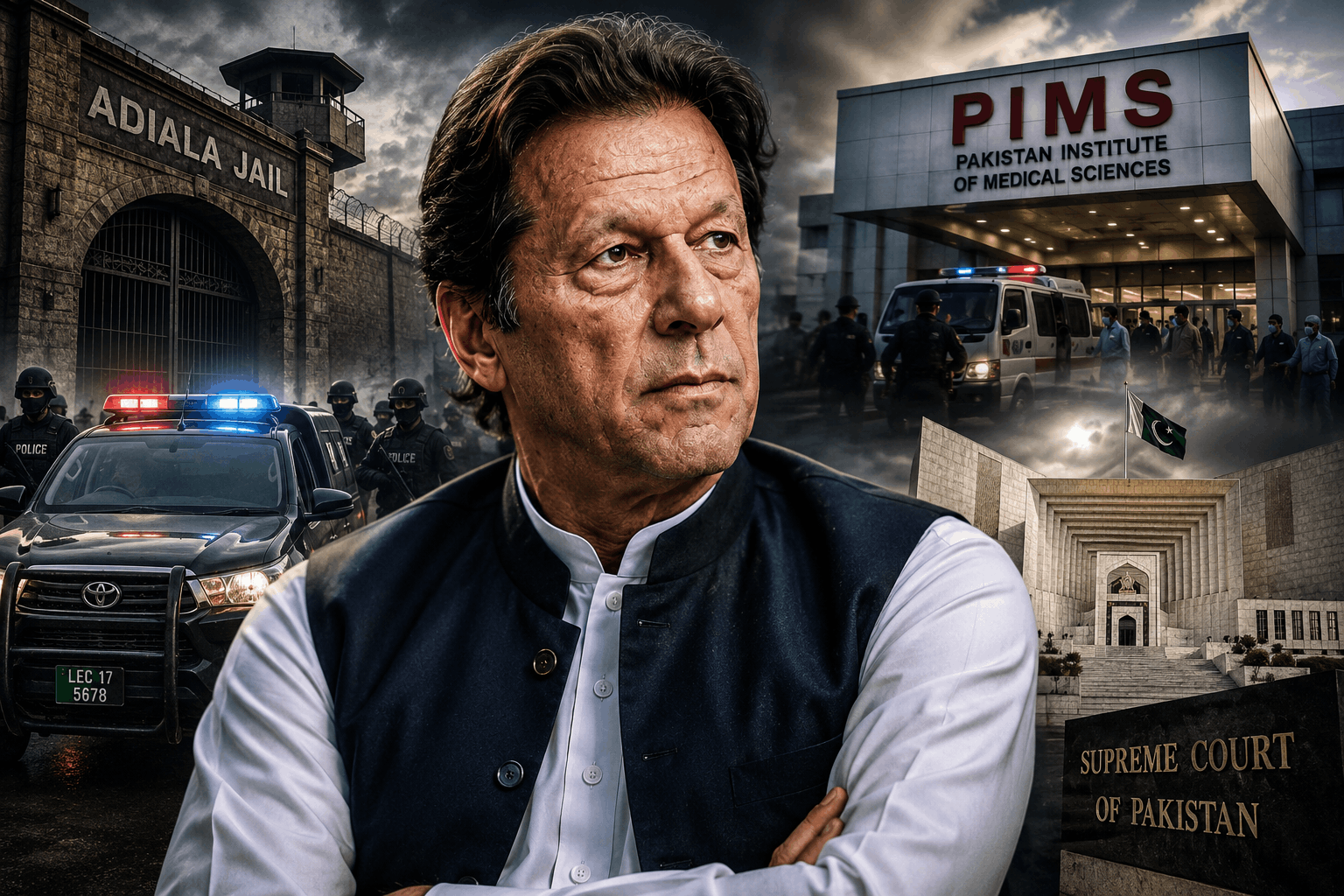
Rochester, NY/Toronto, CA/Islamabad, PK: Questioning the role of the military establishment, the judiciary’s authority, the PML-N government’s political calculations, and whether Pakistan’s power structure is starting to shift again, the brief journey of ex-primier of Pakistan, Imran Khan from Adiala Jail to PIMS Hospital has sparked a controversy much larger than a medical check-up.
An issue of prisoner health care has become yet another test case of Pakistan’s increasingly complicated civil-military and judicial connections due to the temporary imprisonment of Pakistan’s former prime minister Imran Khan from Adiala Jail for a medical check-up.
Controversy surrounds more than only Khan’s transportation to a hospital. Everything from his whereabouts to the transfer process to his speedy return to prison and the reasons for the administration’s decision to deviate from the path laid out by the Supreme Court is at stake.
The 73-year-old ex-prime minister was ordered by Pakistan’s Supreme Court to be transported to Islamabad’s Shifa International Hospital within 48 hours of August 18th. Concerns voiced by Khan’s loved ones and legal team over his health led to the decision. The court considered the findings and recommendations of a multidisciplinary medical panel, one of which would have been his primary care physician.
It was an arrangement that the federal government felt uneasy with. The group’s goal was to challenge or change the order so that Khan could get treatment in a public hospital.
After then, a remarkable chain of events occurred.
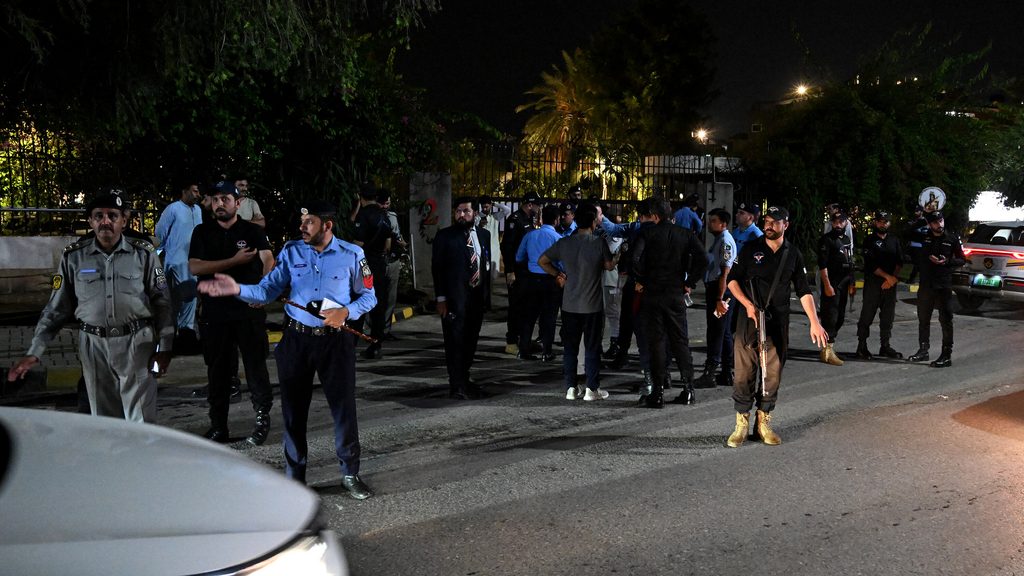
The government-run Pakistan Institute of Medical Sciences (PIMS) took Khan under strict guard instead of sending him to Shifa as ordered. There, doctors from Shifa International Hospital and other professionals examined him. Attaullah Tarar, minister of information, said that security concerns were the driving force for the relocation. Back at Adiala Jail, Khan was transferred at about 5 a.m. on August 21.
Right once, the event brought up a fundamental political question: was the state only trying to solve a security issue administratively, or was it hell-bent on establishing that it will still control Imran Khan’s appearances outside of jail, even when it follows the Supreme Court?
Court Order Compliance—But Whose Conditions?
A straightforward argument is the government’s strongest point. Khan received the proper medical evaluation, Shifa specialists were consulted, and PIMS was the safest option due to the security scenario surrounding the planned move, according to the argument. The administration has also refuted allegations of medical neglect or abuse against Khan, citing previous evaluations and the privileges it claims he has received while inside.
The political and legal questions left unanswered by that line of reasoning, however.
The highest court in the land had not only requested that the government consult with doctors of their choosing. It outlined the parameters for Khan’s medical supervision and specifically mentioned Shifa International Hospital. This discord is central to PTI’s contempt complaint, which asserts that the court’s orders to send Khan to PIMS were disregarded.
Thus, the government’s behavior gave the image of being anxious to fulfill the medical purpose of the Supreme Court ruling while simultaneously rejecting its practical consequences, creating an unusual impression.
In terms of political impact, it may be the single most crucial aspect of the whole enterprise.
Has the chasm widening been seen between the PML-N and the military establishment?
Whenever something out of the usual occurs in Pakistan involving the court, civilian government, or military institution, speculation about the country’s political history is sure to ensue. The ability to distinguish between evidence and inference is crucial for analysis.
Despite their shared goals of political stability and PTI containment, it is reasonable to assume that the interests of the civilian administration and the military institution are not necessarily aligned.
In terms of elections, Imran Khan poses a serious threat to the PML-N. In Punjab in particular, the PML-N may take a hit if Khan were to undergo any political rehabilitation.
A different computation has been made by the military establishment. Preventing a dispute from getting out of hand, maintaining political stability, and establishing institutional authority are its primary concerns.
That distinction is significant.
The PML-N could be doing some political math to figure out who will be the next election’s victor. Institutional assessments on the viability of the existing political setup are more likely to be made by the establishment.
Although there may be some overlap, these purposes are not identical.
The political cost of isolating Khan may surpass the cost of allowing restricted access or limited political engagement, and some in the establishment may eventually choose de-escalation, even if PML-N views this as politically dangerous.
However, sufficient evidence has not yet been found to declare the barrier to have been penetrated.
Will the Establishment Hand PML-N a Loss?
The investigation is historically sound, but there isn’t enough evidence to draw any firm conclusions just yet.
A wider pattern would be expected if there was a genuine rethinking of the establishment at work. This pattern would include: a loosening of restrictions on PTI, progress on Khan’s major legal cases, regular political access restored, negotiations with senior PTI figures, changes in media restrictions, and a noticeable rift between the government and military leadership.
A single hospital transfer does not constitute normal care.
On the contrary, Khan’s rapid re-incarceration and strict monitoring of his movements provide strong evidence that the state is determined to keep him from using his physical presence outside of Adiala as a means of rallying the population.
The narrative is supposedly about Imran Khan’s management, not his political rehabilitation plans, according to the most reasonable interpretation.
That is going to alter. There is currently no evidence to suggest that the military has chosen to sacrifice the PML-N government. Who Exactly Received Political Points?
Ironically, Imran Khan may have gained the most political benefit from an operation that was intended to manage his appearance.
For the PML-N, the incident raised uncomfortable concerns. After challenging the private-hospital deal, the government was forced to clarify how PIMS was chosen over Shifa in response to a Supreme Court ruling that had ordered treatment at Shifa.
Simultaneously, PTI was afforded a powerful political narrative: its incarcerated leader had supposedly been returned to jail hours after winning a Supreme Court order for treatment at a designated private hospital, but the government had disregarded that ruling.
Nevertheless, it remains to be seen if it can withstand the examination of the courts. However, communicating on a political level is simple.
The event furthered Khan’s long-standing political narrative, which he has been promoting, which states that the conflict in Pakistan is about more than simply the PTI vs. PML-N. It is also about the legitimacy of Pakistan’s judicial system, elected officials, and unelected institutions.
Also, Khan’s extreme security measures run the danger of making his captivity seem even more symbolic.
The Perilous Information Vacuum and the Death Hoax of Wajahat S. Khan
However, the hospital scandal is inextricably linked to another shocking incident that occurred earlier in August involving Pakistani writer Wajahat S. Khan, who is residing in the US.
The rumor mill began to turn when Wajahat published information suggesting military sources had reason to believe Imran Khan was dead in jail. The remarks were seen by some reporters as an official confirmation that Khan had died.
Crucially, however, there was never any evidence that Imran Khan had died.
In a later statement, Wajahat denied that his sources had confirmed Khan’s death. Instead of providing evidence of Khan’s death, senior military officers have voiced uncertainties or concerns about his whereabouts. The Pakistani military’s official news agency, ISPR, has dismissed the claims of casualties as baseless.
Therefore, it is inaccurate to refer to the original assertion as “established” news. This journalist then recanted the shocking and unproven accusation.
A more fundamental problem, however, is that such a claim has the potential to inspire widespread concern.
There is a lack of true, independent information on a former prime minister’s health and restricted access to him due to his incarceration. Then that urban legend is competing with news reports.
Furthermore, PTI demanded that Khan’s family, doctors, attorneys, and political representatives be granted access to him, stating that the disturbing claims about his health were causing widespread alarm throughout the nation.
Since Khan was seen alive later on during his hospital stay, the death charge must have been unfounded or at least unsubstantiated while it was being circulated.
However, journalists are not the only ones who have a responsibility to combat this kind of misinformation. Those in charge of a prisoner’s access to a national security prisoner should be forthcoming with accurate, independently verifiable updates on his condition.
Secrecy fosters the growth of disinformation.
A potentially disastrous political stunt
If the goal of the PIMS plan was to alleviate pressing legal and medical concerns without making Imran Khan’s sickness a major political story, then it was a success.
The result in politics is far from certain.
Shifa was not the location of the administration’s prolonged stay. For a brief while, Khan was not confined to prison. Officials from the security force maintained control. There was never a public conflict.
Still, the PTI has a new gripe that might spark a movement. On the other hand, now the administration is facing a contempt action for allegedly disobeying a Supreme Court ruling.
Even more importantly, the gathering demonstrated something that Pakistan’s governing elite has been unable to achieve since Khan’s imprisonment: just because Imran Khan is physically confined within Adiala Jail does not imply he is no longer a political threat in Pakistan.
His incarceration has, in a sense, increased the political value of each photograph, medical report, court appearance, or rumor involving him.
Power Struggles Are More Serious
Whether Khan spent two or several hours in the hospital is irrelevant to the Adiala-PIMS situation.
Now, three institutions are implicitly involved in the dispute.
The location and kind of medical facility where Khan should get treatment were determined by the Supreme Court, which used its judicial authority.
The civilian government moved the event and provided an explanation for it, claiming authority over administration and security.
Given its long history of influence on Pakistan’s political system, the function of the country’s substantial security apparatus, which supports both parties, is inherently open to speculation.
It is not acceptable to rely on speculation as evidence.
There is currently no proof that the military establishment has decided to remove the PML-N government or put Imran Khan back in charge.
A more nuanced take away from the episode is that incarceration has not been successful in eradicating Imran Khan’s political influence, which means that the current political system is uneasy and perhaps unstable.
The medical process of being transferred to the hospital may have been intended by the government to be highly controlled. Actually, it turned out to be just another political vote on how Pakistan’s most infamous prisoner was treated.
And in the ongoing battle for public perception, the man who was escorted out of Adiala Jail at nite and returned before sunrise may emerge victorious once again.
The Variant remains committed to delivering accurate, timely, and insightful coverage of the world’s most important stories.


