


Rochester, NY: The global energy system is entering one of its most fragile and transformative moments in recent history, as the decision by Organization of the Petroleum Exporting Countries (OPEC) to lose the United Arab Emirates intersect with a deepening geopolitical confrontation between the United States and Iran.
The convergence of these developments is not merely coincidental; it reflects a structural shift in how oil is produced, transported, priced, and politicized in the 21st century.
What makes the present moment particularly volatile is that supply-side fragmentation is colliding with one of the most critical chokepoints in global energy logistics—the Strait of Hormuz—through which nearly 20 to 21 million barrels of crude oil and condensates flow daily, accounting for roughly one-fifth of global petroleum consumption.
The UAE’s decision to exit OPEC after decades of membership represents a profound recalibration of its economic and geopolitical priorities.
Producing close to 3.2 to 3.5 million barrels per day, with an installed capacity exceeding 4 million barrels per day and expansion targets nearing 5 million barrels per day by the end of the decade, Abu Dhabi has increasingly found itself constrained by OPEC’s quota system.
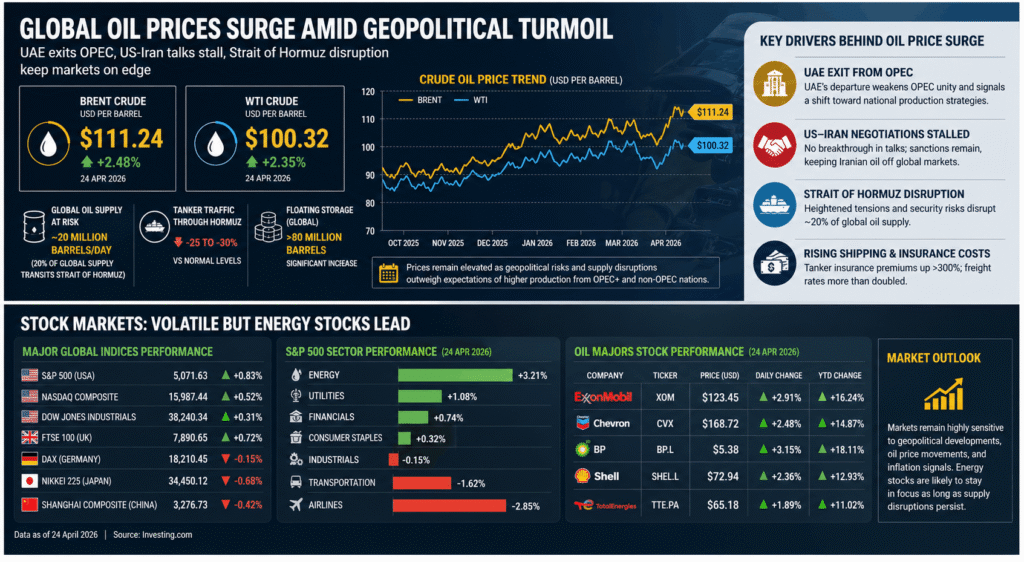
By stepping outside the cartel framework, the UAE is effectively signaling its intent to monetize its spare capacity more aggressively, especially at a time when elevated oil prices—hovering around $110 to $112 per barrel for Brent and approximately $99 to $102 per barrel for WTI—offer substantial revenue incentives.
Yet the timing reveals a deeper strategic logic: the UAE is betting that geopolitical fragmentation will make coordinated production management less effective than national flexibility.
This strategic pivot comes as negotiations between Washington and Tehran remain deadlocked. The administration of Donald Trump has maintained a hardline stance, reportedly extending maritime and financial restrictions on Iran, while Tehran continues to link any reopening of Hormuz shipping lanes to the lifting of sanctions and cessation of hostilities.
Iranian officials, including senior diplomatic figures aligned with the government in Tehran, have repeatedly emphasized that the security of the Strait is conditional rather than guaranteed. This conditionality has transformed the waterway into a geopolitical pressure valve, where even partial disruptions have immediate and disproportionate impacts on global energy markets.
The result is a paradoxical oil pricing environment in which physical supply constraints dominate over theoretical production increases. Despite the UAE’s potential to raise output by several hundred thousand barrels per day in the near term, the inability to safely and efficiently transport crude through the Strait has created a bottleneck that effectively neutralizes additional supply.
Shipping insurance premiums for tankers transiting the Gulf have surged by more than 300 percent in recent weeks, while freight rates for very large crude carriers have more than doubled, reflecting heightened risk perceptions.
Satellite tracking data indicates a noticeable decline in tanker traffic through Hormuz, with some estimates suggesting a drop of 25 to 30 percent in throughput compared to normal operating conditions.
Simultaneously, floating storage volumes—oil held aboard tankers unable to reach destination markets—have risen sharply, in some cases exceeding 80 million barrels globally.
Global leaders have responded with a mixture of concern, strategic caution, and implicit alignment with national interests.
Donald Trump has framed the pressure campaign on Iran as necessary to ensure long-term stability, while also reiterating criticism of OPEC’s historical influence over oil prices. Saudi leadership, including Mohammed bin Salman, has expressed unease over the erosion of coordinated production mechanisms, recognizing that the UAE’s departure weakens collective leverage.
European leaders such as Emmanuel Macron and Olaf Scholz have warned about the inflationary consequences of sustained high energy prices, noting that every $10 increase in crude prices adds approximately 0.2 to 0.3 percentage points to consumer inflation across the euro-zone.
Meanwhile, Asian import-dependent economies have been particularly vocal; Narendra Modi has emphasized the vulnerability of emerging markets, where energy imports constitute a significant share of current account deficits, and Chinese officials under Xi Jinping have underscored the need for uninterrupted energy flows to sustain industrial output.
The ripple effects across global financial markets have been immediate and multifaceted. Equity markets in major economies have exhibited heightened volatility, with energy sectors outperforming while transport, aviation, and manufacturing sectors face downward pressure due to rising input costs.
The S&P 500 has shown mixed performance, with energy stocks contributing disproportionately to gains, while broader indices remain constrained by inflationary concerns. European indices such as the FTSE 100 have benefited from the heavy weighting of oil majors, whereas Asian markets have faced sharper corrections due to import dependency.
Oil giants have emerged as clear financial beneficiaries of the crisis. ExxonMobil has seen its revenues surge, supported by upstream margins exceeding $60 per barrel in some fields, while Chevron has reported strong cash flows driven by high realized prices.
European majors such as BP and Shell have similarly capitalized on the price environment, with quarterly profits rising significantly compared to previous fiscal periods. Share prices across these lies have experienced upward momentum, with some gaining between 8 to 15 percent over recent trading sessions, reflecting investor expectations of sustained profitability amid constrained supply
.
At a structural level, the intersection of UAE’s exit from OPEC and the US-Iran impasse is accelerating the fragmentation of global oil governance. For decades, OPEC functioned as a central coordinating body capable of influencing prices through disciplined production management.
The departure of a major producer like the UAE not only reduces the cartel’s market share but also signals to other producers that adherence to quotas may no longer be strategically advantageous in an increasingly multipolar energy landscape.
This erosion of collective discipline coincides with the growing importance of geopolitical chokepoints, where control over transit routes can outweigh control over production volumes in determining market outcomes.
The broader implications extend beyond energy markets into macroeconomic stability and geopolitical alignment.
Sustained oil prices above $100 per barrel risk entrenching inflationary pressures globally, complicating monetary policy decisions for central banks already navigating post-pandemic economic adjustments.
At the same time, the weaponization of energy routes underscores the increasing integration of economic and security considerations in international relations. For import-dependent economies, the crisis serves as a stark reminder of the vulnerabilities inherent in globalized energy systems, potentially accelerating investments in alternative energy sources and diversification strategies.
In this evolving landscape, the immediate trajectory of oil prices and market stability will depend less on production decisions in Abu Dhabi and more on diplomatic developments between Washington and Tehran.
Unless a breakthrough is achieved that ensures the full reopening and security of the Strait of Hormuz, the world is likely to remain in a state of constrained supply, elevated prices, and persistent uncertainty.
The UAE’s exit from OPEC, while significant in its own right, thus becomes part of a larger narrative—one in which the traditional pillars of the global oil order are being reshaped by a complex interplay of national ambition, geopolitical rivalry, and logistical vulnerability.
Stay well informed about Global Energy Structure by The Variant US.


